Manual interpretation workflow
May 21, 2023· 2 minutes reading
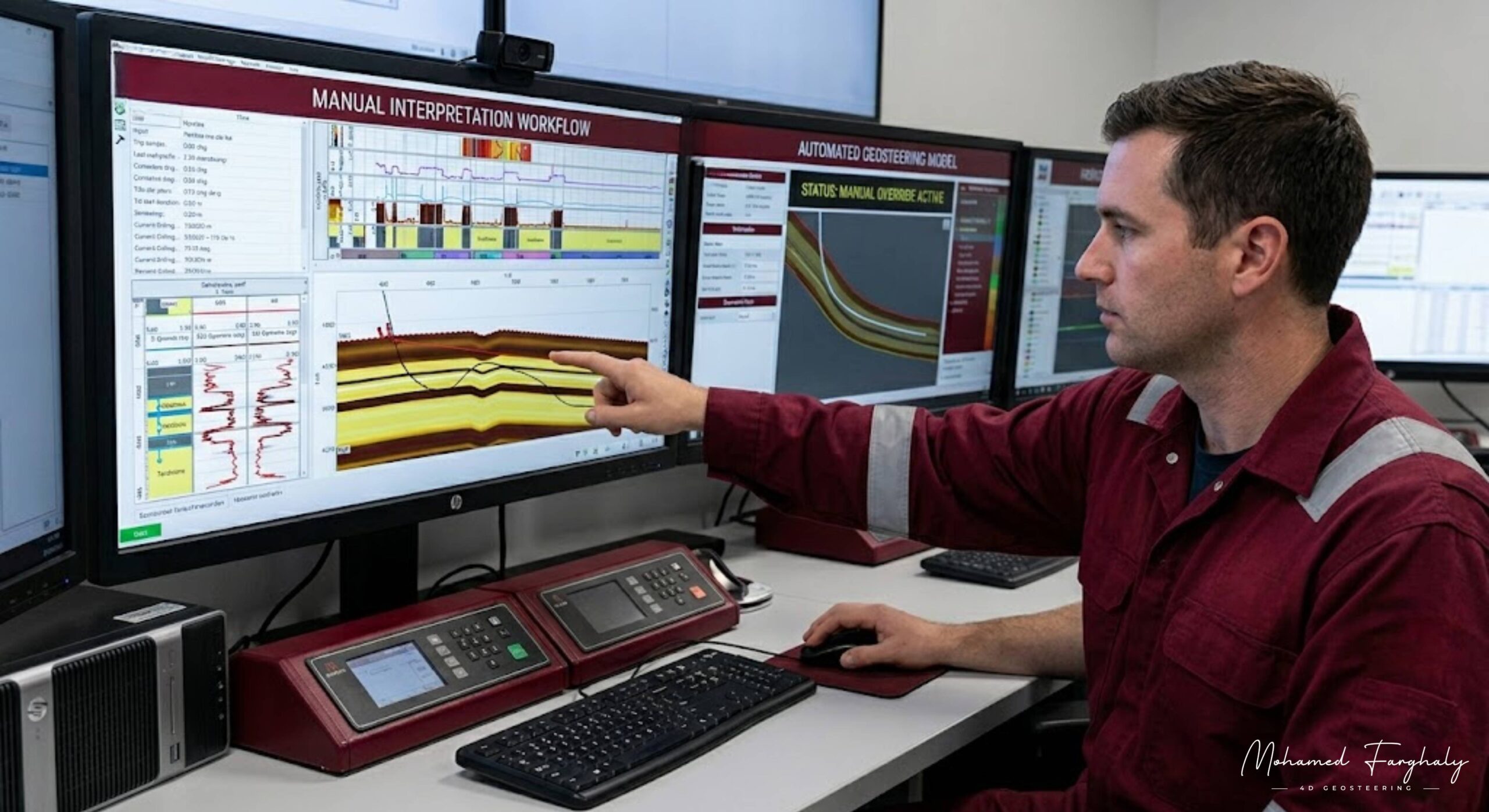
In geosteering, the manual interpretation workflow remains essential because the subsurface does not always behave as expected. Automation can process real-time data quickly, but human interpreters still guide many critical well placement decisions. This becomes especially important in complex reservoirs, thin zones, and areas with structural uncertainty.
The workflow starts with continuous tracking of real-time LWD data, including gamma ray, resistivity, density, neutron porosity, and wellbore inclination. Interpreters compare these measurements with the pre-drill geological model. However, they do not accept every automated update immediately. Instead, they check whether the response reflects the formation or comes from drilling conditions, tool behavior, or data noise.
Data Quality Control
A major step in manual interpretation is data quality control. Not every signal from downhole tools gives a clear geological answer. Therefore, engineers separate true formation changes from borehole effects, tool standoff, and drilling dynamics. This step matters because poor data interpretation can lead to wrong steering decisions.
After data checking, interpreters move into real-time correlation. They match observed log responses with expected geological markers. For example, they may identify bed boundaries, faults, formation dips, and thickness changes. As a result, the geological model becomes closer to the actual subsurface conditions.
Model Updating
The manual interpretation workflow also includes model updating and calibration. When measured data does not match predicted trends, interpreters adjust key parameters. These may include structural dip, layer thickness, reservoir position, and formation boundaries. Because of these updates, the model stays active instead of remaining fixed to pre-drill assumptions.
In addition, human interpretation helps manage uncertainty. Automation may suggest a steering action, but experts still review geological logic, drilling risks, and operational limits before approving a trajectory change. This human review makes decisions more reliable, especially when the well approaches the edge of the target zone.
Real-Time Decisions
Finally, manual interpretation supports communication with the drilling team. Geologists and geosteerers turn subsurface understanding into clear steering instructions. These instructions help directional drillers adjust the well path and keep the borehole inside the reservoir sweet spot.
Although automation improves speed, manual interpretation adds judgment, context, and geological reasoning. That is why it remains a core part of modern geosteering and successful well placement.
🔗 Keywords
Well Correlation, Offset Wells, Formation Tops, Gamma Ray Correlation, Resistivity Trends, LWD Data, Structural Dip, Fault Detection, Stratigraphic Variation, Reservoir Modeling, 3D Geosteering Models, Well Placement Optimization, Geological Uncertainty.