Risks and Limitations in Geosteering Automation
May 25, 2023· 1 minute reading
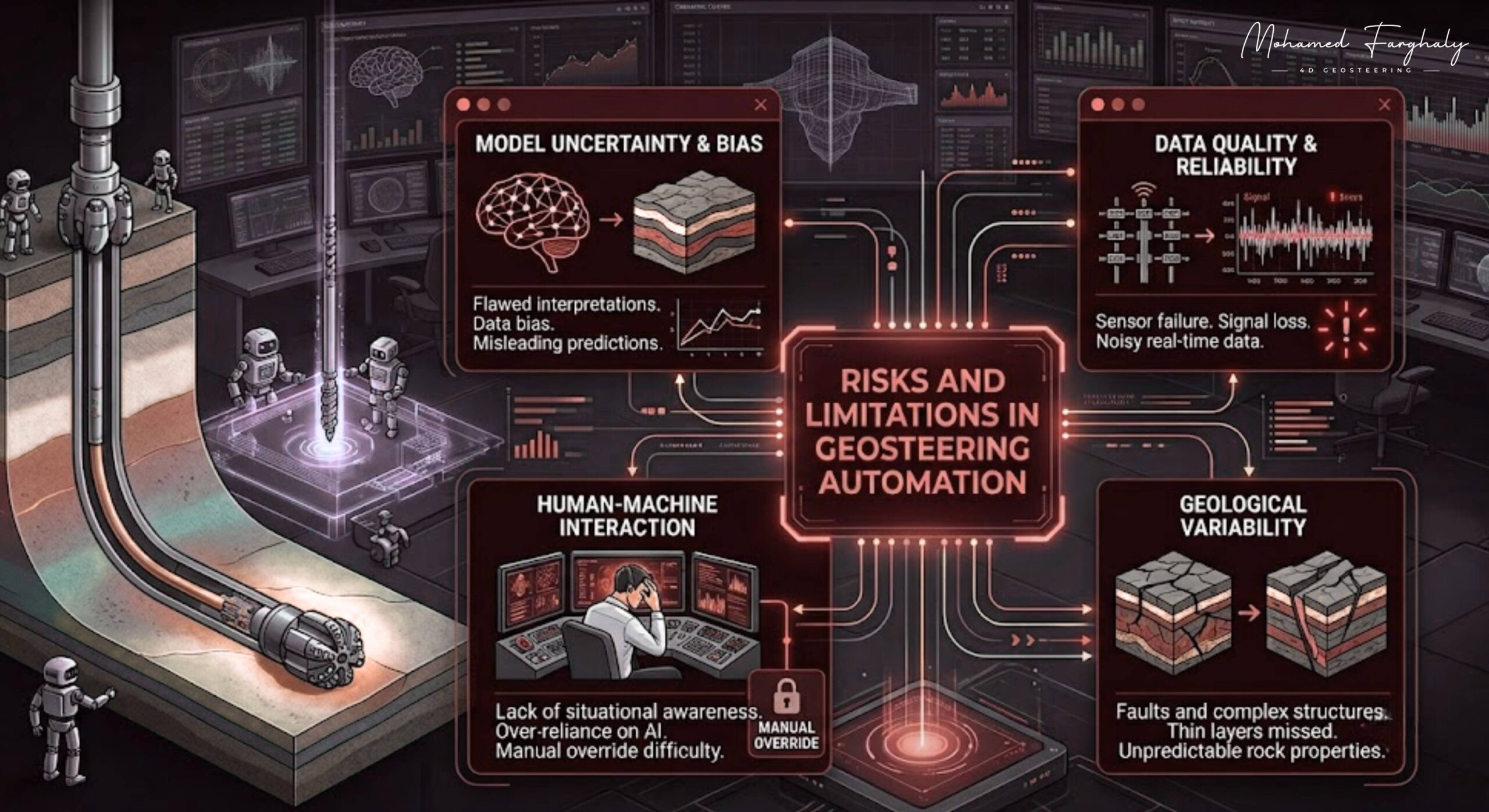
As the oil and gas industry embraces geosteering automation, operators are gaining access to faster data processing, real-time reservoir insights, and more consistent steering recommendations. Advanced algorithms and artificial intelligence are helping drilling teams navigate complex reservoirs with greater efficiency than ever before. However, automated geosteering systems are only as effective as the data, models, and assumptions behind them. Understanding their limitations is essential for maximizing performance while minimizing risk.
Data Quality and Reliability
One of the greatest risks in automated geosteering is poor data quality. Automated systems continuously analyze information from LWD tools, directional surveys, and formation evaluation measurements. If sensors fail, signals are lost, or measurements become noisy, the system may interpret the subsurface incorrectly. Since automation depends heavily on real-time data, inaccurate inputs can quickly lead to inaccurate steering decisions.
Model Uncertainty and Bias
Every automated geosteering workflow relies on a geological model. These models are built using available well data, seismic interpretations, and geological assumptions. However, the subsurface rarely behaves exactly as predicted. Model uncertainty, incomplete datasets, and algorithm bias can create misleading predictions about formation boundaries and reservoir properties. When the model differs from reality, automated recommendations may move the wellbore away from the optimal target zone.
Human-Machine Interaction
Automation improves speed, but it cannot completely replace geological expertise. A major challenge is maintaining the right balance between automated recommendations and human judgment. Excessive trust in automation can reduce situational awareness, causing critical geological indicators to be overlooked. Experienced geosteering professionals often identify subtle formation changes that algorithms may miss. For this reason, effective operations require a clear manual override capability and continuous expert oversight.
Geological Variability
Reservoirs are naturally complex. Faults, unexpected stratigraphic changes, thin reservoir layers, and rapidly changing rock properties can create conditions that differ significantly from the geological model. While automated systems perform well in predictable environments, they may struggle when encountering unexpected geological scenarios. The greater the geological complexity, the more important human interpretation becomes.
As geosteering automation continues to evolve, its success will depend on combining high-quality data, robust geological models, advanced algorithms, and expert human supervision. The most effective geosteering workflows are not fully automated—they are intelligently assisted, leveraging technology to enhance decision-making while keeping experienced professionals in control of critical operations.
🔗 Keywords
Geosteering Automation, Automated Geosteering, Real-Time Geosteering, Machine Learning in Oil and Gas, LWD Data, Formation Evaluation, Well Placement, Geosteering Risks, Geosteering Limitations, Digital Oilfield, Drilling Automation, Reservoir Navigation.