Thin vs thick reservoir handling
May 4, 2023· 3 minutes reading
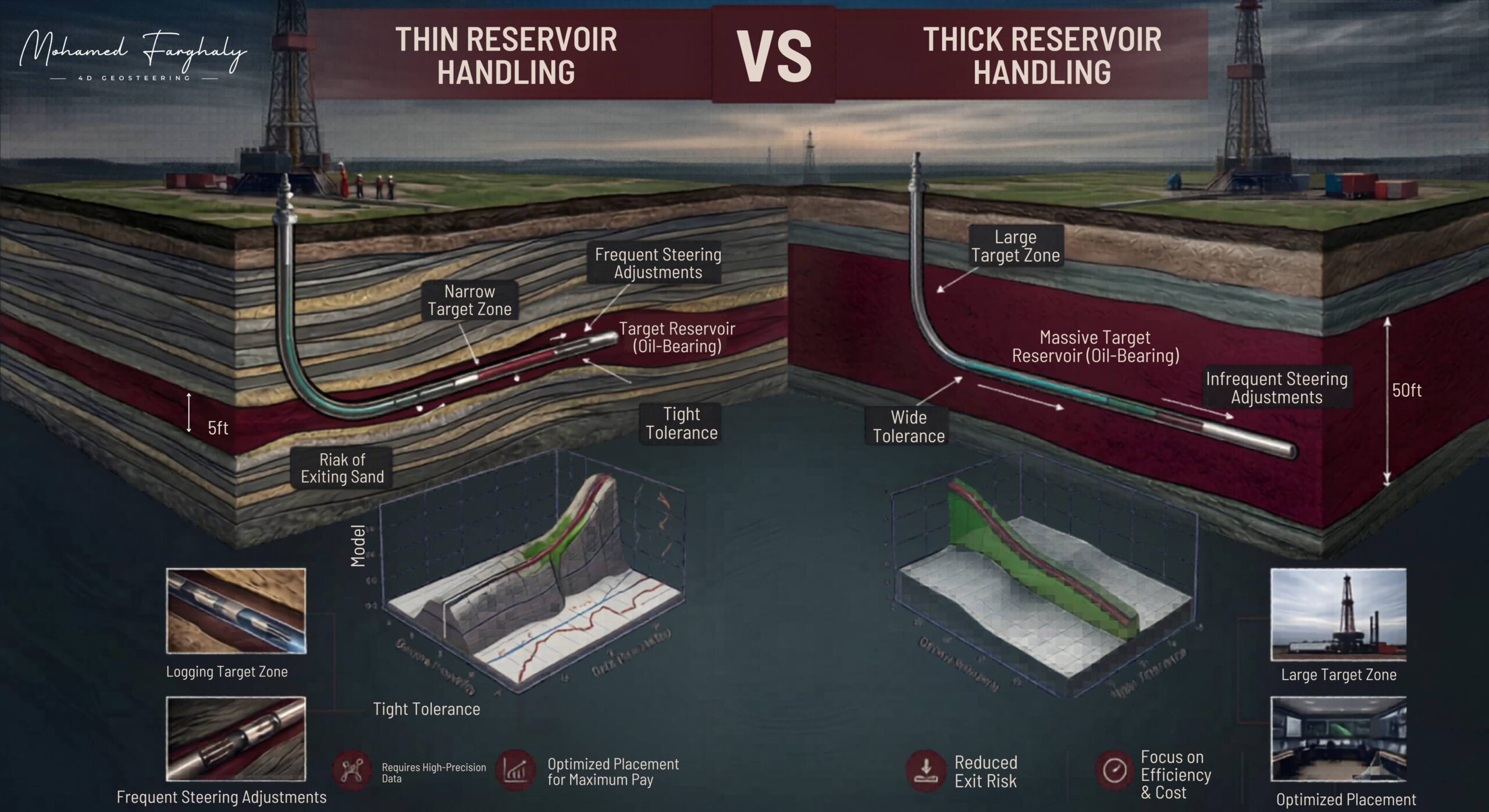
Thin vs thick reservoir geosteering is one of the most important topics in real-time well placement. Reservoir thickness affects steering sensitivity, drilling risk, LWD interpretation, and how quickly the geosteering team must make decisions.
Both thin and thick reservoirs can contain valuable hydrocarbons. However, geosteerers do not handle them in the same way. Each reservoir type needs a different drilling strategy, interpretation style, and level of precision.
Thick Reservoir Geosteering
In thick reservoirs, geosteering is usually more forgiving. The target zone gives the drilling team a wider vertical window. This means the well can stay inside the reservoir even when small trajectory changes happen.
Minor formation dip changes, slight steering delays, or small tool response issues may not immediately push the well out of the productive interval. Because of this, geosteerers can focus more on maximizing reservoir contact and improving lateral placement.
Thick reservoirs also give the team more time to react. If the well starts moving toward the upper or lower boundary, there is often enough space to correct the trajectory before leaving the target zone.
Thin Reservoir Geosteering
Thin reservoirs create a much more sensitive drilling environment. In some cases, the distance between the top and bottom reservoir boundaries may be only a few feet.
A small interpretation error can quickly move the drill bit into shale, water-bearing zones, or non-productive rock. This makes accurate geosteering decisions extremely important.
In thin reservoir geosteering, the team must monitor gamma ray, resistivity, density, neutron, and other LWD measurements very carefully. Even small log changes can show that the well is approaching a reservoir boundary.
Thin vs Thick Reservoir Geosteering Comparison
The table below summarizes the main differences between thick reservoir geosteering and thin reservoir geosteering.
| Factor | Thick Reservoir Geosteering | Thin Reservoir Geosteering |
|---|---|---|
| Target window | Wider vertical target zone | Narrow vertical target zone |
| Steering sensitivity | More forgiving | Highly sensitive |
| Risk of exiting reservoir | Lower risk from small errors | Higher risk from small errors |
| Reaction time | More time to correct trajectory | Faster decisions required |
| LWD interpretation | Log changes are usually easier to manage | Small log changes can be critical |
| Measurement lag impact | Usually less severe | Can strongly affect well placement |
| Main focus | Maximize reservoir contact and drilling efficiency | Maintain precise placement inside the pay zone |
| Steering style | More flexible and reactive | More proactive and predictive |
Measurement Lag in Thin Reservoirs
Measurement positioning becomes critical in thin reservoirs. Many LWD sensors sit behind the drill bit, not directly at the bit. This creates measurement lag.
In thick reservoirs, this delay may not cause a major problem. In thin reservoirs, it can strongly affect well placement accuracy. By the time a boundary appears on the log, the bit may already be very close to it or past it.
Because of this, geosteerers must think ahead of the bit. They do not only react to logs. They predict where the bit is going based on trajectory, dip, tool position, and real-time geological trends.
Steering Strategy Differences
Thin vs thick reservoir geosteering depends on how much room the drilling team has to make corrections. Thick reservoirs allow more flexibility. Thin reservoirs demand more precision.
Thin reservoirs require faster and more proactive steering decisions. The team must update the geological model continuously while drilling. Small changes in dip, faults, or stratigraphic variation can quickly change the reservoir position.
Modern geosteering software helps by improving visualization, boundary detection, and real-time interpretation. Still, experienced geosteerers must combine software outputs with geological reasoning and operational awareness.
The thinner the reservoir, the more important accurate interpretation becomes. In thin reservoir geosteering, every foot matters.