Tool Placement in BHA in Geosteering
May 8, 2023· 4 minutes reading
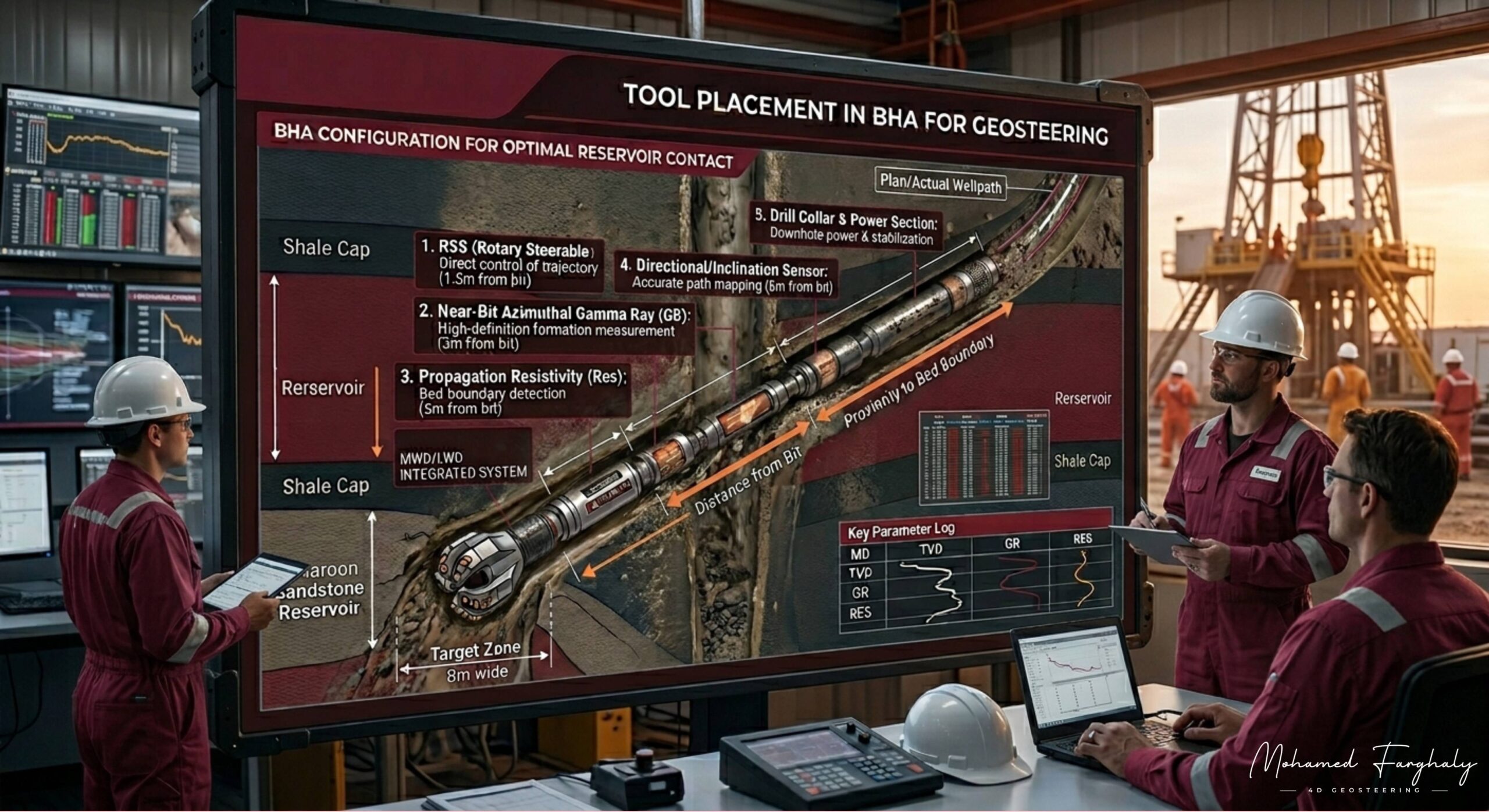
Tool placement in BHA geosteering is one of the most important factors in accurate well placement. The position of each sensor inside the Bottom Hole Assembly controls when the drilling team receives formation data. This affects how fast geosteerers detect changes and adjust the well path.
In geosteering, the data does not always come from the drill bit itself. Many tools sit several feet behind the bit. Because of this, the log response may represent a point the bit has already passed. Understanding this distance helps the team make better real-time decisions.
What Is Tool Placement in the BHA?
The Bottom Hole Assembly, or BHA, is the lower part of the drill string. It includes the drill bit, motor, stabilizers, MWD tools, and LWD sensors.
Tool placement means the position of each measurement tool inside the BHA. These tools may include gamma ray, resistivity, density, neutron, and directional sensors. Each tool has a different distance from the bit.
This distance matters because drilling continues while data is being recorded. If the team does not know where the sensor sits, they may misread the true position of the bit inside the reservoir.
Why Sensor Position Matters
Sensor position affects the timing of every geological response. A tool placed close to the bit gives faster feedback. A tool placed farther behind the bit gives delayed feedback.
This delay is called measurement lag. It means the formation change appears on the log after the bit has already drilled beyond that point.
In thin reservoirs, measurement lag can create serious risk. A small delay may allow the wellbore to exit the target zone before the team reacts. In thicker reservoirs, the team may have more time to interpret the data and correct the trajectory.
Tool Placement and Measurement Lag
Measurement lag is one of the main reasons tool placement in BHA geosteering is important. Geosteerers must always ask one question:
Where is the bit now compared to where the sensor measured the data?
For example, if a gamma ray sensor sits 20 feet behind the bit, the gamma ray response does not show the current bit position. It shows the formation from 20 feet earlier. The team must correct for this spacing before making steering decisions.
Ignoring this lag can lead to wrong reactions. The team may think the well is still inside the reservoir while the bit is already close to a boundary.
Common Tool Placement Considerations
Different tools serve different purposes in the BHA. Their placement depends on the drilling objective, reservoir thickness, well profile, and required data quality.
Gamma ray tools help identify shale, sand, and lithology changes. Their placement matters because they often provide one of the fastest signs of a formation change.
Resistivity tools help detect reservoir boundaries, fluid changes, and bed changes. Their position affects how early the team can recognize movement toward or away from the target zone.
Density and neutron tools support formation evaluation and porosity interpretation. These tools may need more stable borehole conditions, so their placement depends on data quality requirements.
MWD survey tools track inclination, azimuth, and wellbore direction. Their position helps the team understand the actual trajectory of the well while drilling.
How Tool Placement Affects Steering Decisions
Tool placement affects how geosteerers interpret real-time logs. If the sensor is far from the bit, the team must adjust the interpretation for distance. If the sensor is close to the bit, the team can react faster.
Good BHA planning helps reduce uncertainty before drilling starts. The team should know:
- The distance from each sensor to the bit
- Which tool gives the fastest response
- Which measurement has the most lag
- How reservoir thickness affects reaction time
- How tool position supports the steering objective
Tool Placement and Reservoir Thickness
Reservoir thickness plays a major role in BHA design. In thin reservoirs, fast response is critical. The team needs quick data to keep the well inside the productive interval.
In thicker reservoirs, the team may accept more distance between the bit and some tools. The larger target gives more room for interpretation and correction.
The best tool placement depends on the well objective. A horizontal well in a thin target may need faster sensor response. A well in a thicker and more stable formation may focus more on data quality and drilling efficiency.
Why BHA Planning Is Important
Strong BHA planning improves geosteering performance. It helps the team understand when each measurement arrives and how it relates to the current bit position.
Tool placement in BHA geosteering is not just a drilling design detail. It directly affects real-time interpretation, steering reaction, and reservoir exposure. When the team understands sensor position, they can make faster and more accurate decisions while drilling.