Curtain model concept in Geosteering
May 15, 2023· 3 minutes reading
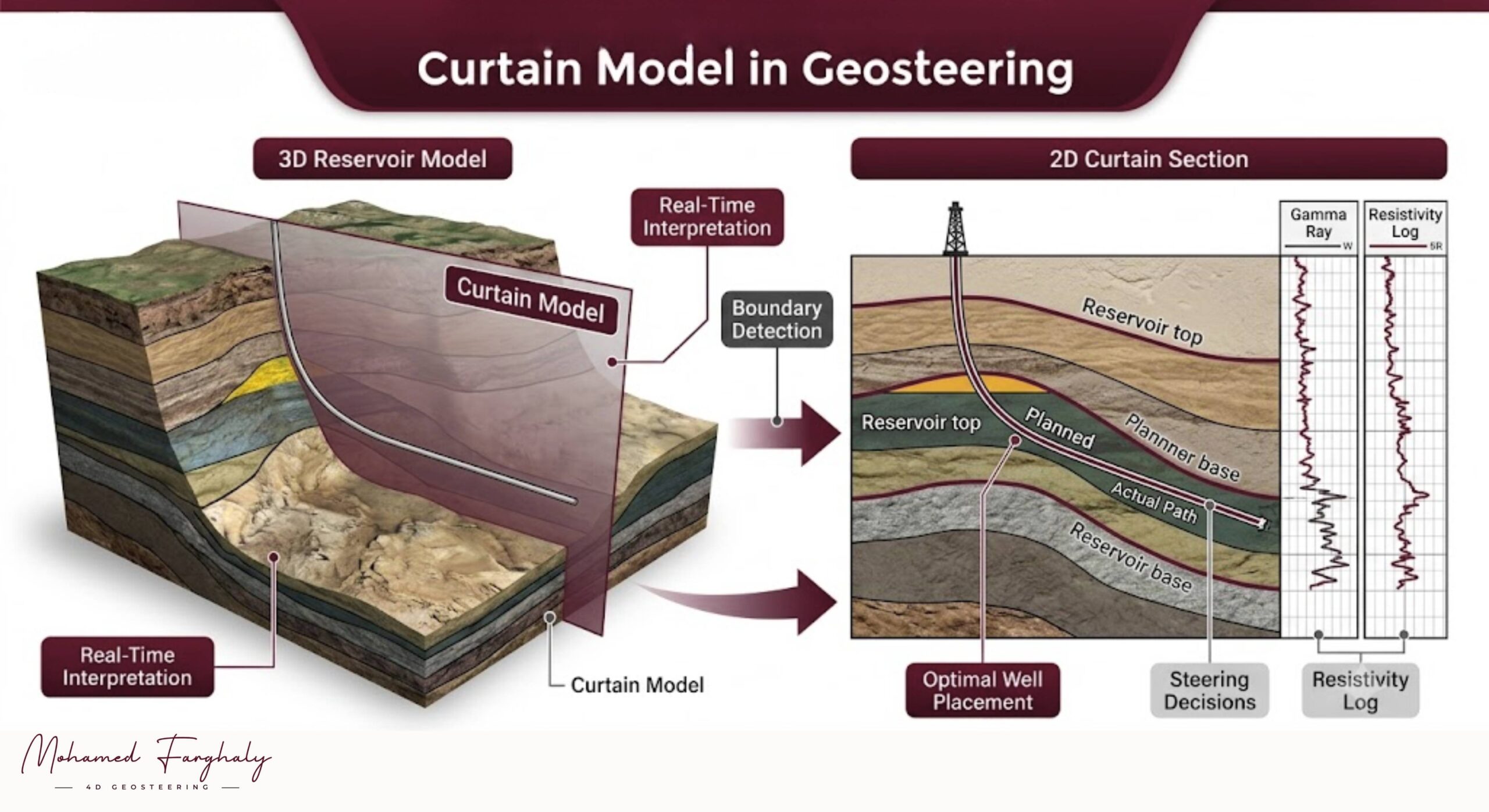
Curtain model in geosteering is a practical visualization method used to understand the relationship between the well trajectory and nearby geological boundaries. In horizontal drilling, especially in thin reservoirs, this view helps geologists and drilling teams make faster decisions while the well is being drilled.
Instead of relying only on complex 3D models during real-time operations, the curtain view presents the reservoir along the drilled path. This makes it easier to see whether the well is staying inside the target zone or moving close to the roof or floor of the reservoir.
What Is the Curtain Model in Geosteering?
The curtain model in geosteering is a simplified geological section that follows the wellbore. It shows formation layers, reservoir limits, and the drilled trajectory in one continuous vertical section.
The idea is similar to unfolding the geology around the well into a curtain-like view. Because of this, the team can quickly understand how the well is moving through the reservoir without needing to study a full 3D model during every decision.
This method is especially useful in thin, dipping, faulted, or laterally changing reservoirs. In these cases, even a small steering error can move the well out of the best production zone.
How Curtain Visualization Supports Real-Time Decisions
During drilling, the curtain view is updated using Logging While Drilling data. Common LWD measurements include gamma ray, resistivity, density, neutron porosity, and other formation evaluation curves.
As new data arrives, geosteerers compare the measured response with the expected geological model. Then, they adjust the interpretation based on actual formation behavior.
For example, a sudden change in gamma ray or resistivity may show that the well is approaching a shale boundary, reservoir roof, or water-bearing interval. With the curtain model in geosteering, the team can connect these log changes to the well position and react faster.
Why the Curtain Model Matters in Thin Reservoirs
Thin reservoirs require accurate well placement because the productive interval may be very narrow. A small change in inclination or formation dip can affect reservoir contact.
The curtain model helps by showing the well path against the main geological boundaries. This allows the geosteering team to decide whether to hold trajectory, steer up, or steer down.
It also improves communication between geologists, drilling engineers, and directional drillers. Instead of discussing only log curves or numbers, the team can review one clear visual section.
Benefits of Using a Curtain View
The main benefit of the curtain model in geosteering is simplicity. It turns complex subsurface information into a clear working view that supports active drilling decisions.
It also helps reduce uncertainty, improve reservoir contact, and support better well placement. In fast drilling operations, this clarity can make decision-making more efficient and more consistent.
Limitations of the Curtain Model
Although the curtain model is valuable, it is still a simplified representation of the subsurface. It should not replace seismic interpretation, offset well data, structural models, or detailed reservoir studies.
For the best result, geosteering teams should use the curtain view together with real-time LWD data, geological experience, and reservoir modeling. When combined properly, the curtain model in geosteering becomes a strong tool for improving drilling performance.
🔗 Keywords
Geosteering, Curtain Model, Earth Model, LWD, Real-Time Geosteering, Reservoir Navigation, Well Placement, Formation Boundaries, Horizontal Drilling, Oil and Gas Geosteering.