Structural vs Stratigraphic Models
May 16, 2023· 3 minutes reading
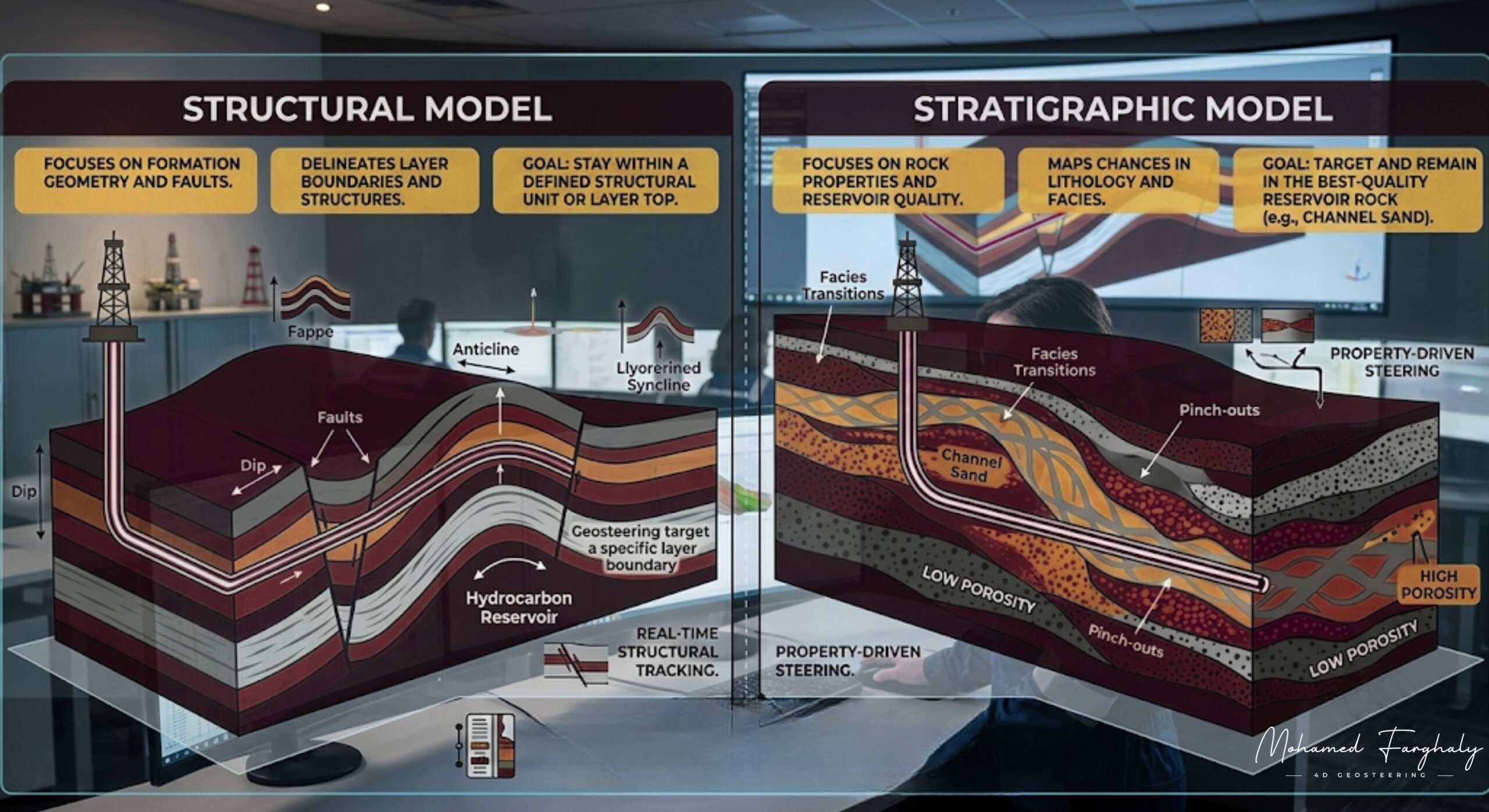
In modern geosteering, accurately placing a well within the most productive part of a reservoir depends on having a reliable geological model. Two of the most widely used approaches are structural models and stratigraphic models. Understanding the difference between these models is essential for improving well placement, maximizing reservoir contact, and reducing drilling uncertainty in the oil and gas industry.
A structural model focuses on the geometry of the subsurface. It is designed to represent geological features such as faults, folds, formation dips, and structural offsets. In reservoirs affected by tectonic activity, structural interpretation becomes critical because even small changes in formation position can cause a horizontal well to exit the target zone. During real-time geosteering, geologists continuously compare LWD (Logging While Drilling) measurements with the structural model to identify approaching faults, update formation tops, and make steering corrections before reservoir contact is lost.
A stratigraphic model, on the other hand, focuses on the depositional architecture of the reservoir. Instead of tracking structural movement, it follows changes in lithology, facies, rock properties, and sedimentary sequences. This approach is especially useful in reservoirs where production performance is controlled by depositional patterns rather than structural complexity. By recognizing distinctive stratigraphic markers, geosteering teams can stay within the highest-quality reservoir intervals and avoid non-productive zones.
In many modern fields, neither model alone provides a complete picture. Advanced geosteering software often combines both structural and stratigraphic interpretations to create a dynamic model that updates continuously as new drilling data becomes available. This integrated approach allows teams to make faster and more confident steering decisions while drilling.
Structural vs Stratigraphic Models Comparison
| Feature | Structural Model | Stratigraphic Model |
|---|---|---|
| Primary Focus | Faults, folds, and formation geometry | Facies, lithology, and depositional layers |
| Main Objective | Maintain structural position within the reservoir | Maintain stratigraphic position within the reservoir |
| Best Application | Structurally complex reservoirs | Layered sedimentary reservoirs |
| Key Data Sources | Formation tops, dips, fault interpretation | Rock properties, facies, and stratigraphic markers |
| Main Challenge | Predicting structural changes and fault crossings | Tracking lateral reservoir variations |
| Geosteering Benefit | Improved navigation through complex structures | Better targeting of high-quality reservoir zones |
Why Both Models Matter in Modern Geosteering
As reservoirs become more challenging to develop, successful geosteering operations increasingly rely on a combination of structural modeling and stratigraphic modeling. Structural models help geologists understand where formations are located, while stratigraphic models explain how reservoir quality changes within those formations. Together, they provide a more complete understanding of the subsurface, enabling better well trajectory optimization, improved formation evaluation, and higher drilling success rates.
By integrating both approaches, operators can reduce uncertainty, improve reservoir exposure, and maximize the value of every drilled foot—making structural and stratigraphic models fundamental components of modern geosteering workflows.
🔗 Keywords
Geosteering, Structural Model, Stratigraphic Model, Oil and Gas, Well Placement, Horizontal Drilling, LWD, Formation Evaluation, Reservoir Modeling, Real-Time Geosteering, Directional Drilling, Reservoir Characterization, Well Trajectory Optimization, Geosteering Software, Subsurface Interpretation.