Target window definition
April 17, 2023 ·2 minutes reading
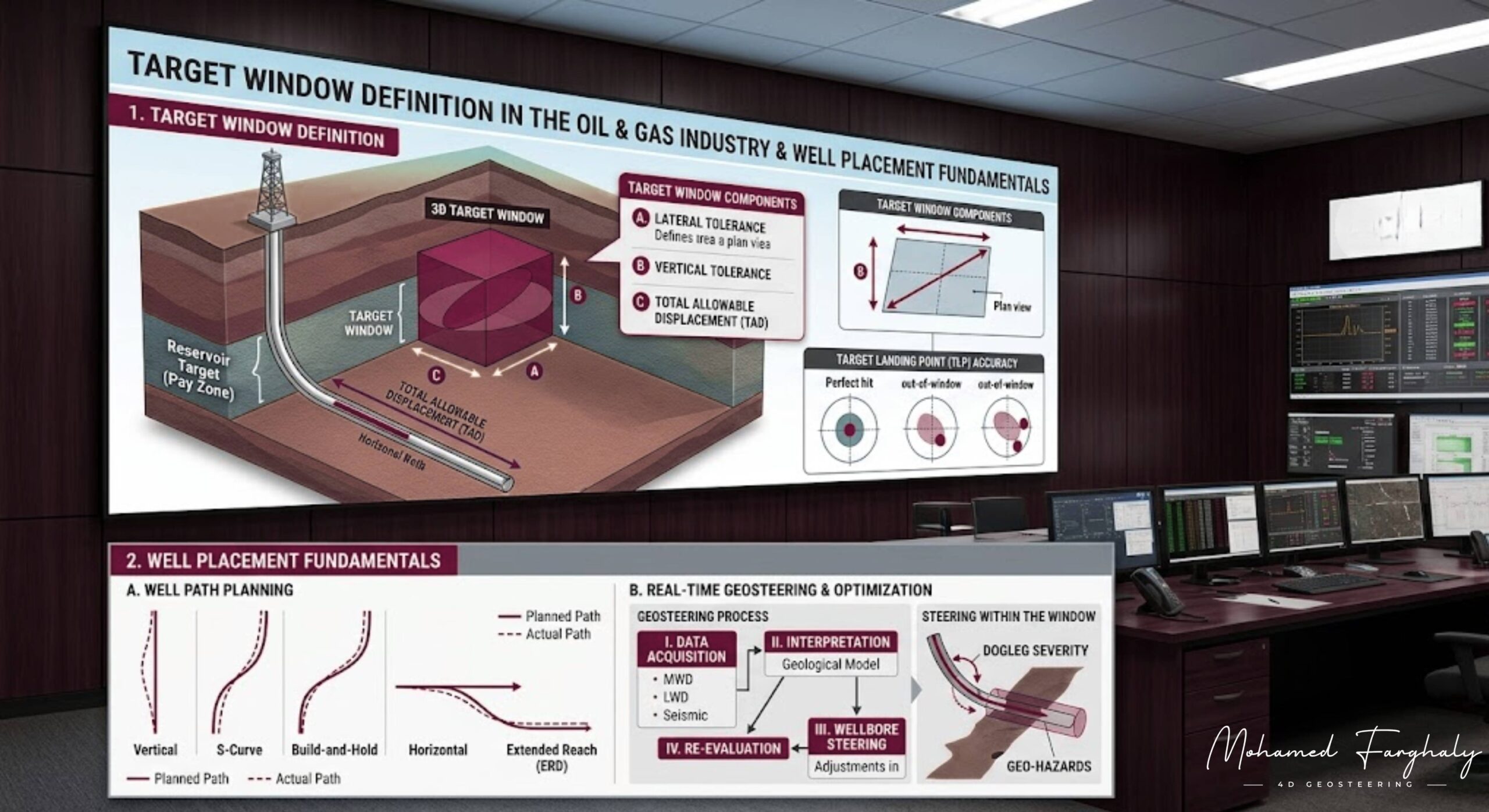
Target Window Definition
In geosteering, well placement involves more than reaching the reservoir; it requires staying precisely within the most productive interval. That objective starts with defining the target window. This core concept in well placement fundamentals directly impacts drilling success and reservoir performance.
Defining the Target Window
Geologists define the target window as the subsurface zone where they land the wellbore and maintain it throughout drilling. This window provides a carefully defined interval that combines optimal reservoir properties such as high porosity, good permeability, and favorable hydrocarbon saturation. In geosteering-focused operations, teams identify this window as the “sweet spot” that maximizes production efficiency.
Data Integration for Accuracy
Defining the target window requires integrating multiple data sources. Seismic interpretation provides the structural framework, while offset well data and formation logs help geologists identify reservoir quality and boundaries. Geosteering teams analyze this information to map formation tops, fluid contacts, and heterogeneities. This process ensures that the window remains both productive and drillable.
Handling Subsurface Uncertainty
One of the biggest challenges involves dealing with uncertainty. Subsurface models offer predictions, not exact representations. Faults, formation dips, and lateral variations often shift the expected position of the reservoir. For this reason, geoscientists define the target window with a vertical tolerance. This allows some flexibility while still maintaining well objectives. In thin reservoirs, planners limit this tolerance, making precision critical.
Aligning Trajectory and Design
The target window directly influences trajectory design. Engineers design the well path to enter the window at the optimal inclination and azimuth, then keep the well inside it for as long as possible. In horizontal wells, even a small deviation outside the window significantly reduces reservoir contact and overall recovery.
Real-Time Monitoring
Geosteering plays a vital role here. Real-time data from Logging-While-Drilling (LWD) and Measurement-While-Drilling (MWD) tools allow continuous monitoring of formation properties. Geosteering specialists interpret these measurements to confirm the well’s position relative to the target window, which enables immediate corrections to the trajectory.
Ultimately, target window definition acts as the bridge between geological understanding and real-time drilling decisions. It ensures that well placement is not left to chance, but guided by data, interpretation, and continuous adjustment—maximizing both accuracy and reservoir value.