Vertical Drilling Limitations: The Evolution of Well Placement
April 26, 2023 ·2 minutes reading
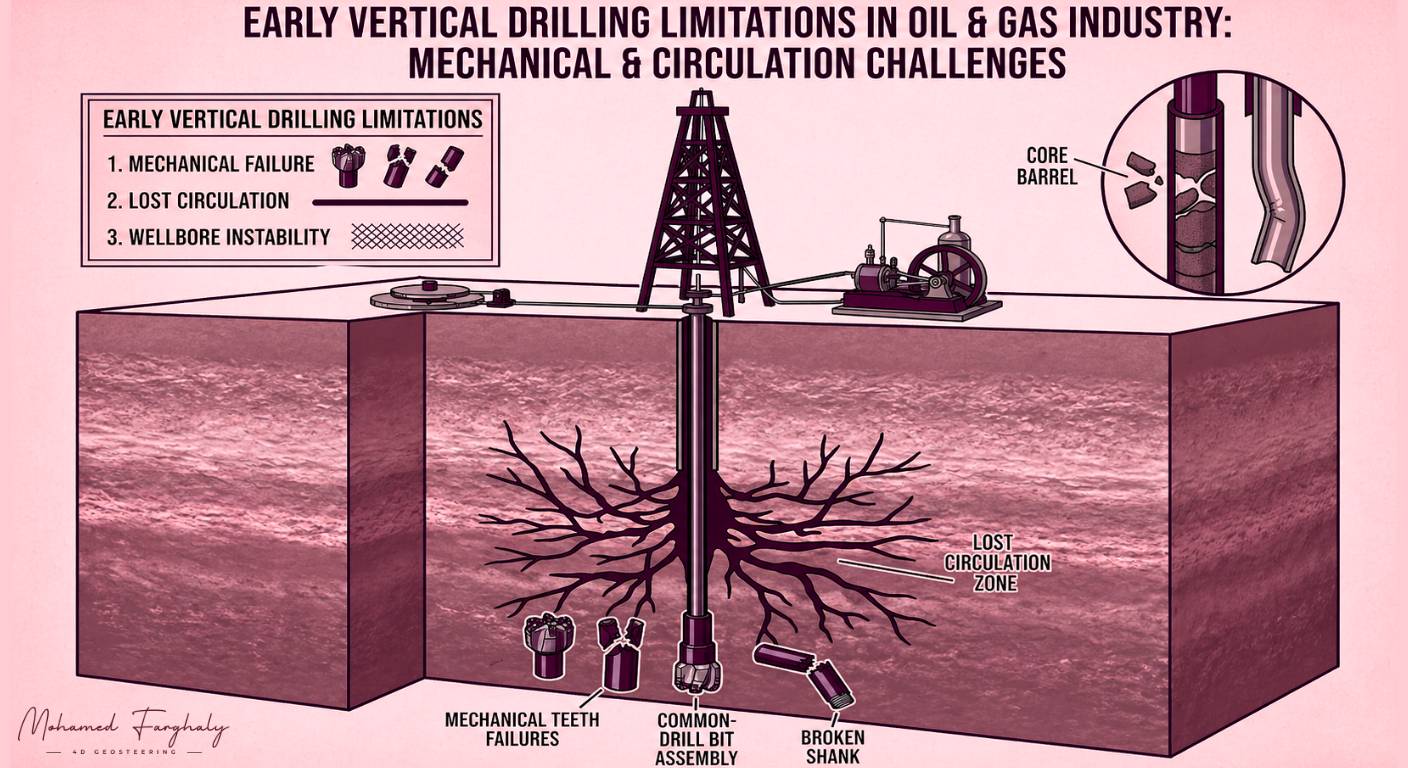
In the early days of the oil and gas industry, exploration teams drilled straight down to find hydrocarbons. Because teams worked with limited geological understanding and no real-time measurements, they often struggled to hit targets. When a vertical well successfully reached a reservoir, operators considered it a technical success. Initially, this method worked well in large, homogeneous reservoirs; however, as exploration expanded into complex formations, the weaknesses of vertical drilling became increasingly clear.
Restricted Reservoir Contact
One major limitation involved restricted reservoir contact. A vertical well only intersects a small portion of the reservoir, often missing large productive intervals. In thin or layered formations, this resulted in low exposure to hydrocarbons and reduced production efficiency.
Subsurface Uncertainty
Furthermore, subsurface uncertainty created another major issue. Without advanced seismic imaging or real-time logging tools, operators lacked the ability to predict reservoir position accurately. Teams frequently drilled wells above or below the optimal zone. Since drilling provided no mechanism to correct the trajectory, these errors remained permanent.
Geographic and Production Constraints
As development moved into challenging environments, access limitations became a serious problem. Reservoirs located beneath rivers, cities, or offshore areas made placing a vertical well directly above the target unfeasible. Additionally, vertical wells failed to follow the geometry of the reservoir, which left large volumes of hydrocarbons untouched. As fields matured, this poor drainage efficiency became critical.
Lack of Real-Time Decision Making
Another key challenge involved the absence of real-time decision-making. Operators performed formation evaluation after drilling using wireline logs. This delayed feedback meant that teams discovered well placement errors too late to fix them. Consequently, these operational risks often led to suboptimal placement or dry holes.
The Shift Toward Modern Drilling
These limitations changed how the industry viewed drilling. It became clear that reaching the reservoir was not enough; the goal shifted toward controlling the well path within the formation. This realization marked the beginning of a major transformation.
Advancing Toward Geosteering
Directional drilling introduced the ability to deviate from vertical paths, while advancements such as MWD and LWD enabled real-time monitoring. Ultimately, these developments evolved into geosteering, where specialists actively guide wells within the most productive zones. Early vertical drilling may have served as the foundation of the industry, but modern technology now ensures far greater precision.