LWD advancements
April 29, 2023 ·3 minutes reading
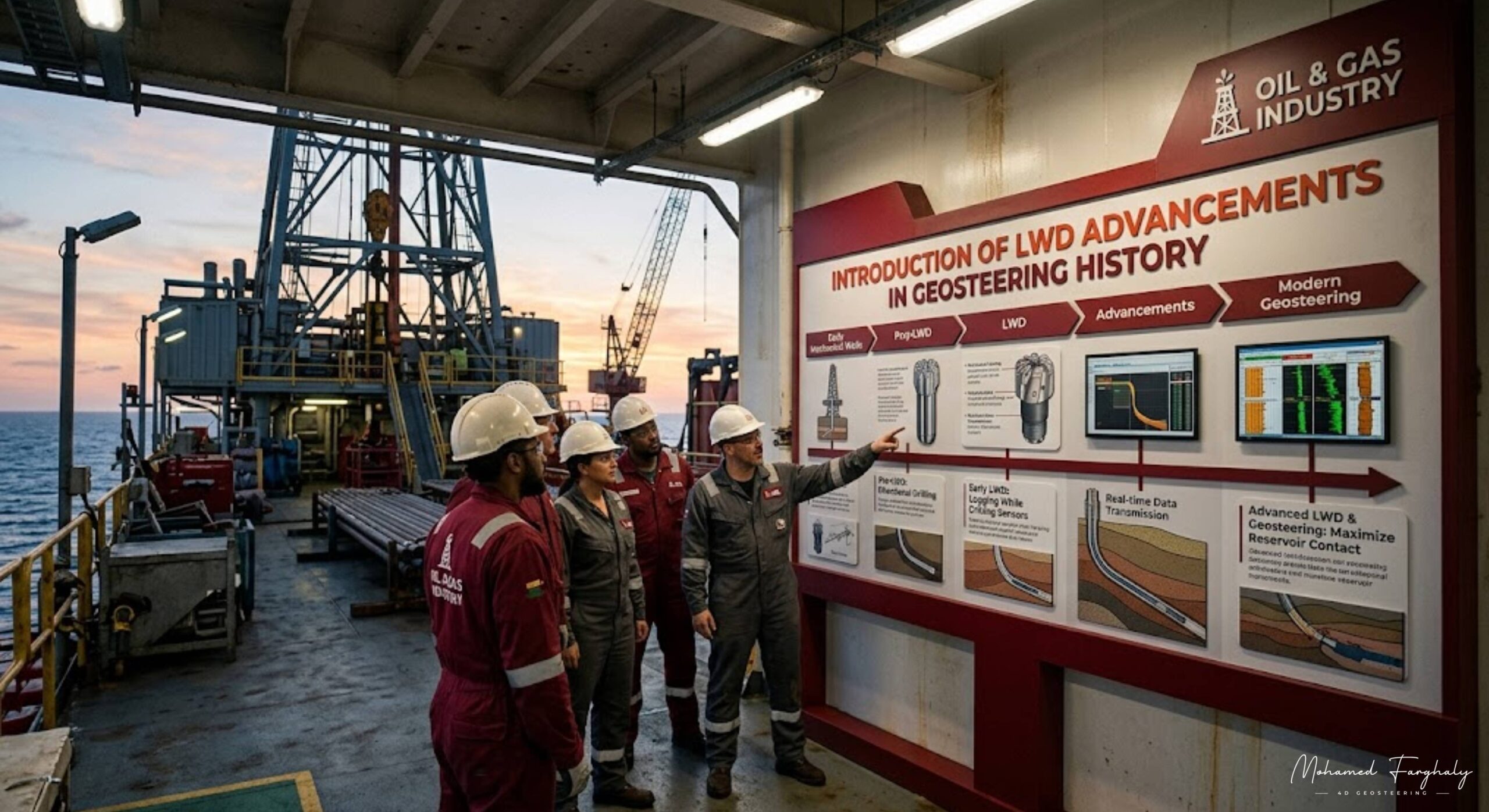
The evolution of Logging While Drilling represents one of the most important technological breakthroughs in modern subsurface operations. These recent LWD advancements have completely transformed how the oil and gas industry approaches formation evaluation. Before this technology became available, data acquisition mainly depended on wireline logging, which engineers performed only after completing drilling operations.
Although conventional wireline logging provided valuable reservoir information, it also created severe operational limitations. Collecting data after drilling meant that if the wellbore had already exited the target zone, the opportunity to correct the trajectory was completely lost.
The industry required a reliable way to understand formation properties in real time while the drill bit was still advancing. This challenge directly led to the rapid development of modern Logging While Drilling systems.
By integrating specialized geological and petrophysical measurement sensors directly into the Bottom Hole Assembly (BHA), teams no longer had to wait for post-drilling analysis. Because of these engineering breakthroughs, geologists, directional drillers, and operators could observe formation behavior in real time and make immediate path corrections.
Early Measurements vs. Modern Sensors
Early downhole tools focused mainly on basic data acquisition, specifically gamma ray and resistivity logs. Gamma ray measurements helped wellsite geologists identify shale content and lithology changes, while basic resistivity measurements assisted in recognizing hydrocarbon-bearing formations and fluid variations. These foundational tools quickly became essential for basic reservoir navigation and stratigraphic correlation.
As drilling operations expanded into highly complex reservoirs, technology progressed rapidly. Service companies developed a comprehensive suite of cutting-edge petrophysical measurements while drilling ahead, including:
- Bulk density and neutron porosity logs
- Sonic travel time data
- High-resolution borehole imaging
Deep-Reading Resistivity and Boundary Detection
One of the most significant LWD advancements was the introduction of extra-deep directional resistivity tools. Unlike conventional sensors that only investigate rock properties a few inches from the wellbore, deep-reading tools can detect geological boundaries and fluid contacts dozens of feet away from the drill bit.
This proactive capability completely transformed modern geosteering workflows. Instead of reacting defensively after accidentally exiting a thin reservoir block, geosteering teams can now proactively adjust the well trajectory based on real-time structural mapping. This optimization maximizes reservoir contact and significantly reduces costly directional corrections.
The Core of Modern Intelligent Drilling
Advanced evaluation became critical for keeping long horizontal laterals within the most productive reservoir windows. Today, modern subsurface systems incorporate high-tier digital technologies, such as:
- Azimuthal measurements: Providing 360-degree data mapping around the tool.
- Real-time formation pressure testing: Identifying reservoir compartmentalization instantly.
- Advanced resistivity inversion modeling: Processing raw sensor data into clear cloud-based visual structures.
These technologies successfully transform drilling from a purely mechanical process into an intelligent, data-driven system. By linking geology, real-time reservoir evaluation, and directional steering into a continuous feedback loop, operators can navigate highly complex reservoirs with remarkable precision.