Steering Decision Logic in Geosteering
May 3, 2023· 2 minutes reading
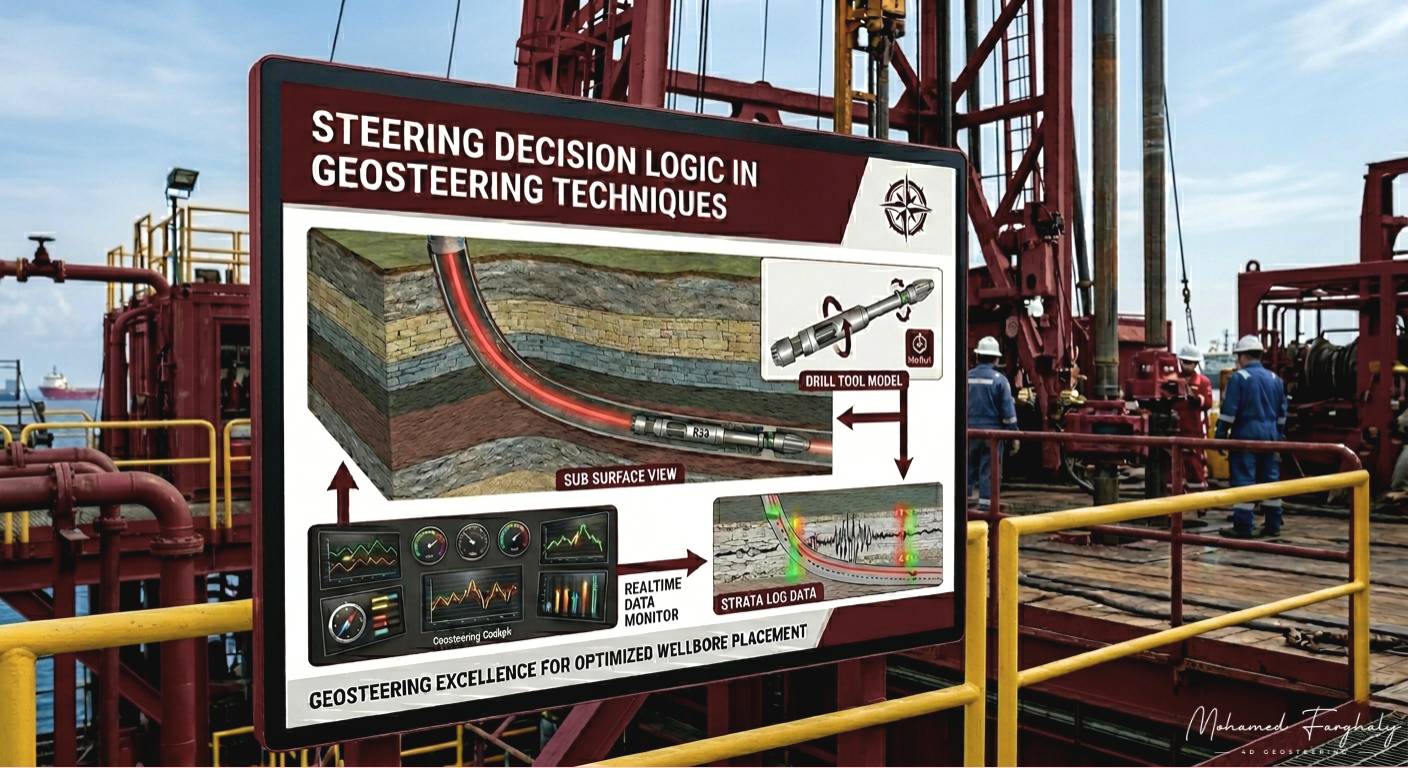
In geosteering, every drilling adjustment depends on clear decision logic. Steering decision logic is the process geosteerers use to decide whether a well should hold its path, build angle, drop angle, or adjust direction inside the target formation.
This process connects geology, drilling engineering, and real-time data interpretation. The goal is simple: keep the well in the best reservoir position while drilling continues.
What Is Steering Decision Logic?
Steering decision logic is the workflow used to turn subsurface data into drilling actions. Unlike post-drill geology, geosteering happens while the well is still being drilled.
This means the team must make decisions quickly. The bit continues moving, and every delay can affect well placement. For this reason, geosteerers do not rely on one measurement only. They combine several data sources to understand where the well is and where it is going.
Using LWD Data in Geosteering Decisions
Logging While Drilling, or LWD data, plays a major role in steering decisions. Gamma ray, resistivity, density, neutron, and other measurements help identify formation changes and reservoir quality.
For example, an increase in gamma ray may suggest the well is moving closer to shale. A decrease in resistivity may also indicate lower reservoir quality or a nearby boundary.
Geosteerers compare these live measurements with the planned geological model. If the real data does not match the model, the team updates the interpretation and adjusts the steering plan.
Reading Formation Trends Ahead of the Bit
Good steering decision logic does not only react to data. It also predicts what may happen ahead of the bit.
Geosteerers study log trends, well trajectory, formation dip, and structural uncertainty. These clues help the team decide whether a change is local or part of a larger geological shift.
If the well appears to approach the top or base of the reservoir, the team may choose to steer up, steer down, or hold trajectory. The correct decision depends on the full geological picture.
Balancing Geology and Drilling Limits
Geology may suggest a quick correction, but drilling conditions must also allow it. Directional drilling limits, dogleg severity, BHA performance, hole condition, and drilling efficiency all affect the final decision.
This balance is important. A technically correct geological decision can still create operational problems if the well cannot safely follow the required path.
Why Human Interpretation Still Matters
Modern geosteering software helps teams visualize well paths, geological models, and real-time logs. These tools improve speed and accuracy.
However, software does not replace human judgment. Reservoirs are complex, and subsurface conditions often change unexpectedly. Experienced geosteerers use pattern recognition, geological reasoning, and continuous model updates to make better decisions.
Key Elements of Steering Decision Logic
Strong steering decision logic usually includes:
- Real-time LWD interpretation
- Comparison with the geological model
- Formation dip and boundary analysis
- Well trajectory review
- Operational limits and drilling constraints
- Continuous model updates
- Clear communication between geology and drilling teams
In modern geosteering, successful well placement depends on more than data collection. It depends on the quality of the decisions made from that data.