Near-bit vs far-bit techniques comparison
May 6, 2023· 2 minutes reading
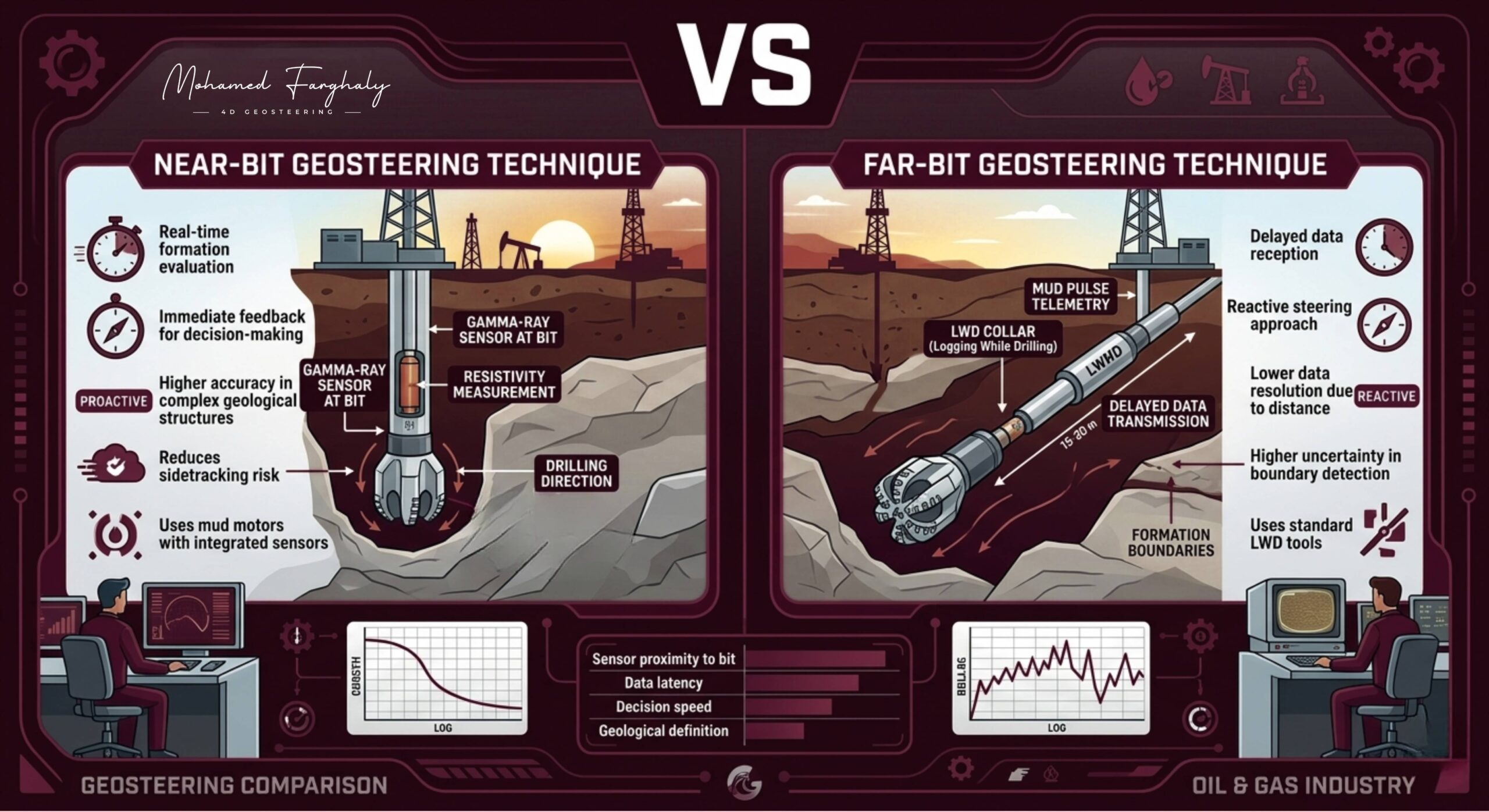
In modern geosteering, one of the biggest challenges is understanding where the wellbore is heading before the drill bit exits the target zone. This is where near-bit and far-bit measurement techniques become essential. Both methods help geosteering teams make real-time steering decisions, but they provide different levels of visibility into the formation ahead of the bit.
What Are Near-Bit Techniques?
Near-bit measurements are taken very close to the drill bit, sometimes only a few feet behind it. These measurements provide immediate information about the formation currently being drilled. Because the sensors are close to the bit, the response is fast and highly accurate for identifying lithology changes, bed boundaries, and reservoir entry or exit points.
Near-bit techniques are extremely valuable in thin reservoirs, where even small trajectory changes can move the well outside the productive zone. Geosteering teams rely on near-bit data for rapid corrections and maintaining precise well placement.
However, near-bit measurements mainly show what the bit is drilling right now, not what lies ahead. This limits the ability to predict approaching geological changes early.
What Are Far-Bit Techniques?
Far-bit techniques look deeper into the formation ahead of the drill bit using advanced resistivity and electromagnetic technologies. Instead of only measuring the current formation, these tools help geosteerers detect approaching boundaries, fluid contacts, or formation changes before the bit reaches them.
This predictive capability gives drilling teams more time to adjust the trajectory proactively rather than reactively. Far-bit measurements are especially useful in complex structures, faulted reservoirs, and wells requiring long horizontal exposure.
The tradeoff is that far-bit measurements may have lower resolution compared to near-bit tools and can involve more interpretation uncertainty.
Near-Bit vs Far-Bit Comparison
| Feature | Near-Bit Techniques | Far-Bit Techniques |
|---|---|---|
| Sensor Position | Very close to the drill bit | Deeper investigation ahead of bit |
| Main Purpose | Immediate formation evaluation | Predictive boundary detection |
| Response Speed | Very fast | Slightly slower interpretation |
| Best For | Thin reservoirs and precise control | Complex geology and proactive steering |
| Data Type | Current formation | Upcoming formation trends |
| Risk Reduction | Corrects trajectory quickly | Prevents unexpected exits early |
Why Both Techniques Matter
In today’s geosteering workflows, operators often combine both methods to achieve better reservoir navigation. Near-bit measurements provide high-confidence real-time positioning, while far-bit technologies improve anticipation of geological changes ahead.
The combination allows geosteering teams to reduce uncertainty, improve well placement accuracy, minimize non-productive drilling, and maximize reservoir contact. As drilling environments become more complex, integrating both near-bit and far-bit techniques is becoming a major advantage in the oil and gas industry.