Model assumptions
May 20, 2023· 2 minutes reading
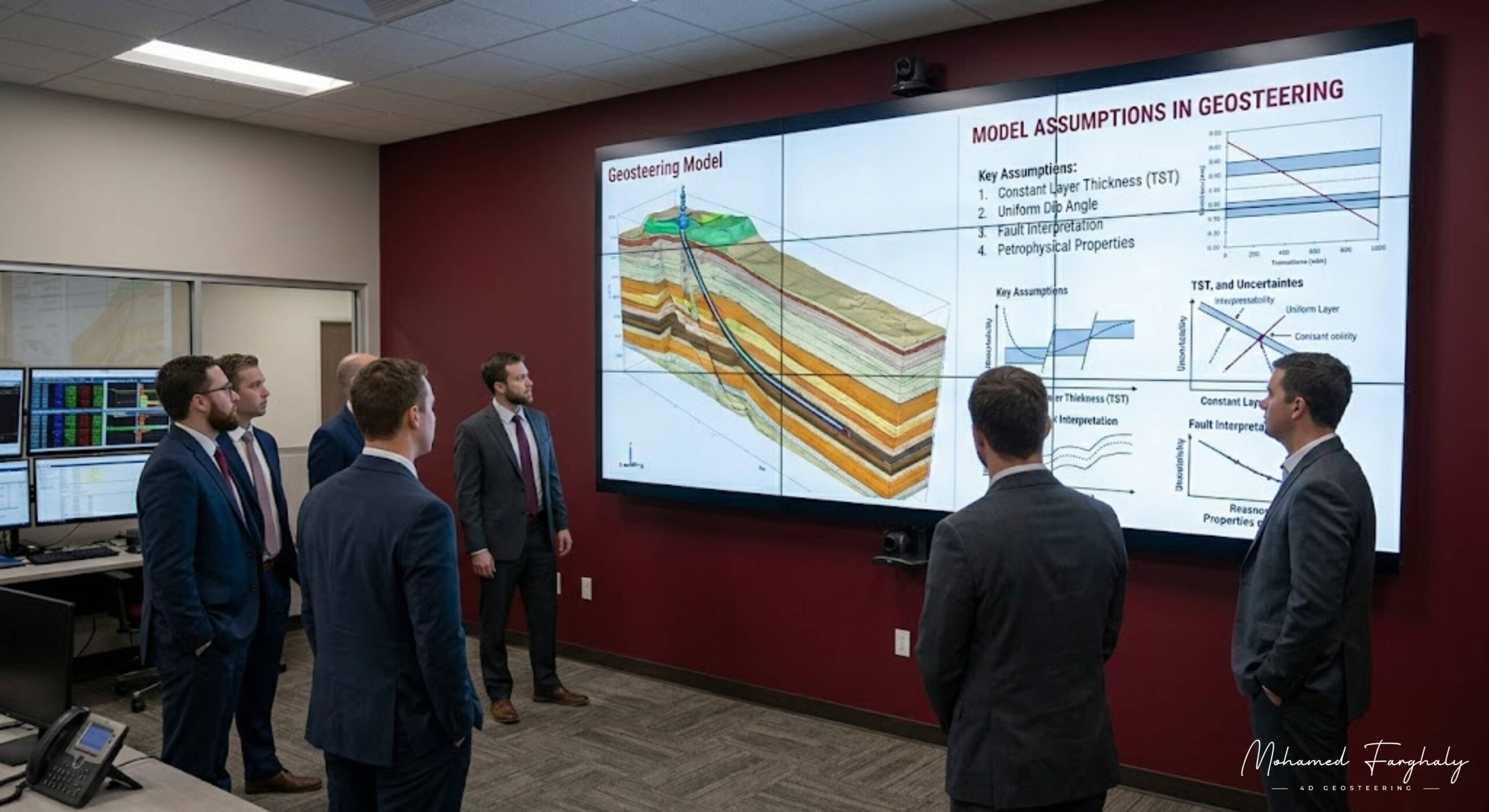
“Everyone trusts the geosteering model, but few realize how hidden assumptions can quietly change the well path.”
In geosteering, model assumptions guide every real-time decision. They help teams place wells, read data, and manage uncertainty. No model shows the reservoir perfectly. Instead, geologists simplify reality so they can act while drilling continues.
Why Model Assumptions Matter
A geosteering model gives direction, but it cannot remove uncertainty. It helps the team work with limited data. When teams treat the model as absolute truth, small errors can grow quickly. However, when geosteerers understand model limits, they can adjust faster and make better decisions.
One common assumption is layer continuity. Geologists often expect formations to continue between offset wells. This makes well-to-well correlation easier. However, real reservoirs may contain faults, channels, pinch-outs, and sudden facies changes. As a result, the target zone can move away from the planned position.
Another assumption involves stable petrophysical properties. A model may expect porosity, resistivity, gamma ray response, and lithology to stay similar within a zone. In real reservoirs, these properties can change over short distances. Therefore, LWD responses may differ from the expected trend. This can confuse boundary interpretation and affect well placement.
Geosteering models also simplify structure. The planned model may show flat layers or gentle dips. In the subsurface, folds, faults, and local dip changes can move formation boundaries. When this happens, the actual bed position may differ from the prediction. Because of that, geosteerers must update the interpretation while drilling.
Final Thoughts
Geosteering also depends on measurement quality. Real-time data may include depth uncertainty, tool limits, noise, or delayed responses. At the same time, new data can change the geological interpretation. Therefore, teams should keep the model flexible throughout the operation.
Understanding model assumptions in geosteering does not mean removing them completely. That is impossible. Instead, the goal is to know what the model simplifies. When teams understand these limits, they can respond faster, reduce uncertainty, and keep the well inside the target zone.
🔗 Keywords
Well Correlation, Offset Wells, Formation Tops, Gamma Ray Correlation, Resistivity Trends, LWD Data, Structural Dip, Fault Detection, Stratigraphic Variation, Reservoir Modeling, 3D Geosteering Models, Well Placement Optimization, Geological Uncertainty.