Bottom Hole Assembly
June 6, 2023· 2 minute reading
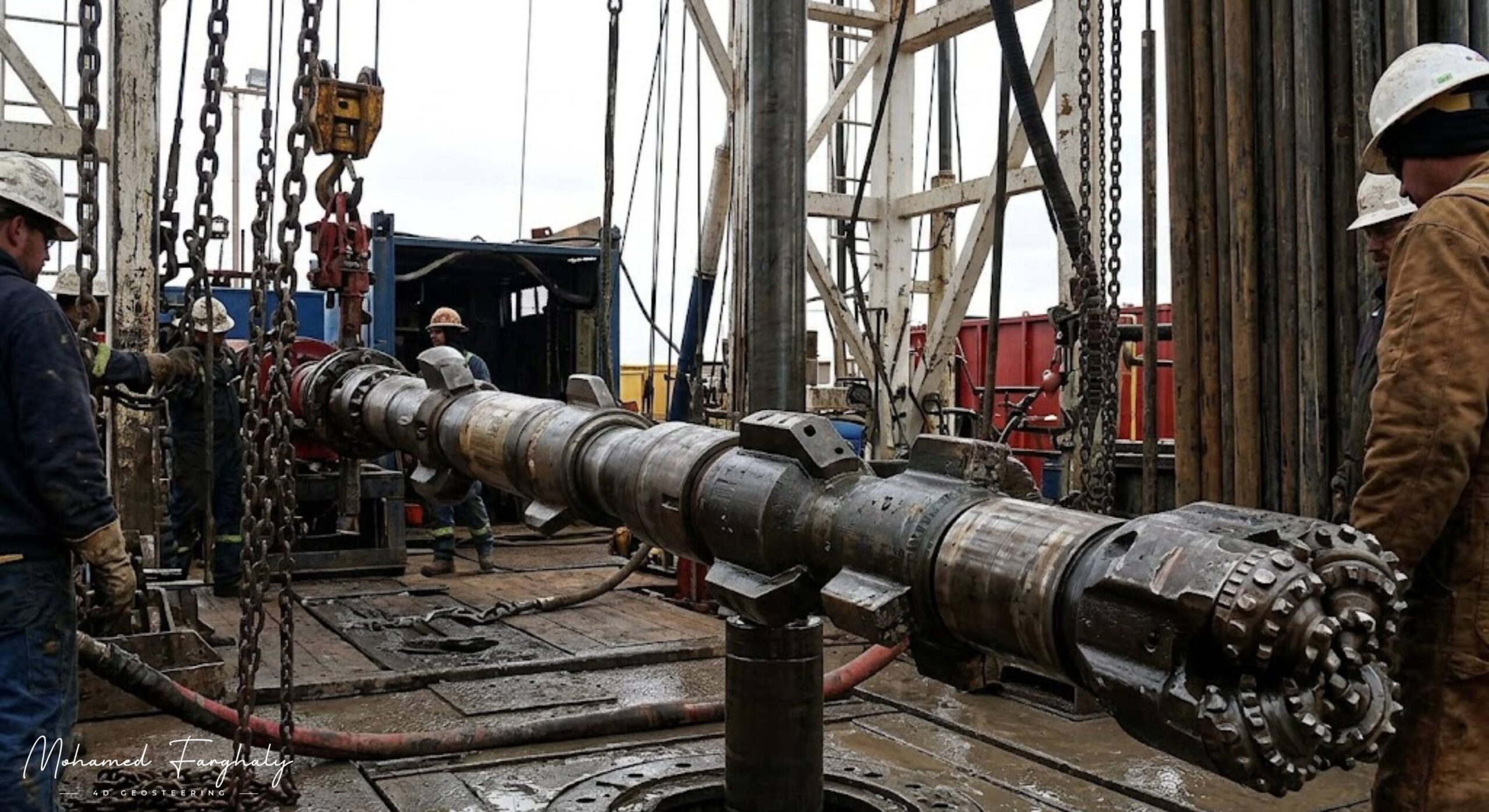
Bottom Hole Assembly in geosteering plays a critical role in turning real-time geological decisions into actual wellbore movement. Geosteering is not only about interpreting data. Because of this, downhole control also depends on how the drilling system responds while drilling.
Located just above the drill bit, the Bottom Hole Assembly, or BHA, contains key drilling components. A typical BHA may include stabilizers, drill collars, mud motors, rotary steerable systems, MWD tools, and LWD tools. Together, these components help control the well path and provide the data needed for accurate steering decisions.
Why Bottom Hole Assembly in Geosteering Matters
In directional drilling, the BHA directly affects the well trajectory. Its design helps the well build angle, hold inclination, or change direction when needed. As a result, BHA design becomes essential for precise well placement inside the target reservoir.
A well-designed assembly allows the drilling team to respond quickly to formation changes. However, poor BHA design can slow steering response, reduce control, and increase the risk of drilling outside the productive zone.
MWD and LWD Tools Inside the BHA
MWD and LWD tools are important parts of the Bottom Hole Assembly. MWD tools provide directional data such as inclination, azimuth, and toolface. In addition, LWD tools provide formation data such as gamma ray, resistivity, density, and porosity.
These measurements support real-time interpretation while drilling. Geosteerers use this data to adjust the well path and keep the borehole inside the best reservoir section. Therefore, reliable tool response inside the BHA can improve geosteering accuracy.
BHA and Well Placement
The BHA acts as the execution system of geosteering. It connects surface interpretation with controlled downhole movement. By combining mechanical control with real-time measurements, the BHA helps reduce uncertainty and support better reservoir contact.
🔗 Keywords
Drilling Rig, Drilling Mud, MWD, LWD, Directional Drilling, Geosteering, Well Placement, Oil Reservoir, Surface Logging, Borehole Imaging, Electromagnetic Resistivity LWD Tool, Bottom Hole Assembly, Study of Real-Time LWD Data, LWD Interpretation, Borehole Image Log, Dip Calculation Methods, Shale Gas Sweet Spot, Accurate Reservoir Boundary Detection, Machine Learning, Artificial Intelligence, The Future of Automated Geosteering, Ensemble-Based Well Log Interpretation, Digital Twins in Drilling, Remote Operations Centers