What is an Oil Reservoir?
Sept 8, 2023· 1 minute reading
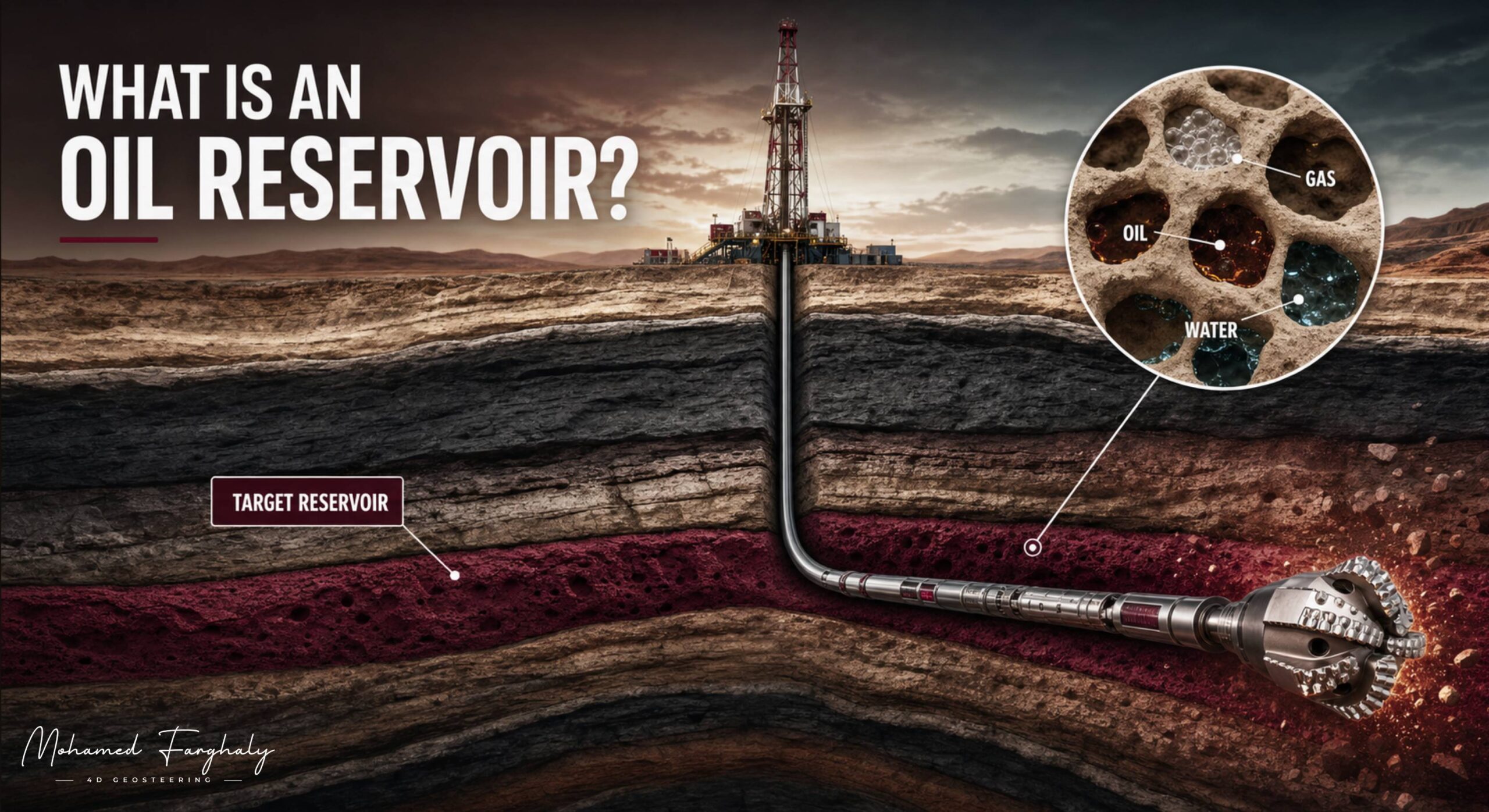
Many people imagine an oil reservoir as a large underground lake filled with crude oil. However, it is actually a body of porous rock that stores oil, natural gas, and water inside tiny connected spaces. A useful comparison is a sponge: the rock is solid, but its pores can hold and transmit fluids.
Key Properties of Reservoir Rocks
Oil reservoirs commonly occur in porous rocks such as sandstone and limestone. Their production potential depends mainly on two properties:
- Porosity measures how much fluid the rock can store.
- Permeability describes how easily oil, gas, and water can flow through connected pores.
A productive reservoir usually needs sufficient porosity and permeability. However, pressure, fluid saturation, rock structure, and reservoir thickness also affect its commercial value.
In addition, hydrocarbons need a sealing rock above the reservoir. This impermeable layer prevents oil and gas from escaping toward the surface.
Oil Reservoirs and Geosteering
Understanding reservoir boundaries is essential for accurate geosteering and well placement. During drilling, engineers use real-time data from Logging While Drilling (LWD) and Measurement While Drilling (MWD) tools. These measurements help identify formation changes and determine the well’s position within the target zone.
When drilling horizontal wells, even a small trajectory change can move the well outside the productive interval. Therefore, geosteering teams continuously interpret subsurface data and adjust the well path when needed.
Advanced technologies, including borehole imaging and electromagnetic resistivity LWD tools, can improve reservoir boundary detection. As a result, engineers can keep the well within the most productive section for longer distances.
Artificial intelligence and machine learning are also improving reservoir interpretation. These technologies process large volumes of drilling data, detect patterns, and support faster geosteering decisions. However, geological expertise remains essential for validating results and managing uncertainty.
In simple terms, an oil reservoir is not an underground lake. It is a complex rock formation that stores and transmits hydrocarbons. Understanding its properties allows drilling teams to improve well placement, reduce risk, and maximize production.
🔗 Keywords
Drilling Rig, Drilling Mud, MWD, LWD, Directional Drilling, Geosteering, Well Placement, Oil Reservoir, Surface Logging, Borehole Imaging, Electromagnetic Resistivity LWD Tool, Bottom Hole Assembly, Study of Real-Time LWD Data, LWD Interpretation, Borehole Image Log, Dip Calculation Methods, Shale Gas Sweet Spot, Accurate Reservoir Boundary Detection, Machine Learning, Artificial Intelligence, The Future of Automated Geosteering, Ensemble-Based Well Log Interpretation, Digital Twins in Drilling, Remote Operations Centers