Impact of the BHA on Well Trajectory
June 6, 2023· 2 minute reading
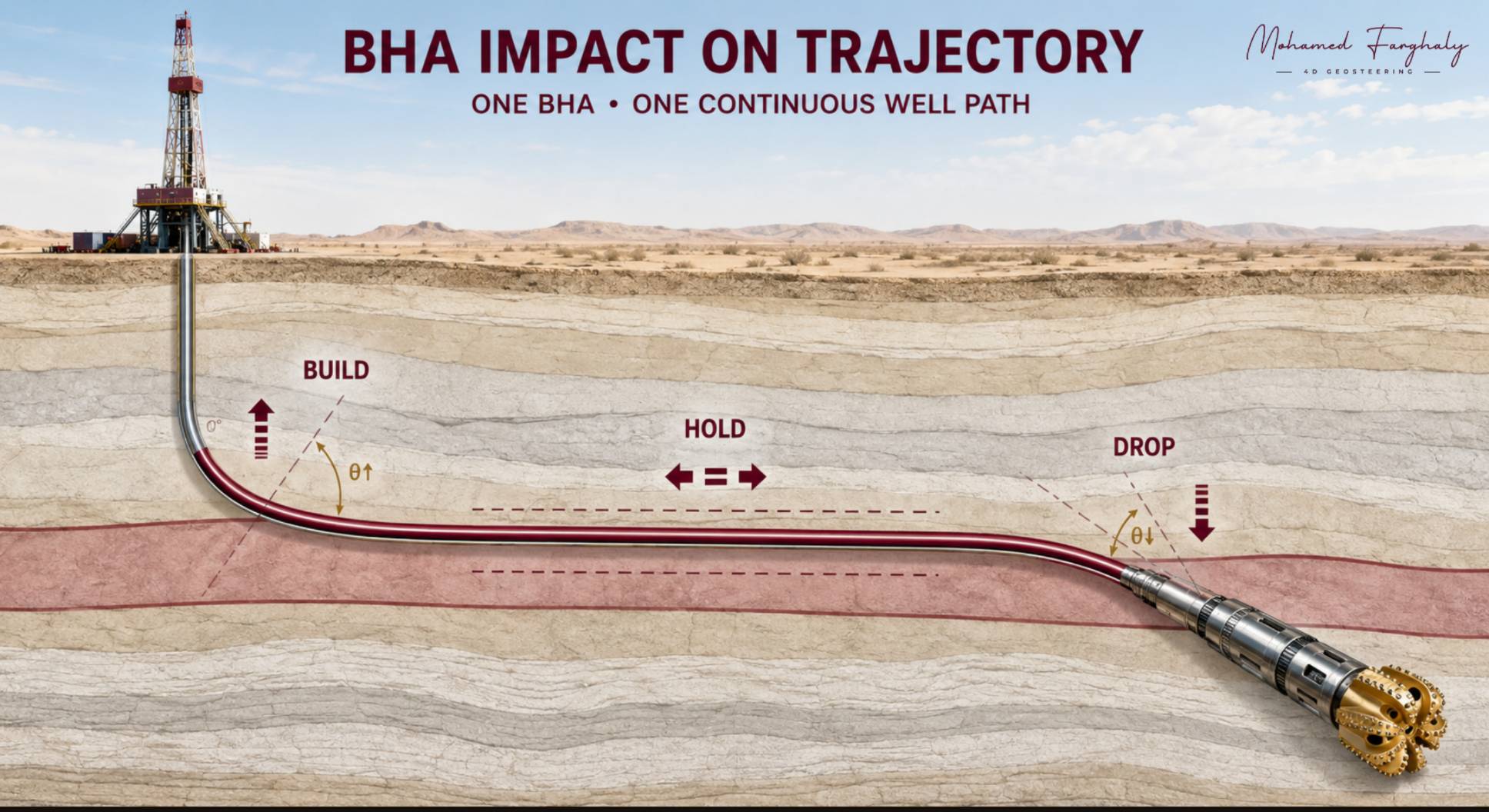
The bottom hole assembly does more than connect the drillstring to the bit. Its design controls how forces act near the bottom of the hole. Therefore, the BHA impact on trajectory can determine whether the well builds inclination, drops inclination, or maintains its current direction.
Small changes in BHA configuration can create different side forces at the bit. As a result, engineers must understand the assembly’s directional tendency before drilling each well section.
How BHA Design Influences Direction
The position of contact points between the assembly and the borehole creates mechanical leverage. This leverage changes the direction and strength of the force acting on the bit.
Three common directional tendencies include:
- Build tendency: A side force pushes the bit toward the high side of the hole, increasing inclination.
- Drop tendency: Gravity and BHA contact create a force toward the low side, reducing inclination.
- Hold tendency: The assembly limits bit tilt and helps maintain a relatively steady inclination.
However, the actual response depends on more than the planned configuration. Hole size, formation strength, weight on bit, rotary speed, tool wear, and borehole condition can all change the result.
Controlling the Planned Well Path
Before drilling, engineers select a BHA that matches the required directional objective. For example, a build section needs an assembly capable of generating enough side force to reach the planned inclination. Meanwhile, a tangent section requires a more neutral response to reduce unnecessary directional change.
Rotary steerable systems and bent motor assemblies can provide active directional control. These systems apply controlled steering forces while downhole surveys confirm the well’s actual position.
Nevertheless, no BHA follows its theoretical tendency perfectly. Different formations may react differently to the same assembly. A harder layer can deflect the bit, while a softer layer may allow a stronger directional response. Therefore, engineers compare planned and actual survey results throughout the run.
If the well begins moving away from the planned path, the team may adjust drilling parameters, change steering commands, or select a different assembly for the next run.
Ultimately, understanding the BHA impact on trajectory helps the drilling team predict directional behavior and react earlier. With the correct configuration and continuous survey monitoring, the team can guide the well more accurately toward its intended target.
🔗 Keywords
Drilling Rig, Drilling Mud, MWD, LWD, Directional Drilling, Geosteering, Well Placement, Oil Reservoir, Surface Logging, Borehole Imaging, Electromagnetic Resistivity LWD Tool, Bottom Hole Assembly, Study of Real-Time LWD Data, LWD Interpretation, Borehole Image Log, Dip Calculation Methods, Shale Gas Sweet Spot, Accurate Reservoir Boundary Detection, Machine Learning, Artificial Intelligence, The Future of Automated Geosteering, Ensemble-Based Well Log Interpretation, Digital Twins in Drilling, Remote Operations Centers
