Stabilization in Bottom Hole Assemblies
June 6, 2023· 2 minute reading
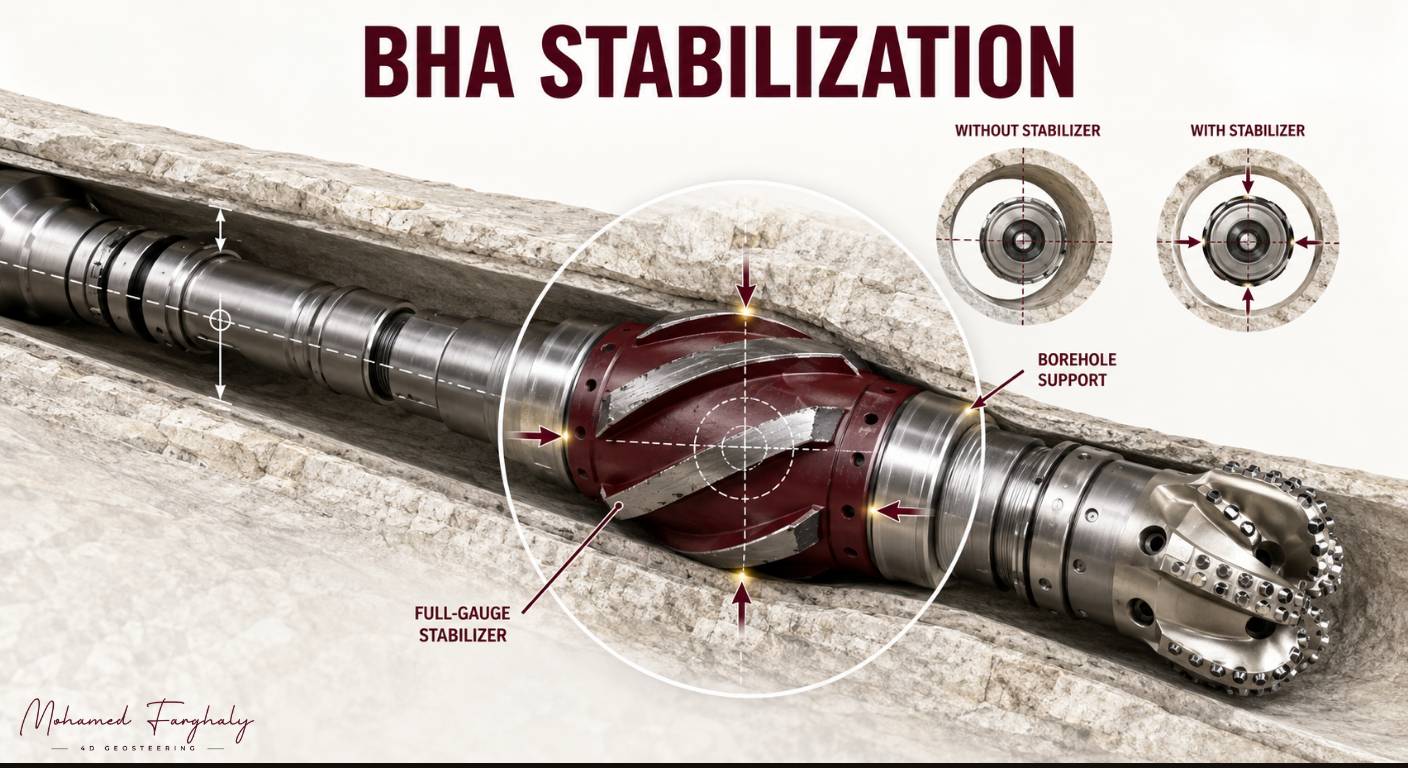
A bottom hole assembly operates under high weight, torque, pressure, and continuous contact with the borehole wall. Therefore, BHA stabilization helps maintain mechanical support around the drillstring while drilling through changing formations.
Stabilizers form the main contact points between the bottom hole assembly and the borehole wall. Their blades extend outward from the tool body and help keep the assembly supported inside the hole. As a result, the BHA can operate with better alignment and reduced uncontrolled lateral movement.
How BHA Stabilizers Work
A stabilizer consists of a strong tubular body with external blades. These blades contact, or nearly contact, the borehole wall while drilling fluid flows around them.
When side forces push the assembly toward the borehole wall, the stabilizer provides an opposing contact force. Consequently, it limits excessive sideways movement and helps maintain a more controlled mechanical position.
Drilling teams commonly use two stabilizer configurations:
- Full-gauge stabilizers: Their outside diameter closely matches the planned borehole diameter, so they provide stronger wall contact.
- Undergauge stabilizers: Their diameter remains slightly smaller than the borehole, allowing more clearance around the assembly.
Engineers select the stabilizer type according to hole size, formation behavior, expected loads, and operational requirements.
Factors That Influence Stabilization Performance
Effective stabilization depends on more than the stabilizer’s diameter. Blade design, wear condition, borehole quality, and formation strength also affect its performance.
For example, spiral blades can maintain broad wall contact while allowing drilling fluid and cuttings to pass around the tool. Meanwhile, straight blades offer a simpler contact geometry for specific drilling conditions.
However, stabilizer wear gradually reduces the outside diameter. Even a small reduction can increase the clearance between the BHA and the borehole wall. Therefore, drilling teams should inspect and measure stabilizers before and after each run.
Additionally, soft or enlarged formations may reduce stabilizer contact because the borehole diameter can exceed the planned size. Hard formations, by contrast, may increase blade wear and create irregular contact loads.
Successful BHA stabilization requires the correct stabilizer design, accurate gauge measurements, and continuous awareness of hole conditions. When these elements work together, the assembly receives dependable mechanical support throughout the drilling operation.
🔗 Keywords
Drilling Rig, Drilling Mud, MWD, LWD, Directional Drilling, Geosteering, Well Placement, Oil Reservoir, Surface Logging, Borehole Imaging, Electromagnetic Resistivity LWD Tool, Bottom Hole Assembly, Study of Real-Time LWD Data, LWD Interpretation, Borehole Image Log, Dip Calculation Methods, Shale Gas Sweet Spot, Accurate Reservoir Boundary Detection, Machine Learning, Artificial Intelligence, The Future of Automated Geosteering, Ensemble-Based Well Log Interpretation, Digital Twins in Drilling, Remote Operations Centers
