Tool placement optimization
June 6, 2023· 2 minute reading
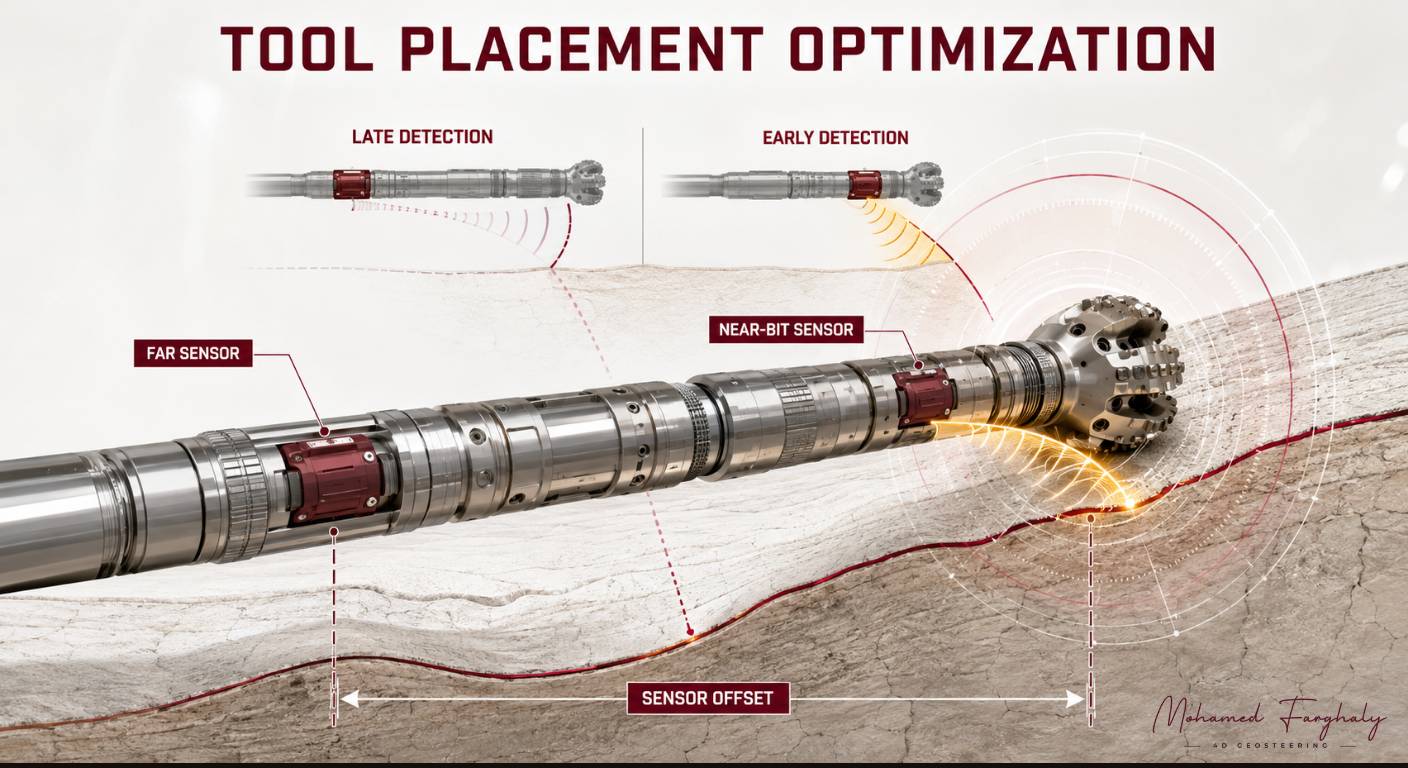
The position of each tool inside a bottom hole assembly (BHA) directly affects drilling performance and data quality. Therefore, tool placement optimization helps drilling teams build an assembly that produces reliable measurements, responds effectively, and supports safer drilling decisions.
Every tool occupies a specific distance from the bit. However, that distance determines when the tool detects a formation change and how accurately engineers can relate the measurement to the bit’s current position.
Why Tool Position Matters
Measurements taken closer to the bit provide earlier information about the formation ahead. For example, near-bit sensors can identify changes in inclination, gamma response, or formation characteristics before sensors positioned farther behind the bit reach the same interval.
This measurement delay becomes especially important near geological boundaries. If the sensor sits far behind the bit, the bit may already have crossed a boundary before the drilling team sees the response. As a result, the team receives less time to interpret the change and adjust its decisions.
Nevertheless, placing every tool close to the bit is not possible. Mechanical connections, power requirements, communication systems, tool dimensions, and operating limits all influence the final arrangement. Therefore, engineers must balance measurement value with practical BHA design constraints.
How Engineers Optimize Tool Placement
Engineers begin by defining which measurements matter most for the planned well section. They then review the distance between each sensor and the bit, commonly called the sensor offset.
For critical measurements, a shorter offset can improve situational awareness. Meanwhile, other tools may require specific positions to operate correctly or remain protected from harsh downhole conditions.
A successful layout also considers:
- The expected formation structure
- Required measurement timing
- Communication and power connections
- Tool length and compatibility
- Downhole temperature and pressure limits
- Planned drilling parameters
Additionally, engineers must record the exact sensor offsets in the drilling and interpretation software. Incorrect offsets can place measurements at the wrong depth, which may lead to inaccurate correlations and poor decisions.
Ultimately, tool placement optimization connects physical BHA design with real-time interpretation. When engineers position and configure the tools correctly, the drilling team receives more timely information and builds a clearer picture of the formation around the well.
🔗 Keywords
Drilling Rig, Drilling Mud, MWD, LWD, Directional Drilling, Geosteering, Well Placement, Oil Reservoir, Surface Logging, Borehole Imaging, Electromagnetic Resistivity LWD Tool, Bottom Hole Assembly, Study of Real-Time LWD Data, LWD Interpretation, Borehole Image Log, Dip Calculation Methods, Shale Gas Sweet Spot, Accurate Reservoir Boundary Detection, Machine Learning, Artificial Intelligence, The Future of Automated Geosteering, Ensemble-Based Well Log Interpretation, Digital Twins in Drilling, Remote Operations Centers
