Vibration Control in Bottom Hole Assemblies
June 6, 2023· 2 minute reading
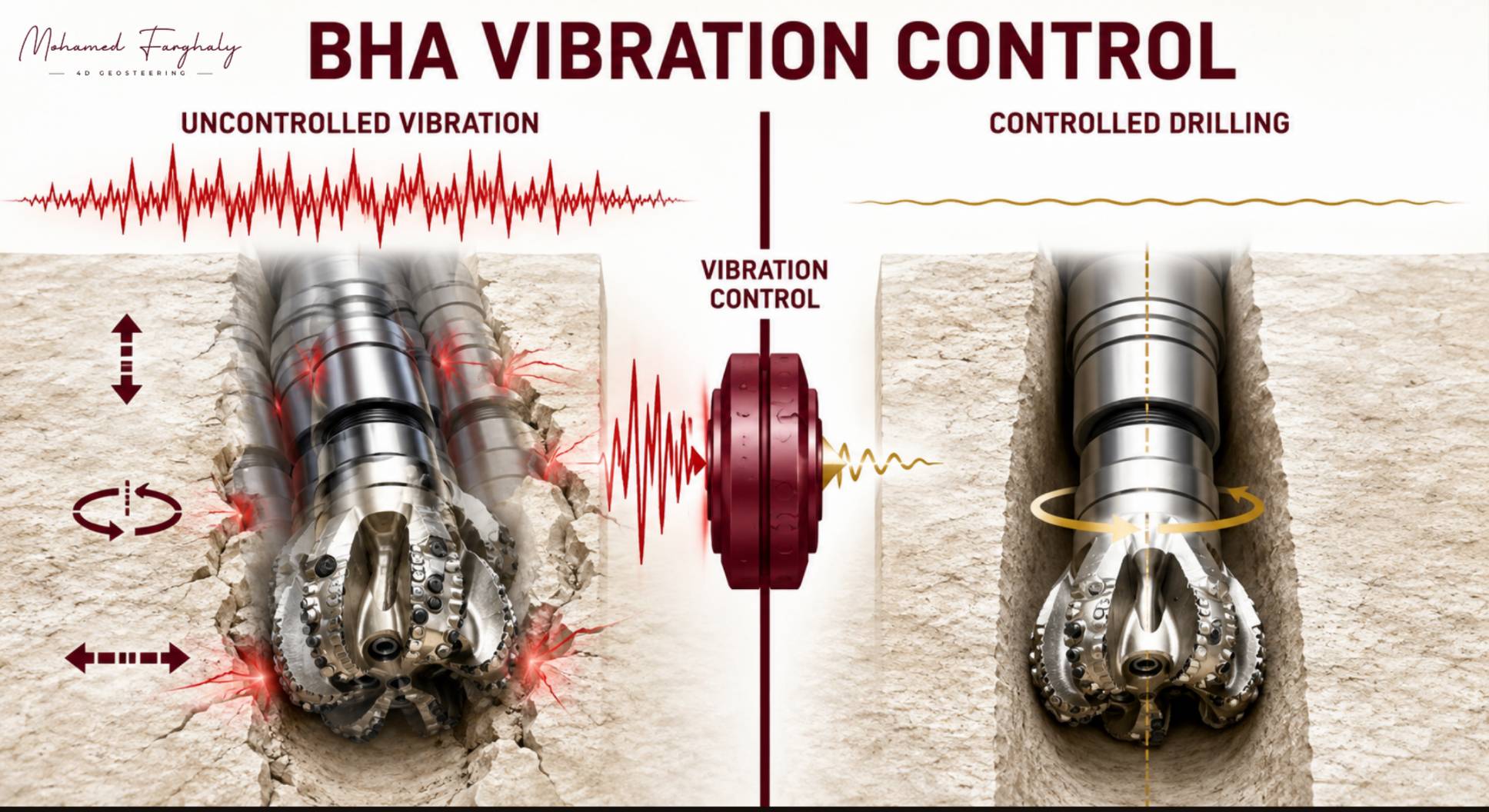
Drilling creates powerful dynamic forces throughout the bottom hole assembly. If these forces become excessive, they can damage tools, reduce drilling efficiency, and weaken measurement quality. Therefore, BHA vibration control protects downhole equipment and supports more consistent drilling performance.
Main Types of BHA Vibration
Drilling teams usually monitor three main vibration modes:
- Axial vibration: The BHA moves repeatedly along its length. Severe axial movement may cause the bit to bounce against the bottom of the hole, creating a condition known as bit bounce.
- Torsional vibration: The drillstring twists unevenly. In severe cases, the bit temporarily stops while torque builds, then suddenly accelerates. This behavior creates stick-slip.
- Lateral vibration: The BHA moves sideways and repeatedly strikes the borehole wall. Strong lateral motion can develop into whirl, where the bit or assembly rotates around the borehole instead of its own center.
Each vibration mode creates different loads. However, several modes may occur together and make the downhole environment more destructive.
How Drilling Teams Control Vibration
Effective vibration control begins with real-time downhole measurements. Sensors track shock, rotational speed, torque, and acceleration. Consequently, the drilling team can identify harmful behavior before serious damage occurs.
The team can then adjust operating parameters. For example, changing weight on bit, rotary speed, flow rate, or rate of penetration may move the BHA away from a damaging vibration range. Nevertheless, every adjustment should match the formation and drilling system.
Engineers may also use shock absorbers, vibration dampers, or tools designed to reduce sudden energy transfer. In addition, suitable bit selection can produce smoother cutting action and reduce unstable interaction with the formation.
Clear alarm limits also improve the response. Instead of waiting for severe vibration, the team can define warning levels and take action when measurements begin to rise.
Successful BHA vibration control combines responsive monitoring, suitable downhole equipment, and controlled drilling parameters. When the team manages these elements correctly, it protects sensitive tools, extends equipment life, improves data reliability, and reduces the risk of costly downhole failure.
🔗 Keywords
Drilling Rig, Drilling Mud, MWD, LWD, Directional Drilling, Geosteering, Well Placement, Oil Reservoir, Surface Logging, Borehole Imaging, Electromagnetic Resistivity LWD Tool, Bottom Hole Assembly, Study of Real-Time LWD Data, LWD Interpretation, Borehole Image Log, Dip Calculation Methods, Shale Gas Sweet Spot, Accurate Reservoir Boundary Detection, Machine Learning, Artificial Intelligence, The Future of Automated Geosteering, Ensemble-Based Well Log Interpretation, Digital Twins in Drilling, Remote Operations Centers
