Understanding ESP Components: The Anatomy of an Artificial Lift System
July 2, 2023· 3 minutes reading
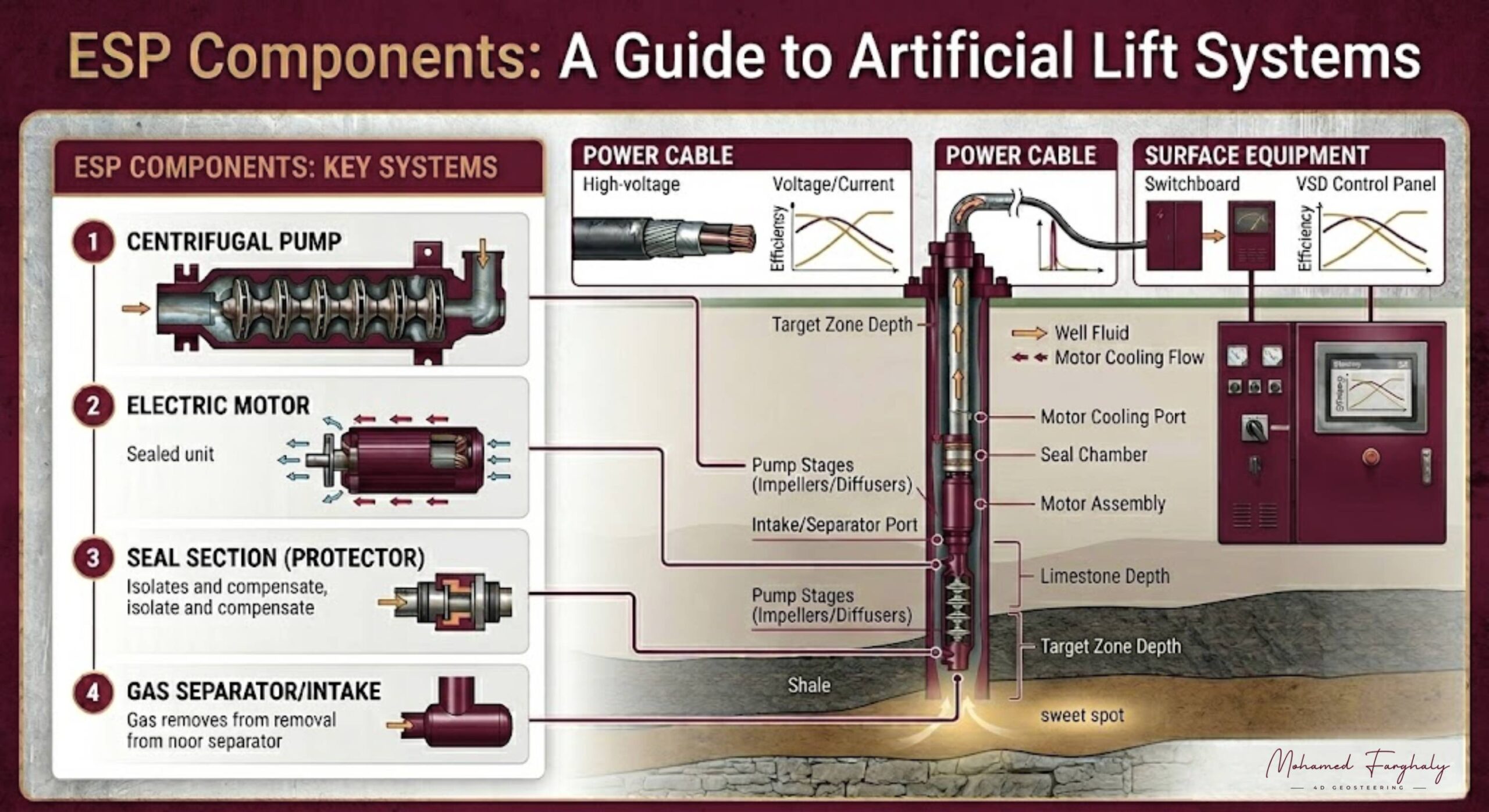
ESP components act as the foundation for modern artificial lift, as operators deploy them in over 33% of operational wells globally to maintain production as reservoir energy declines. Because these systems function in harsh downhole conditions, production engineers and field operators must understand the function and configuration of ESP components to ensure efficiency. Furthermore, proper selection of ESP components extends the overall run life of the system.
The assembly forms a modular unit that operators submerge directly in the well fluid. The following primary parts drive its operation.
1. Centrifugal Pump and ESP Components
The pump serves as the heart of the system and increases fluid pressure to lift it to the surface. It consists of multiple stages, and each stage contains an impeller and a diffuser.
- Functionality: As the motor drives the impeller, the impeller increases fluid velocity and the diffuser converts that velocity into pressure.
- Design: Engineers calculate the number of stages based on the Total Dynamic Head (TDH) required to overcome pressure losses in the tubing.
2. Electric Motor
Specifically, the electric motor provides the mechanical energy that drives the centrifugal pump.
- Cooling: Since the motor remains submerged, it relies on the flow of produced fluids—oil and water—to dissipate heat and prevent overheating.
- Failure Modes: Excessive heat or motor short circuits often cause premature failure, so operators prioritize thermal management to ensure system longevity.
3. Seal Section (Protector)
The seal section sits between the pump and the motor. Essentially, it isolates the motor from the wellbore fluids and prevents the ingress of oil or water into the motor housing. Additionally, it compensates for the thermal expansion and contraction of motor oil, which balances the internal pressure with the surrounding wellbore environment.
4. Gas Separator or Intake
Consequently, if a well possesses a high Gas/Oil Ratio (GOR), gas interference significantly reduces pump efficiency.
- Gas Separator: This component removes free gas from the produced fluids before they enter the pump.
- Intake: For wells with low gas content, engineers use a standard intake to allow fluid to enter the pump assembly smoothly.
5. Power Cable and Surface Equipment
Specialized power cables connect the downhole assembly to the surface, and these include both round and flat configurations. Once power reaches the surface, specific equipment manages it:
- Switchboard: The switchboard controls the power supply to the downhole motor.
- Junction Box: The junction box provides a safe connection point between the power cable and the surface switchboard.
- Variable Speed Drive (VSD): Operators often use a Variable Speed Drive to adjust the frequency, which allows the ESP components to operate at different speeds for improved production optimization.
🔗 Keywords
Drilling Rig, Drilling Mud, MWD, LWD, Directional Drilling, Geosteering, Well Placement, Oil Reservoir, Surface Logging, Borehole Imaging, Electromagnetic Resistivity LWD Tool, Bottom Hole Assembly, Study of Real-Time LWD Data, LWD Interpretation, Borehole Image Log, Dip Calculation Methods, Shale Gas Sweet Spot, Accurate Reservoir Boundary Detection, Machine Learning, Artificial Intelligence, The Future of Automated Geosteering, Ensemble-Based Well Log Interpretation, Digital Twins in Drilling, Remote Operations Centers