Mechanical Packers in Packers and Zonal Isolation
July 4, 2023· 3 minutes reading
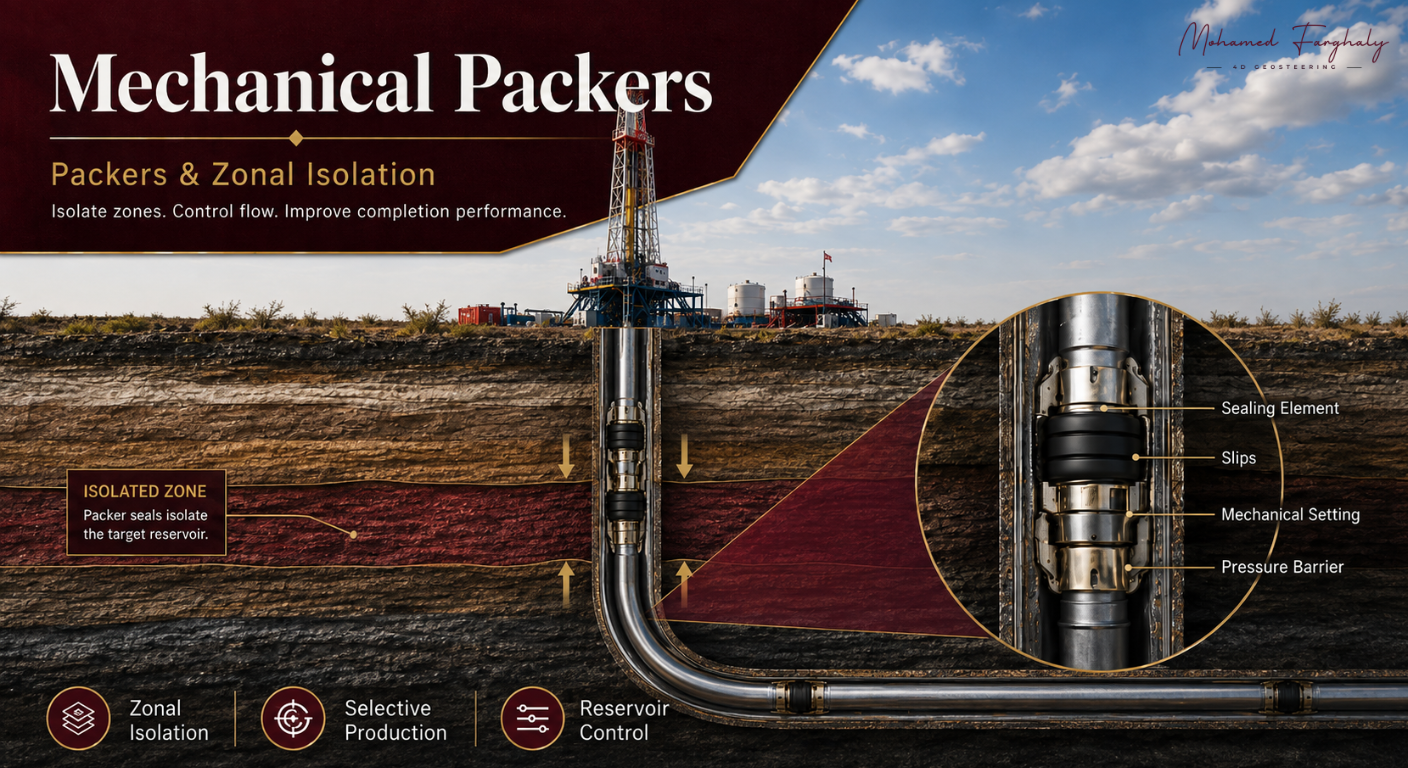
Mechanical packers play an important role in modern well completions because they create a reliable seal between the tubing and the casing or wellbore. In geosteered wells, accurate well placement defines where the lateral enters the target reservoir. Then, mechanical packers help control and isolate the selected reservoir intervals during completion.
What Are Mechanical Packers?
A mechanical packer is a downhole completion tool that uses mechanical movement to create a seal. Operators may set the packer through tubing rotation, compression, tension, or a combination of these actions.
When the setting mechanism activates, the sealing element expands against the casing or wellbore wall. As a result, the packer creates a pressure barrier between different downhole sections.
Unlike hydraulic or swellable packers, mechanical packers depend mainly on mechanical force for activation. Therefore, operators can place and set them at a planned measured depth according to the completion design.
Typical mechanical packer components include:
- Elastomer sealing elements
- Slips or anchoring mechanisms
- Mandrel
- Mechanical setting mechanism
- Release mechanism in retrievable designs
Mechanical Packers and Zonal Isolation
The main purpose of mechanical packers is to separate one downhole interval from another. Consequently, they help control unwanted fluid movement between formations and allow engineers to manage selected reservoir zones independently.
For example, engineers may install several mechanical packers along a horizontal completion string. In this way, they divide the lateral into separate production or stimulation intervals.
Mechanical packers can support:
- Selective production
- Water or gas control
- Stimulation isolation
- Pressure management
- Reservoir compartment control
Moreover, zonal isolation becomes especially important when a well crosses formations with different pressures, permeabilities, or fluid properties.
Why Mechanical Packers Matter in Geosteered Wells
Geosteering helps drilling teams keep the wellbore inside the most valuable part of the reservoir by using real-time geological and drilling data. However, accurate placement alone does not guarantee effective reservoir management.
After the drilling team places the lateral inside the target interval, the completion system must control how different reservoir sections communicate with the well.
For instance, a geosteered horizontal well may cross zones with different reservoir quality. Mechanical packers can separate these intervals so engineers can manage each section more effectively.
Therefore, geosteering and mechanical packers support different parts of the same reservoir-development strategy.
Geosteering controls where the well goes, while mechanical packers help control how the completed well interacts with each reservoir zone.
Key Considerations for Mechanical Packer Selection
Engineers must consider several factors when selecting a mechanical packer. These include well trajectory, casing size, temperature, differential pressure, completion design, and expected mechanical loads.
In addition, long horizontal laterals can create extra challenges. Friction and complex wellbore geometry may reduce the mechanical force that reaches the packer.
Therefore, engineers must evaluate whether the completion string can reliably transmit enough force to set the packer at the required depth.
Finally, correct packer selection and placement can strengthen the overall Packers and Zonal Isolation strategy. By combining accurate geosteering with effective mechanical isolation, operators can gain better control over reservoir sections and improve completion performance.
🔗 Keywords
Drilling Rig, Drilling Mud, MWD, LWD, Directional Drilling, Geosteering, Well Placement, Oil Reservoir, Surface Logging, Borehole Imaging, Electromagnetic Resistivity LWD Tool, Bottom Hole Assembly, Study of Real-Time LWD Data, LWD Interpretation, Borehole Image Log, Dip Calculation Methods, Shale Gas Sweet Spot, Accurate Reservoir Boundary Detection, Machine Learning, Artificial Intelligence, The Future of Automated Geosteering, Ensemble-Based Well Log Interpretation, Digital Twins in Drilling, Remote Operations Centers
