Packers and Zonal Isolation
July 4, 2023· 2 minutes reading
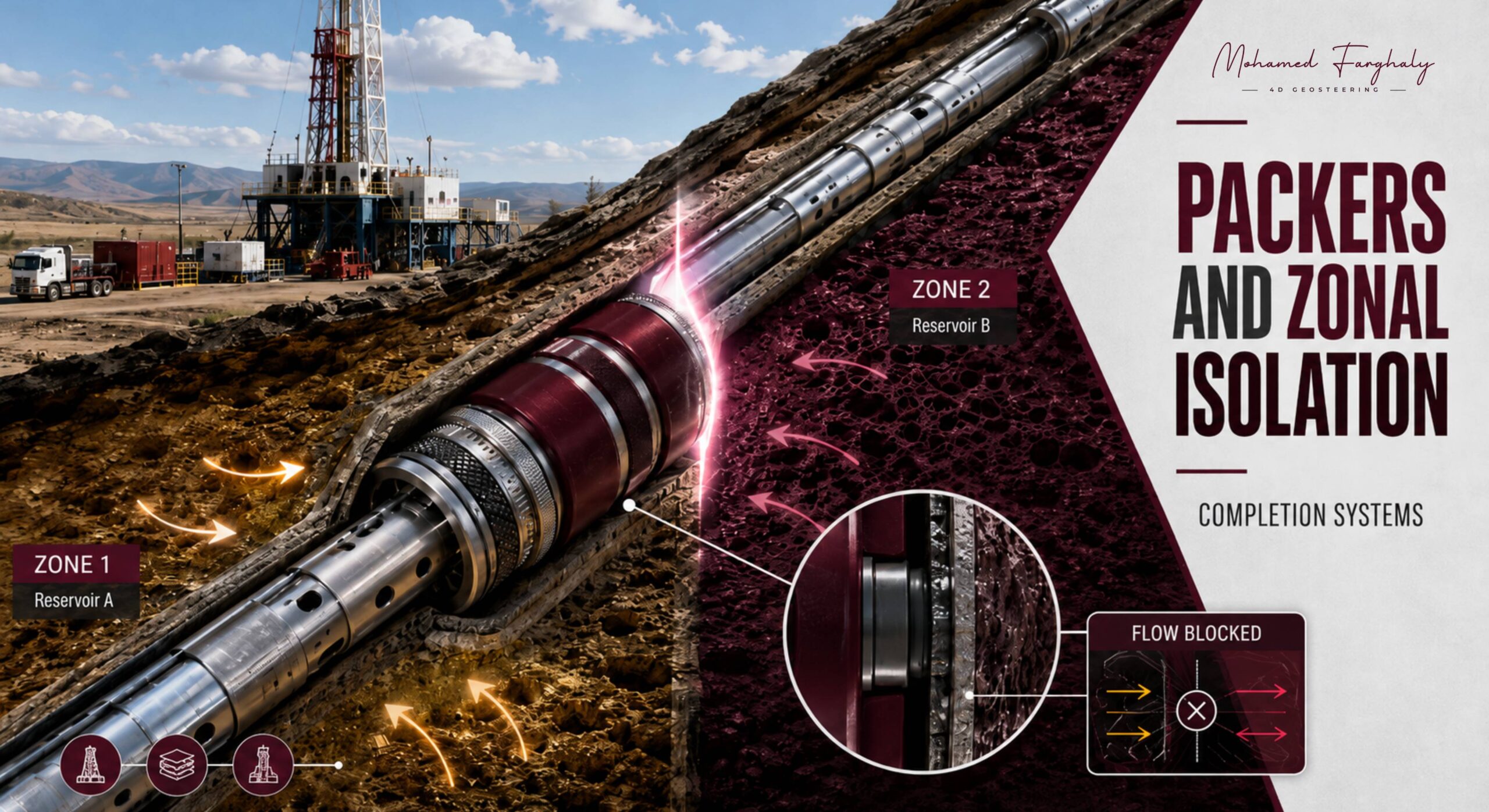
In horizontal and geosteered wells, reaching the target reservoir is only part of the challenge. After drilling, the completion system must help control how different sections of the well communicate with the reservoir. Packers and zonal isolation play a major role in achieving that control.
What Are Packers?
A packer is a downhole completion device designed to create a seal between the completion string and the wellbore or casing. Once set, the packer restricts fluid movement through the annular space.
Depending on the completion design, operators can use packers to separate different reservoir intervals, support production tubing, isolate unwanted zones, or improve pressure control.
Common types include:
- Production packers
- Open-hole packers
- Inflatable packers
- Swellable packers
- Hydraulic-set packers
- Mechanical-set packers
The selected type depends on the well architecture, formation conditions, pressure, temperature, completion objectives, and whether the interval is cased or open hole.
What Is Zonal Isolation?
Zonal isolation means preventing unwanted fluid communication between different sections of the reservoir or wellbore.
In a long horizontal well, geological properties can change considerably along the lateral. For example, one section may contain high-quality reservoir rock while another interval may have higher water saturation, different pressure, fractures, or poorer permeability.
Therefore, completion engineers may divide the horizontal section into several isolated zones.
Packers create physical barriers between these zones. Additional completion equipment, such as sliding sleeves, inflow control devices, valves, or stimulation ports, can then control how each interval communicates with the well.
Packers in Horizontal and Geosteered Wells
Geosteering aims to keep the wellbore within the most valuable part of the reservoir. However, the final trajectory often crosses intervals with different reservoir properties.
Information gathered during geosteering, including gamma ray, resistivity, formation boundaries, structural interpretation, and reservoir quality, can support later completion planning.
For example, engineers may identify changes in reservoir quality or geological boundaries along the lateral. The completion team can then consider these variations when determining where isolation points and completion stages should be placed.
Consequently, geosteering interpretation and completion design can complement each other by connecting well placement with the reservoir intervals that will eventually contribute to production.
Why Zonal Isolation Matters
Effective zonal isolation can provide several operational advantages. It can help:
- Separate reservoir intervals
- Reduce unwanted water or gas contribution
- Improve stimulation control
- Manage production from different zones
- Support selective treatment or intervention
- Limit communication between zones with different pressures
- Improve reservoir management throughout the well life
In multistage completions, isolation becomes especially important because engineers may need to stimulate or produce individual sections independently.
Packers as Part of Completion Strategy
Packers are not simply mechanical barriers. Their placement forms part of the overall completion strategy.
The completion team must consider the well trajectory, reservoir architecture, fractures, pressure differences, formation quality, expected production behavior, and future intervention requirements.
As a result, successful zonal isolation links well placement, reservoir understanding, and completion engineering. In geosteered horizontal wells, this integration helps convert an accurately placed wellbore into a completion that can effectively manage reservoir contribution along the lateral.
🔗 Keywords
Drilling Rig, Drilling Mud, MWD, LWD, Directional Drilling, Geosteering, Well Placement, Oil Reservoir, Surface Logging, Borehole Imaging, Electromagnetic Resistivity LWD Tool, Bottom Hole Assembly, Study of Real-Time LWD Data, LWD Interpretation, Borehole Image Log, Dip Calculation Methods, Shale Gas Sweet Spot, Accurate Reservoir Boundary Detection, Machine Learning, Artificial Intelligence, The Future of Automated Geosteering, Ensemble-Based Well Log Interpretation, Digital Twins in Drilling, Remote Operations Centers
