Swellable packers
July 4, 2023· 3 minutes reading
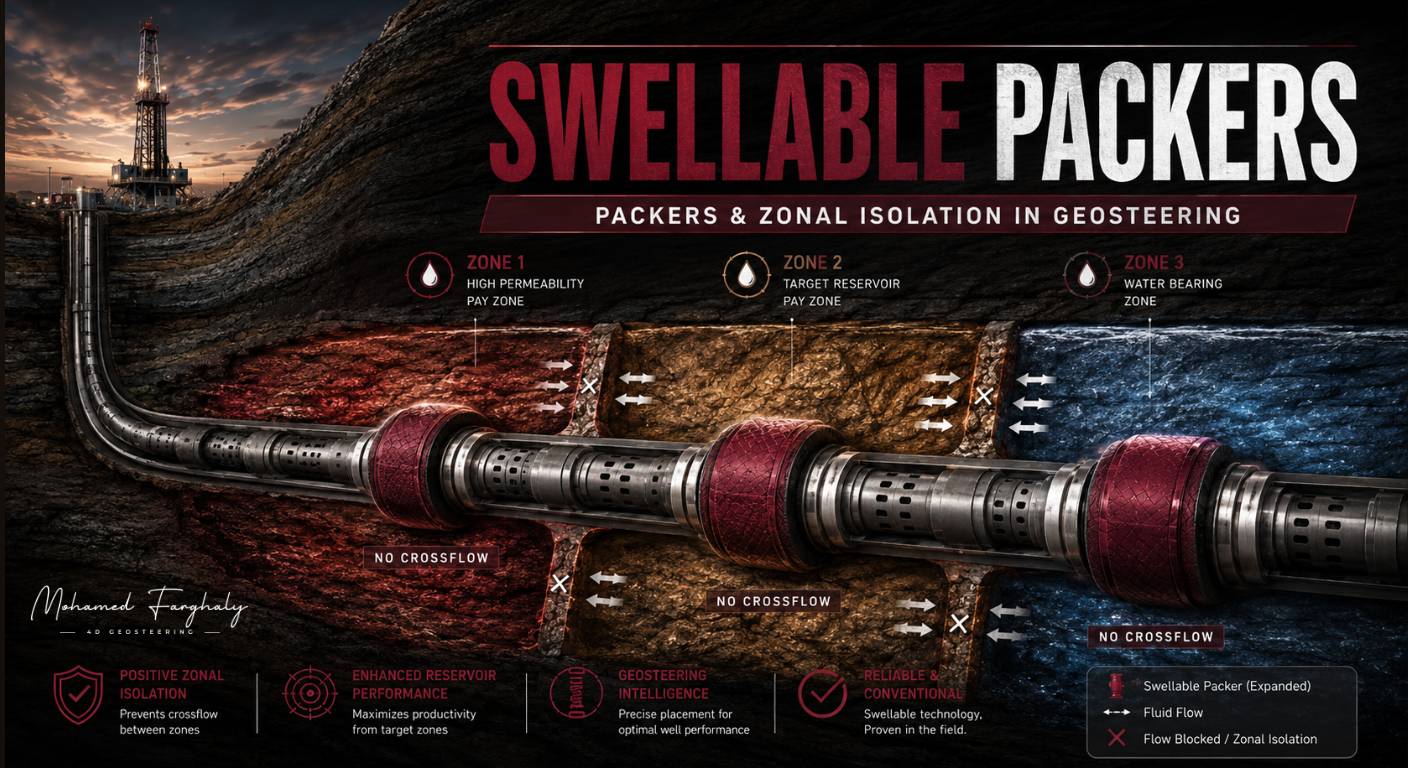
Swellable packers are completion tools designed to create zonal isolation inside a wellbore without requiring complex mechanical or hydraulic activation. They contain an elastomer material that expands when it contacts specific well fluids, such as oil, water, or specially designed activation fluids.
As the elastomer swells, the packer gradually increases in diameter until it contacts the surrounding casing or open-hole formation. This contact creates a seal that restricts fluid movement between different reservoir intervals.
In horizontal and geosteered wells, this isolation becomes especially important because the well may pass through several geological layers or reservoir compartments.
How Do Swellable Packers Work?
A swellable packer usually consists of a base pipe covered with an engineered elastomer. During installation, the packer maintains a relatively small diameter, which allows the completion string to move through the wellbore.
After reaching the required depth, the elastomer interacts with the selected fluid and starts expanding. The swelling process develops progressively rather than instantly, allowing the completion team enough time to position the equipment correctly.
Eventually, the expanded element presses against the wellbore or casing and forms an annular seal.
The swelling rate depends on several factors, including:
- Fluid composition
- Downhole temperature
- Elastomer type
- Wellbore geometry
- Exposure time
- Pressure conditions
Therefore, engineers select the packer material according to the expected downhole environment.
Swellable Packers and Zonal Isolation
Effective zonal isolation prevents unwanted communication between different sections of the reservoir. Swellable packers can divide a long horizontal well into separate completion zones.
For example, a geosteered lateral may encounter intervals with different permeability, pressure, water saturation, or reservoir quality. Packers placed at strategic positions can isolate these sections.
Consequently, operators gain better control over how fluids enter or leave individual zones.
Swellable packers can also help reduce unwanted water or gas movement between reservoir sections while supporting selective stimulation and production strategies.
Why Are Swellable Packers Relevant to Geosteered Wells?
Geosteering aims to keep the well trajectory within the most valuable part of the reservoir. However, accurate well placement is only one part of maximizing reservoir contact.
After drilling, the completion system must manage the different geological intervals encountered along the lateral.
Geosteering data can help identify where reservoir properties, boundaries, or fluid characteristics change. Completion engineers can use this geological understanding when selecting suitable locations for zonal isolation equipment.
Therefore, swellable packers connect drilling-stage reservoir knowledge with completion-stage flow control.
Key Advantages of Swellable Packers
Swellable packers offer a relatively simple isolation method because they do not depend on complicated mechanical setting operations. In addition, they can conform to irregular open-hole surfaces as the elastomer expands.
Their compact running diameter can also simplify installation in long horizontal sections.
However, successful application requires proper packer selection, accurate placement, and careful evaluation of temperature, fluids, swelling time, and wellbore conditions.
When engineers combine these factors with geosteering and reservoir interpretation, swellable packers can provide effective zonal isolation throughout complex horizontal completions.
🔗 Keywords
Drilling Rig, Drilling Mud, MWD, LWD, Directional Drilling, Geosteering, Well Placement, Oil Reservoir, Surface Logging, Borehole Imaging, Electromagnetic Resistivity LWD Tool, Bottom Hole Assembly, Study of Real-Time LWD Data, LWD Interpretation, Borehole Image Log, Dip Calculation Methods, Shale Gas Sweet Spot, Accurate Reservoir Boundary Detection, Machine Learning, Artificial Intelligence, The Future of Automated Geosteering, Ensemble-Based Well Log Interpretation, Digital Twins in Drilling, Remote Operations Centers
