Installation Methods: Placing Packers for Reliable Zonal Isolation
July 7, 2023· 2 minutes reading
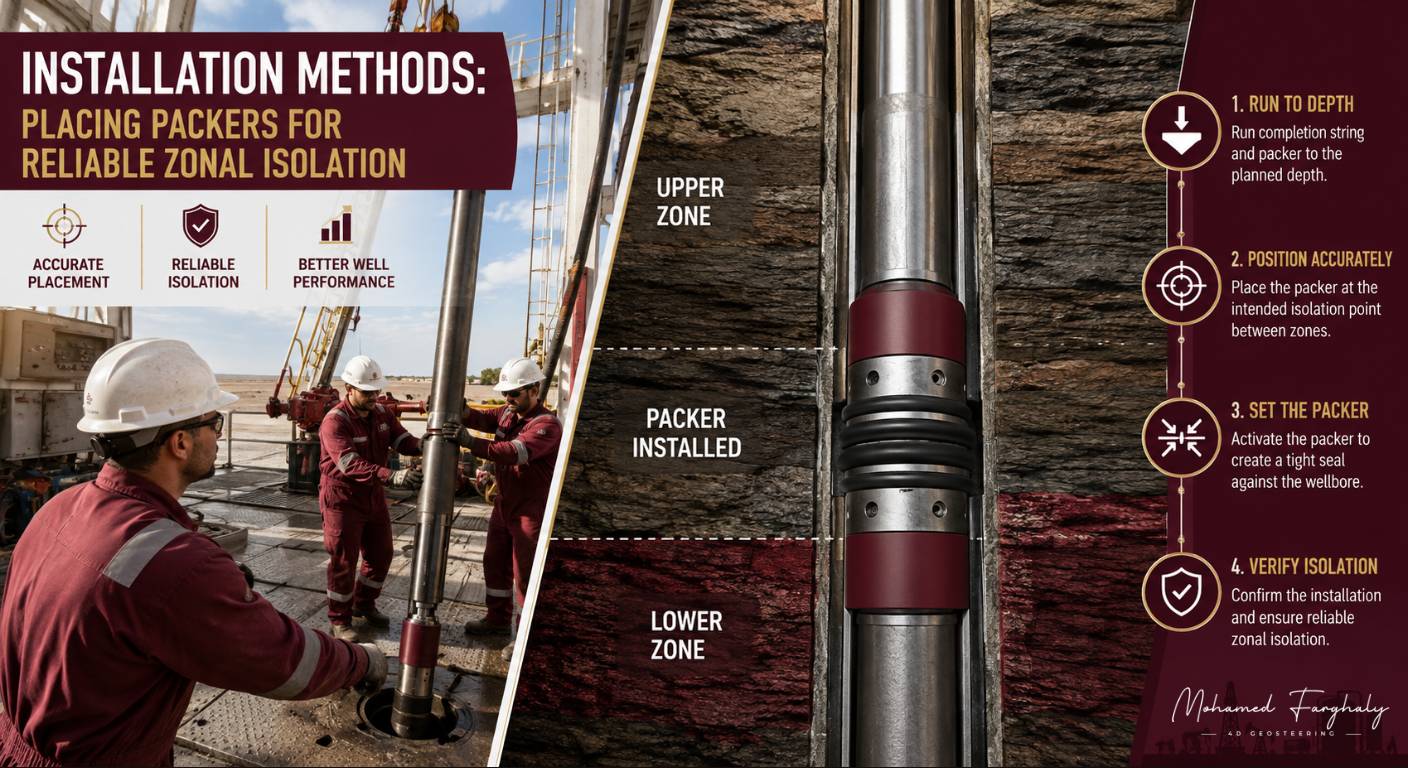
Successful packer installation methods in zonal isolation depend on placing each packer at the correct depth and in the right wellbore section. Accurate installation helps the completion isolate the planned reservoir intervals effectively.
In geosteered wells, this becomes especially important because the well may pass close to formation boundaries or extend through long horizontal sections. The final installation points should match the actual well trajectory and geological interpretation.
Preparing the Wellbore
Before installation, engineers review the well trajectory, hole condition, completion design, and planned isolation depths.
They also check for restrictions, irregular hole sections, debris, or other conditions that could make it difficult to run the completion equipment to depth.
In horizontal wells, friction, doglegs, and long lateral sections can make this stage more challenging.
Running Packers to Depth
Packers are typically run downhole as part of the completion string.
During this stage, the team carefully monitors depth and movement to make sure the equipment reaches the planned position without damage or obstruction.
Depth correlation is critical. The installation depth should match the geological and completion references used during planning.
In geosteered wells, final drilling information may also help confirm whether the planned packer positions still align with the actual reservoir structure.
Positioning Between Reservoir Zones
When several packers are used, spacing between them becomes important.
Each packer should sit at the correct location so the completion divides the well into the intended reservoir intervals. Placement errors can become more significant in thin formations or complex horizontal wells.
Connecting Installation With Geosteering
Good installation connects three important elements:
the final well path, the geological interpretation, and the completion design.
Geosteering helps place the well inside the target reservoir, while accurate packer installation methods in zonal isolation help ensure that the completion follows the same subsurface strategy.
🔗 Keywords
Drilling Rig, Drilling Mud, MWD, LWD, Directional Drilling, Geosteering, Well Placement, Oil Reservoir, Surface Logging, Borehole Imaging, Electromagnetic Resistivity LWD Tool, Bottom Hole Assembly, Study of Real-Time LWD Data, LWD Interpretation, Borehole Image Log, Dip Calculation Methods, Shale Gas Sweet Spot, Accurate Reservoir Boundary Detection, Machine Learning, Artificial Intelligence, The Future of Automated Geosteering, Ensemble-Based Well Log Interpretation, Digital Twins in Drilling, Remote Operations Centers
