Primary and secondary well control barriers
August 2, 2023· 2 minutes reading
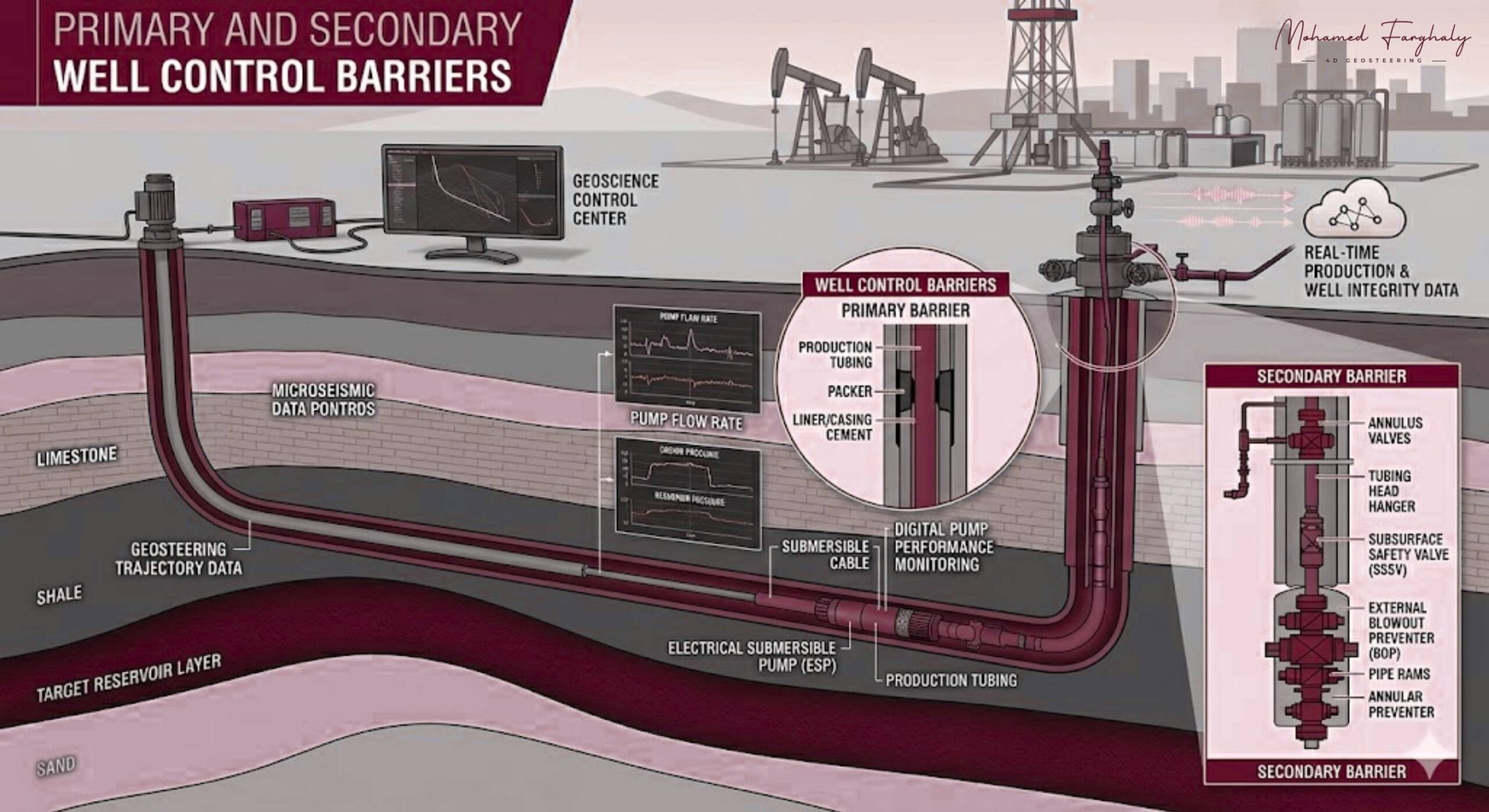
Maintaining well integrity and pressure control is essential in oil and gas production, especially when using artificial lift systems in complex reservoirs. Artificial lift methods such as Electrical Submersible Pumps (ESP), Gas Lift, and Rod Pumps help increase hydrocarbon production when natural reservoir pressure declines.
To ensure safe operations, wells rely on primary and secondary well control barriers. These barriers prevent uncontrolled fluid movement and protect the well throughout its production life. When combined with geosteering, they help improve well placement, completion decisions, and overall production efficiency.
Primary Well Control Barrier in Artificial Lift Systems
The primary well control barrier is the first layer of protection that prevents formation fluids from flowing outside the controlled production path. In artificial lift wells, this barrier is mainly provided by the completion system, including production tubing, packers, completion fluids, valves, and wellhead equipment.
The primary barrier must handle reservoir pressure, production flow, and the additional pressure effects created by artificial lift operations. For example, in an ESP system, the tubing and completion components maintain controlled fluid movement while the pump increases the flow of hydrocarbons toward the surface. In gas lift operations, the production tubing and valves must safely manage injected gas and changing pressure conditions.
Secondary Well Control Barrier in Artificial Lift Systems
The secondary well control barrier provides backup protection if the primary barrier fails or becomes unreliable. It ensures that the well remains controlled during unexpected events or intervention activities.
During artificial lift maintenance, such as replacing an ESP or performing a workover, the primary barrier may be temporarily affected. In these situations, secondary barriers such as wellhead valves, safety valves, and pressure control equipment provide additional protection against unwanted fluid flow.
The Role of Geosteering in Well Barrier Performance
Although geosteering focuses on keeping the wellbore within the target reservoir, it also supports well integrity and artificial lift performance. Real-time formation evaluation data helps engineers avoid unwanted zones, reduce water or gas production, and optimize completion placement.
Accurate well placement improves reservoir contact and provides better information about formation changes, fluid contacts, and pressure variations. This allows engineers to select suitable artificial lift systems and operate them more safely.
By integrating geosteering, artificial lift technology, and barrier management, operators can improve production while reducing risks related to pressure control and well integrity.
🔗 Keywords
Drilling Rig, Drilling Mud, MWD, LWD, Directional Drilling, Geosteering, Well Placement, Oil Reservoir, Surface Logging, Borehole Imaging, Electromagnetic Resistivity LWD Tool, Bottom Hole Assembly, Study of Real-Time LWD Data, LWD Interpretation, Borehole Image Log, Dip Calculation Methods, Shale Gas Sweet Spot, Accurate Reservoir Boundary Detection, Machine Learning, Artificial Intelligence, The Future of Automated Geosteering, Ensemble-Based Well Log Interpretation, Digital Twins in Drilling, Remote Operations Centers