Real-Time Pressure Monitoring in Well Control
August 3, 2023· 3 minutes reading
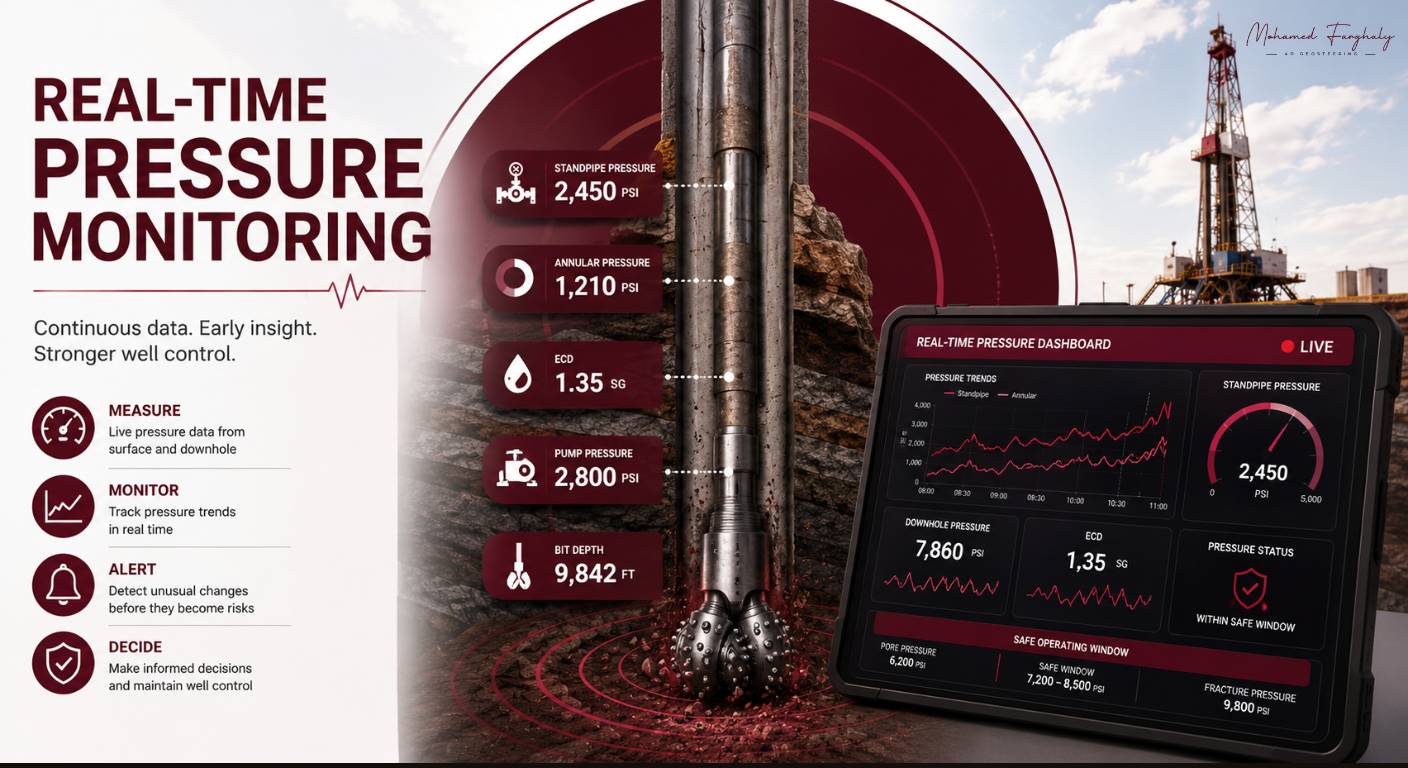
Pressure conditions inside a well can change quickly during drilling. When those changes happen, drilling teams need reliable information as early as possible.
Real-time pressure monitoring gives engineers a continuous view of how pressure behaves during operations. Instead of depending only on individual readings, teams can follow pressure trends, compare them with expected conditions, and recognize unusual behavior as it develops.
This continuous awareness is especially important in complex, highly deviated, and horizontal wells, where surface measurements may not always represent the exact conditions occurring downhole.
What Real-Time Pressure Monitoring Shows
Real-time pressure monitoring uses surface sensors and, when available, downhole measurements to track the pressure response of the drilling system.
Common parameters include:
- Standpipe pressure
- Annular pressure
- Downhole pressure
- Pump pressure
- Equivalent circulating density (ECD)
- Pressure changes during circulation
A single pressure reading provides useful information, but the trend is often more important than the number itself.
For example, pressure may increase gradually, fall unexpectedly, or begin fluctuating differently from its normal pattern. These changes can indicate that wellbore or circulation conditions are changing.
Engineers therefore compare current measurements with previous trends and expected operating behavior.
An unexpected increase in pressure may result from higher flow resistance, changes in circulation, cuttings accumulation, or restrictions in the wellbore.
A pressure decrease may indicate changes in fluid circulation or other operating conditions.
Not every pressure change represents a well-control event. Pump adjustments, connections, changes in flow rate, drilling activity, and fluid properties can all influence pressure. For this reason, engineers interpret pressure data together with the overall drilling operation.
Why Real-Time Pressure Monitoring Matters
The main advantage of real-time pressure monitoring is earlier awareness.
When engineers can see pressure behavior continuously, they can recognize when the well begins moving away from expected conditions. This gives the drilling team more information for evaluating what is happening downhole.
Modern monitoring systems can display pressure information through live trends, digital gauges, alarms, and operating limits. These tools make unusual behavior easier to recognize and allow teams to compare current conditions with established expectations.
Downhole measurements can add another level of understanding. They provide information closer to the bit and formation, which becomes particularly useful in long horizontal sections where pressure at depth may differ from what surface readings suggest.
Real-time pressure monitoring therefore turns pressure from a single measurement into a continuous picture of well behavior.
By following pressure trends, recognizing deviations, and combining surface and downhole information, drilling teams gain better situational awareness and can make more informed decisions throughout the operation.g professionals can make more informed decisions and maintain greater awareness of the well throughout the operation.
🔗 Keywords
Drilling Rig, Drilling Mud, MWD, LWD, Directional Drilling, Geosteering, Well Placement, Oil Reservoir, Surface Logging, Borehole Imaging, Electromagnetic Resistivity LWD Tool, Bottom Hole Assembly, Study of Real-Time LWD Data, LWD Interpretation, Borehole Image Log, Dip Calculation Methods, Shale Gas Sweet Spot, Accurate Reservoir Boundary Detection, Machine Learning, Artificial Intelligence, The Future of Automated Geosteering, Ensemble-Based Well Log Interpretation, Digital Twins in Drilling, Remote Operations Centers
