Borehole Collapse Mechanisms in Wellbore Stability
August 4, 2023· 2 minutes reading
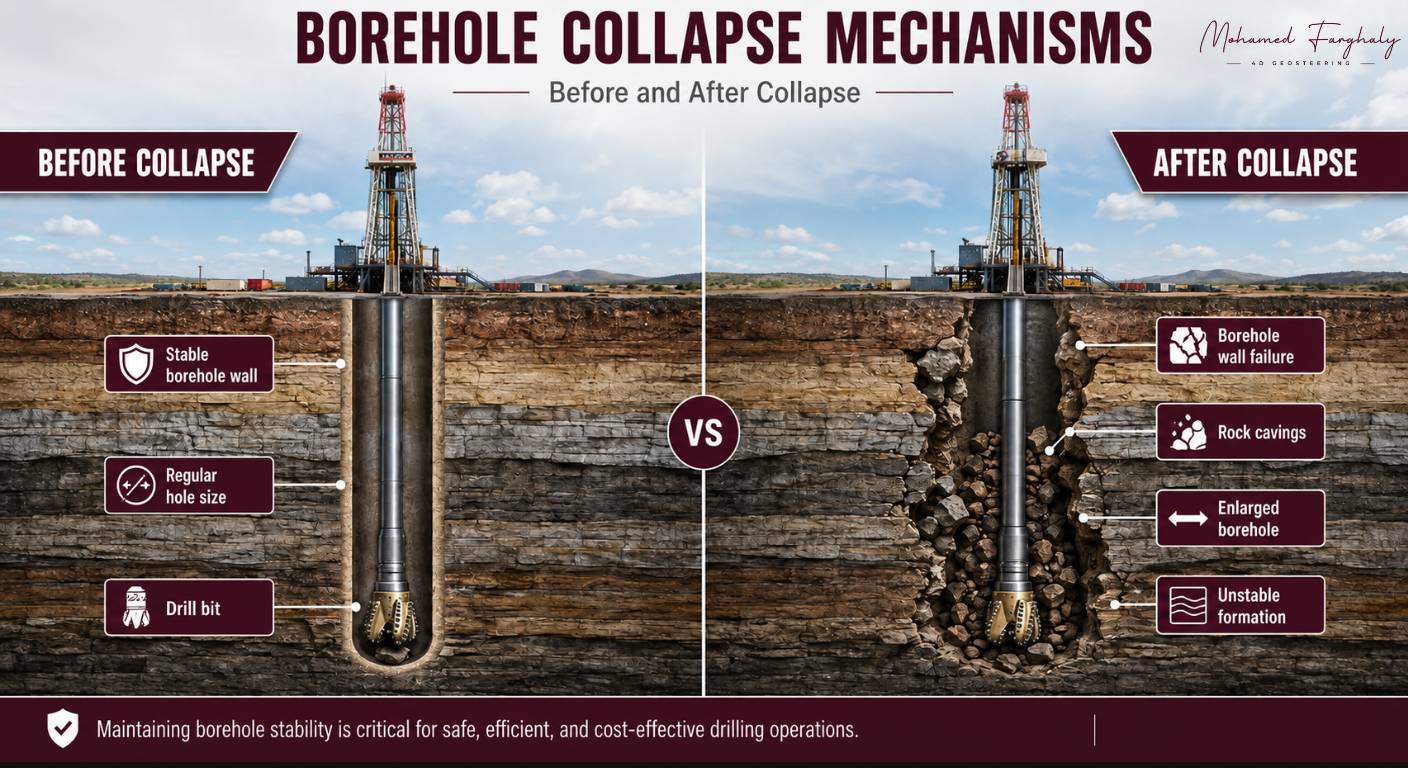
Borehole collapse mechanisms explain how and why the rock surrounding a wellbore can lose stability and fail inward during drilling. This type of failure can affect hole condition, drilling performance, and overall wellbore safety.
When a well is drilled, the original rock is removed and the natural stress balance around the formation changes. As a result, stresses become concentrated around the borehole wall. If these stresses exceed the strength of the surrounding rock, failure can begin.
How Borehole Collapse Develops
Borehole collapse usually starts when the formation around the well experiences excessive compressive stress. The rock may first deform or develop small fractures. Then, as drilling continues, these fractures can grow and cause pieces of the borehole wall to break away.
Several formation conditions can make this process more likely. Weak rock, naturally fractured zones, poor cementation, and high stress concentration can all reduce the ability of the borehole wall to remain intact.
In some cases, the failure develops gradually. Small cavings may appear at first, followed by larger fragments. In more severe conditions, the borehole shape can become highly irregular or enlarged.
The direction of the well can also influence collapse behavior because the borehole interacts differently with the surrounding stress field at different inclinations and azimuths.
What Borehole Collapse Means During Drilling
When rock breaks away from the borehole wall, fragments can enter the well and interfere with drilling operations. These cavings may accumulate around the drillstring, increase drag, and make hole cleaning more difficult.
As instability becomes more severe, the drillstring may experience restricted movement. In addition, the effective borehole diameter can change, which may complicate logging, casing operations, and other downhole activities.
Drilling teams often look for warning signs such as unusual cavings, increased torque and drag, poor hole condition, or repeated difficulties while moving the drillstring.
Understanding borehole collapse mechanisms helps engineers recognize how rock failure develops around the well. This knowledge supports earlier identification of unstable intervals and better decisions to maintain a more stable and efficient drilling operation.
🔗 Keywords
Drilling Rig, Drilling Mud, MWD, LWD, Directional Drilling, Geosteering, Well Placement, Oil Reservoir, Surface Logging, Borehole Imaging, Electromagnetic Resistivity LWD Tool, Bottom Hole Assembly, Study of Real-Time LWD Data, LWD Interpretation, Borehole Image Log, Dip Calculation Methods, Shale Gas Sweet Spot, Accurate Reservoir Boundary Detection, Machine Learning, Artificial Intelligence, The Future of Automated Geosteering, Ensemble-Based Well Log Interpretation, Digital Twins in Drilling, Remote Operations Centers
