Mechanical vs Chemical Instability: What Is Really Destabilizing the Wellbore?
August 4, 2023· 2 minutes reading
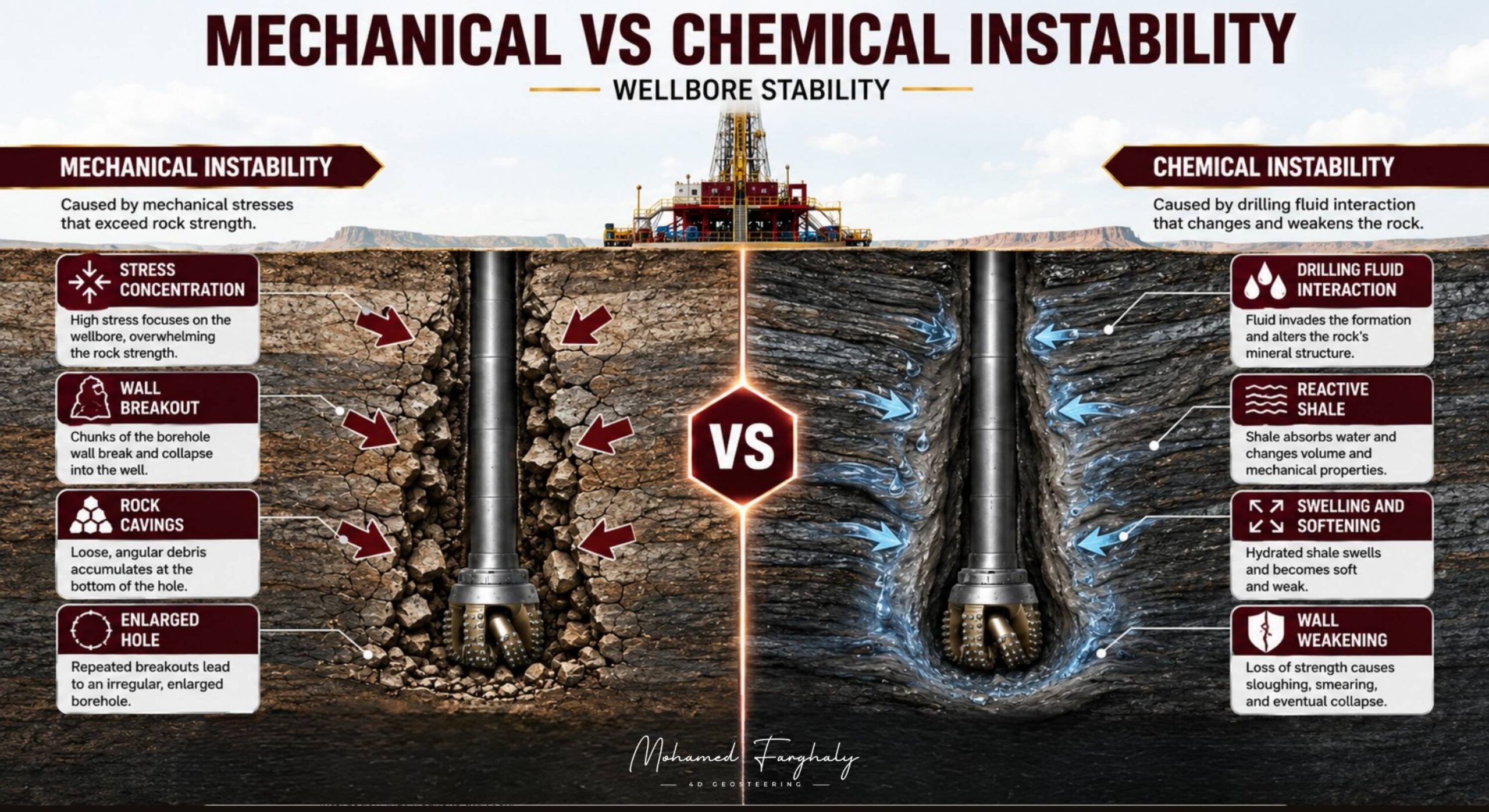
A borehole starts deteriorating. Cavings appear at surface. Torque increases. The hole becomes harder to manage.
But what is actually causing the instability?
Is the formation failing because stresses around the borehole exceed the rock strength?
Or is the drilling fluid interacting with the formation and slowly weakening it?
Understanding mechanical vs chemical instability is important because two problems that look similar at the rig can develop for completely different reasons.
Mechanical Instability: When the Rock Cannot Handle the Stress
Drilling a well removes rock that previously supported the surrounding formation. Immediately, stresses redistribute around the new borehole.
If those stresses become greater than the formation strength, the borehole wall can begin to fail.
Mechanical instability may appear as:
- Borehole breakouts
- Large or angular cavings
- Hole enlargement
- Increased torque and drag
- Tight-hole conditions
Well trajectory can make a major difference. Inclination and azimuth determine how the borehole interacts with the principal stresses underground.
That means where and how you drill can influence whether the formation remains stable.
Chemical Instability: When the Rock Begins to Change
Chemical instability works differently.
Instead of stress alone breaking the rock, the problem begins with the interaction between the formation and drilling fluid.
Reactive shales are a common example. When certain clay minerals interact with incompatible fluids, they may absorb water, swell, soften, or disperse.
The dangerous part?
The formation may look stable at first.
However, as exposure continues, the rock can gradually lose strength until the borehole wall starts deteriorating.
| Mechanical Instability | Chemical Instability |
|---|---|
| Stress-driven failure | Fluid-rock interaction |
| Controlled strongly by rock strength and stresses | Controlled strongly by mineralogy and fluid chemistry |
| Breakouts and fractures may develop | Swelling, softening and dispersion may develop |
| Well orientation can strongly influence risk | Exposure time can strongly influence risk |
And sometimes the answer is both.
Chemical reactions may weaken the formation first. Then mechanical stresses act on that weakened rock and accelerate failure.
That is why identifying the real instability mechanism matters.
The same symptom does not always mean the same problem—and understanding the difference can completely change the drilling response.
🔗 Keywords
Drilling Rig, Drilling Mud, MWD, LWD, Directional Drilling, Geosteering, Well Placement, Oil Reservoir, Surface Logging, Borehole Imaging, Electromagnetic Resistivity LWD Tool, Bottom Hole Assembly, Study of Real-Time LWD Data, LWD Interpretation, Borehole Image Log, Dip Calculation Methods, Shale Gas Sweet Spot, Accurate Reservoir Boundary Detection, Machine Learning, Artificial Intelligence, The Future of Automated Geosteering, Ensemble-Based Well Log Interpretation, Digital Twins in Drilling, Remote Operations Centers
