Stress Regime Analysis for Wellbore Stability
August 4, 2023· 2 minutes reading
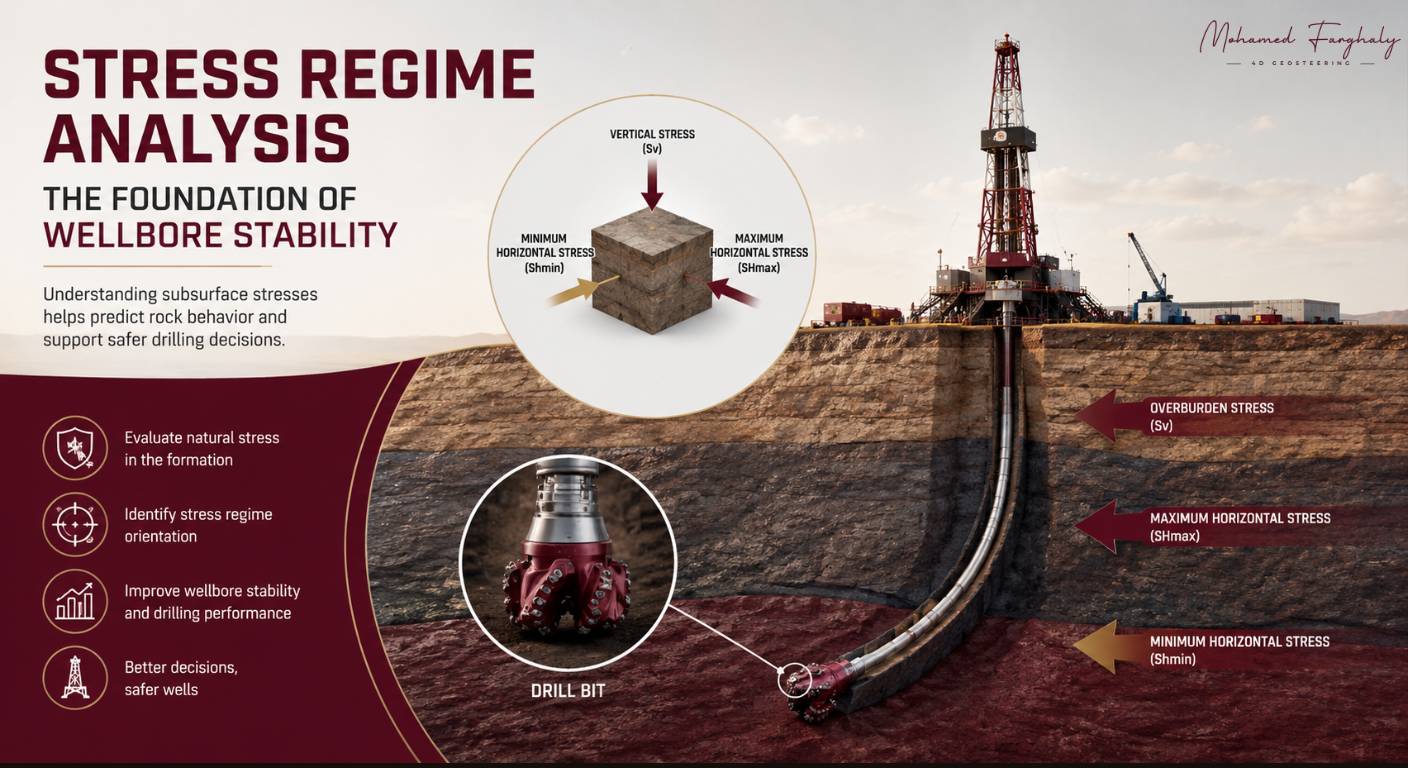
Stress regime analysis helps drilling teams understand how forces act on the rock surrounding a wellbore. Before drilling enters a formation, engineers need to know the magnitude and orientation of these stresses because they directly influence wellbore stability.
Underground formations experience three principal stresses: vertical stress, maximum horizontal stress, and minimum horizontal stress. Their relationship defines the local stress regime.
Why Stress Regime Analysis Matters
Drilling a well changes the natural stress distribution around the borehole. As a result, some sections of the formation may experience much higher stress concentrations than others.
Stress regime analysis allows engineers to evaluate these changes before and during drilling. They can combine formation properties, pressure information, well trajectory, and regional stress data to understand how the rock may respond.
This information also helps teams select a well orientation that reduces unnecessary stress around the borehole.
Using Stress Data for Better Wellbore Stability
Accurate stress information improves geomechanical models and supports better drilling decisions.
Engineers can use stress regime analysis to identify potentially challenging intervals and evaluate how different well trajectories interact with the surrounding formation.
In horizontal and highly deviated wells, this becomes especially important because borehole orientation changes its relationship with the principal stresses.
Therefore, a reliable understanding of the stress regime gives drilling teams a stronger foundation for maintaining wellbore stability and planning safer, more efficient well trajectories.
🔗 Keywords
Drilling Rig, Drilling Mud, MWD, LWD, Directional Drilling, Geosteering, Well Placement, Oil Reservoir, Surface Logging, Borehole Imaging, Electromagnetic Resistivity LWD Tool, Bottom Hole Assembly, Study of Real-Time LWD Data, LWD Interpretation, Borehole Image Log, Dip Calculation Methods, Shale Gas Sweet Spot, Accurate Reservoir Boundary Detection, Machine Learning, Artificial Intelligence, The Future of Automated Geosteering, Ensemble-Based Well Log Interpretation, Digital Twins in Drilling, Remote Operations Centers
