Drilling Margin Concepts: Understanding the Safe Drilling Window
August 5, 2023· 3 minutes reading
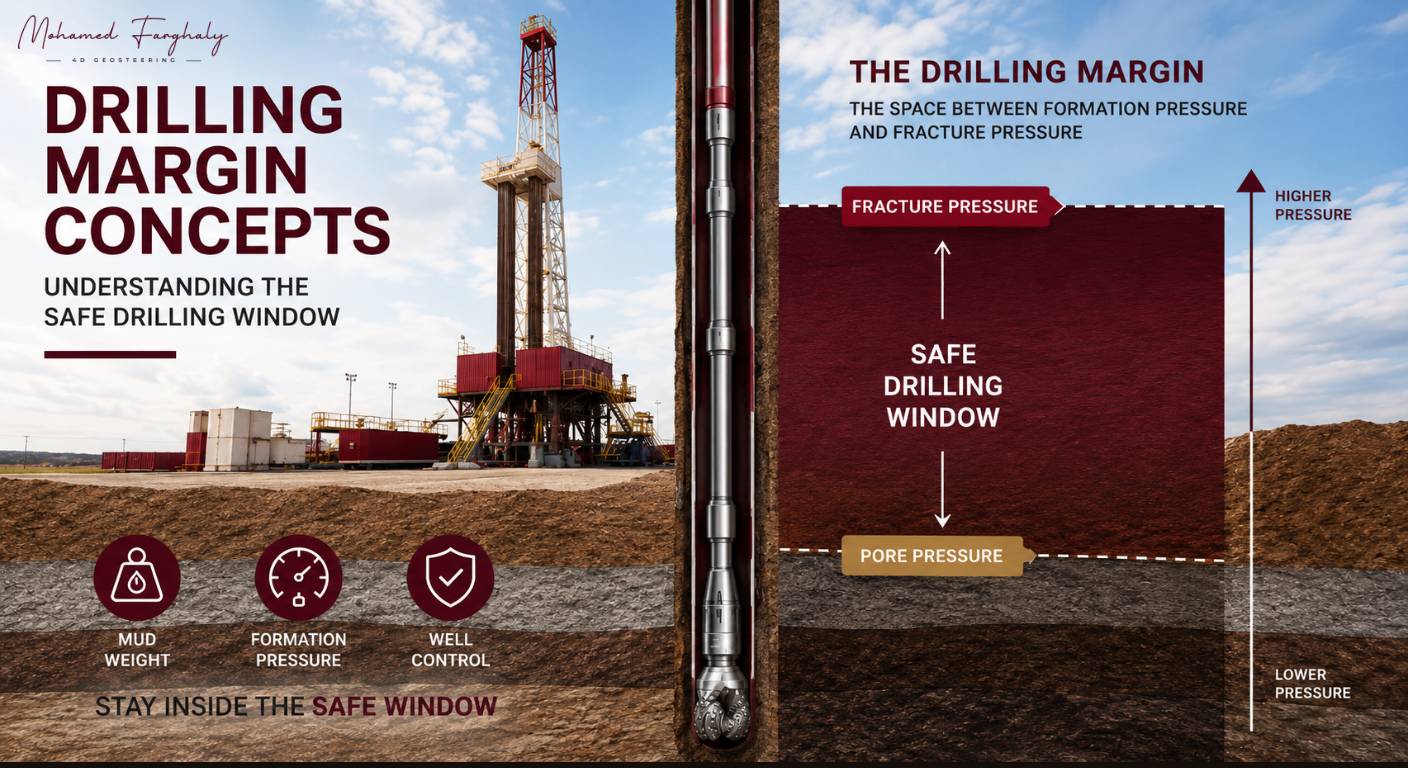
Drilling a well requires more than simply reaching the planned depth. Engineers must keep the well within a safe pressure range throughout the drilling process. Drilling margin concepts help define this operating range and show how much room exists between important formation pressure limits.
Understanding this margin becomes increasingly important when drilling complex, highly deviated, or horizontal wells where the safe operating window can become narrow.
What Is a Drilling Margin?
A drilling margin represents the available pressure range in which drilling operations can continue safely.
Two important boundaries define this range:
- Pore pressure — the pressure of fluids inside the formation.
- Fracture pressure — the pressure at which the formation may begin to fracture.
The drilling fluid pressure should normally remain above the required lower pressure limit while staying below the formation’s fracture limit.
The difference between these boundaries creates the drilling pressure window.
A wider window provides more operating flexibility. A narrow window requires much tighter control of drilling conditions.
Why Drilling Margins Matter
As a well becomes deeper, geological conditions and formation pressures can change. This means the available drilling margin may also change along the well path.
Drilling teams therefore evaluate factors such as:
- mud weight,
- formation pressure,
- fracture gradient,
- well depth,
- inclination,
- annular friction losses,
- equivalent circulating density (ECD).
For example, increasing mud weight raises hydrostatic pressure inside the well. However, if the pressure becomes too high, the formation may approach its fracture limit.
The objective is to maintain enough pressure support without exceeding the upper boundary of the safe drilling window.
Drilling Margin in Deviated and Horizontal Wells
Drilling margin concepts become especially important in directional and horizontal wells.
Longer well sections can increase annular friction and affect equivalent circulating density. As a result, the effective pressure experienced by the formation while circulating may be higher than the static mud pressure.
Engineers must therefore consider both static and dynamic drilling conditions when evaluating the available margin.
Maintaining a Safe Operating Window
A clear understanding of the drilling margin helps drilling teams select operating parameters that remain compatible with formation limits.
When the pressure window becomes narrow, even relatively small changes in mud properties, circulation conditions, or drilling parameters can significantly reduce the available margin.
For this reason, drilling margin concepts are a fundamental part of well control planning. They provide a practical way to understand how close drilling operations are to the pressure limits of the formation and help teams maintain a safer and more stable drilling environment.
🔗 Keywords
Drilling Rig, Drilling Mud, MWD, LWD, Directional Drilling, Geosteering, Well Placement, Oil Reservoir, Surface Logging, Borehole Imaging, Electromagnetic Resistivity LWD Tool, Bottom Hole Assembly, Study of Real-Time LWD Data, LWD Interpretation, Borehole Image Log, Dip Calculation Methods, Shale Gas Sweet Spot, Accurate Reservoir Boundary Detection, Machine Learning, Artificial Intelligence, The Future of Automated Geosteering, Ensemble-Based Well Log Interpretation, Digital Twins in Drilling, Remote Operations Centers
