Water-based vs Oil-based Mud
Oct 2, 2023· 4 minutes reading
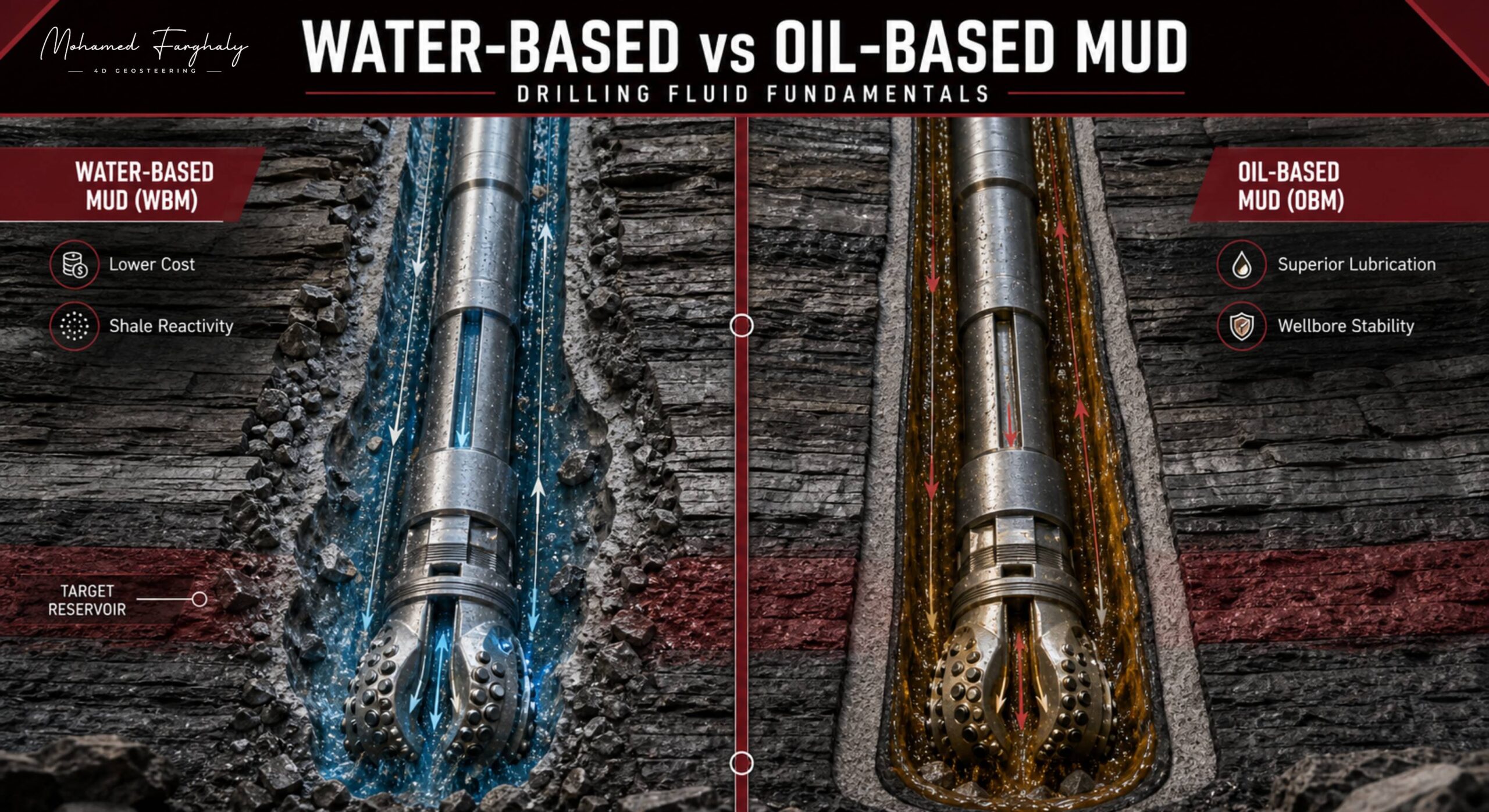
Drilling mud plays a vital role in safe and efficient oil and gas drilling. It carries cuttings to the surface, cools the drill bit, controls formation pressure, and protects the wellbore. However, drilling teams must choose the right mud system for each well.
Water-based mud (WBM) and oil-based mud (OBM) represent two of the most common options. Although both systems perform similar functions, they differ in composition, cost, environmental impact, and drilling performance.
What Is Water-Based Mud?
Water-based mud uses water as its continuous phase. Drilling engineers add clay, polymers, weighting materials, and other chemicals to control density, viscosity, fluid loss, and shale interaction.
First, WBM usually costs less than oil-based mud. In addition, crews can prepare, maintain, and dispose of it more easily. Therefore, many operators choose water-based drilling fluids for conventional wells and less-reactive formations.
However, water can react with sensitive shale. This interaction may cause swelling, dispersion, and wellbore instability. As a result, drilling teams often add shale inhibitors to improve performance and reduce operational risks.
What Is Oil-Based Mud?
Oil-based mud uses oil as its continuous phase and contains water droplets as an internal phase. Its formulation commonly includes emulsifiers, wetting agents, lime, weighting materials, and fluid-loss additives.
Most importantly, OBM provides excellent lubrication and shale inhibition. Moreover, it performs well under high temperatures and challenging downhole conditions. Consequently, operators often select it for deep wells, horizontal sections, reactive shale formations, and extended-reach drilling.
Nevertheless, oil-based mud costs more than WBM. It also requires careful handling, strict environmental controls, and specialized waste management. Therefore, drilling teams must compare its performance benefits with its total operational cost.
Water-Based Mud vs Oil-Based Mud
The following comparison highlights the main differences between water-based and oil-based drilling fluids:
| Comparison | Water-Based Mud | Oil-Based Mud |
|---|---|---|
| Continuous phase | Water | Oil |
| Typical cost | Lower | Higher |
| Environmental impact | Generally lower | Requires stricter controls |
| Lubrication | Moderate | Excellent |
| Shale inhibition | Moderate to good | Excellent |
| Temperature stability | Moderate | High |
| Wellbore stability | Depends on formation conditions | Strong in reactive formations |
| Waste management | Simpler | More complex |
| Common applications | Conventional wells | Deep, hot, horizontal, and complex wells |
How Do These Drilling Fluids Affect Performance?
Both mud systems support essential drilling operations. For example, they clean the hole, suspend solids, balance formation pressure, and reduce friction around the drilling assembly.
Water-based mud can deliver reliable performance at a relatively low cost. Furthermore, modern polymers and inhibitors can improve its ability to stabilize shale. However, highly reactive formations may still create problems.
In contrast, oil-based mud provides better lubrication and stronger wellbore protection. Consequently, it can reduce torque and drag in directional and horizontal wells. It may also improve the rate of penetration and lower the risk of stuck pipe.
How Does Drilling Mud Affect LWD and Geosteering?
Drilling mud can influence Logging While Drilling (LWD) measurements and real-time geosteering decisions. For instance, the fluid type may affect resistivity readings and borehole image quality.
Therefore, formation-evaluation teams must consider the drilling-fluid properties when they interpret downhole data. In addition, geosteering specialists should combine LWD responses with geological models, drilling parameters, and offset-well information. This integrated approach improves formation-boundary detection and well placement.
Which Drilling Mud Should You Choose?
Neither drilling fluid offers the best solution for every well. Instead, drilling engineers should evaluate the formation, well trajectory, temperature, pressure, environmental regulations, and project budget.
Water-based mud often provides the best option when operators prioritize lower costs, simpler maintenance, and easier waste management. On the other hand, oil-based mud usually performs better in reactive shale, high-temperature wells, and complex horizontal sections.
Ultimately, the right choice balances drilling performance, wellbore stability, environmental responsibility, and total well cost.
🔗 Keywords
Drilling Rig, Drilling Mud, MWD, LWD, Directional Drilling, Geosteering, Well Placement, Oil Reservoir, Surface Logging, Borehole Imaging, Electromagnetic Resistivity LWD Tool, Bottom Hole Assembly, Study of Real-Time LWD Data, LWD Interpretation, Borehole Image Log, Dip Calculation Methods, Shale Gas Sweet Spot, Accurate Reservoir Boundary Detection, Machine Learning, Artificial Intelligence, The Future of Automated Geosteering, Ensemble-Based Well Log Interpretation, Digital Twins in Drilling, Remote Operations Centers