Formation Interaction with Drilling Fluids
Oct 3, 2023· 2 minutes reading
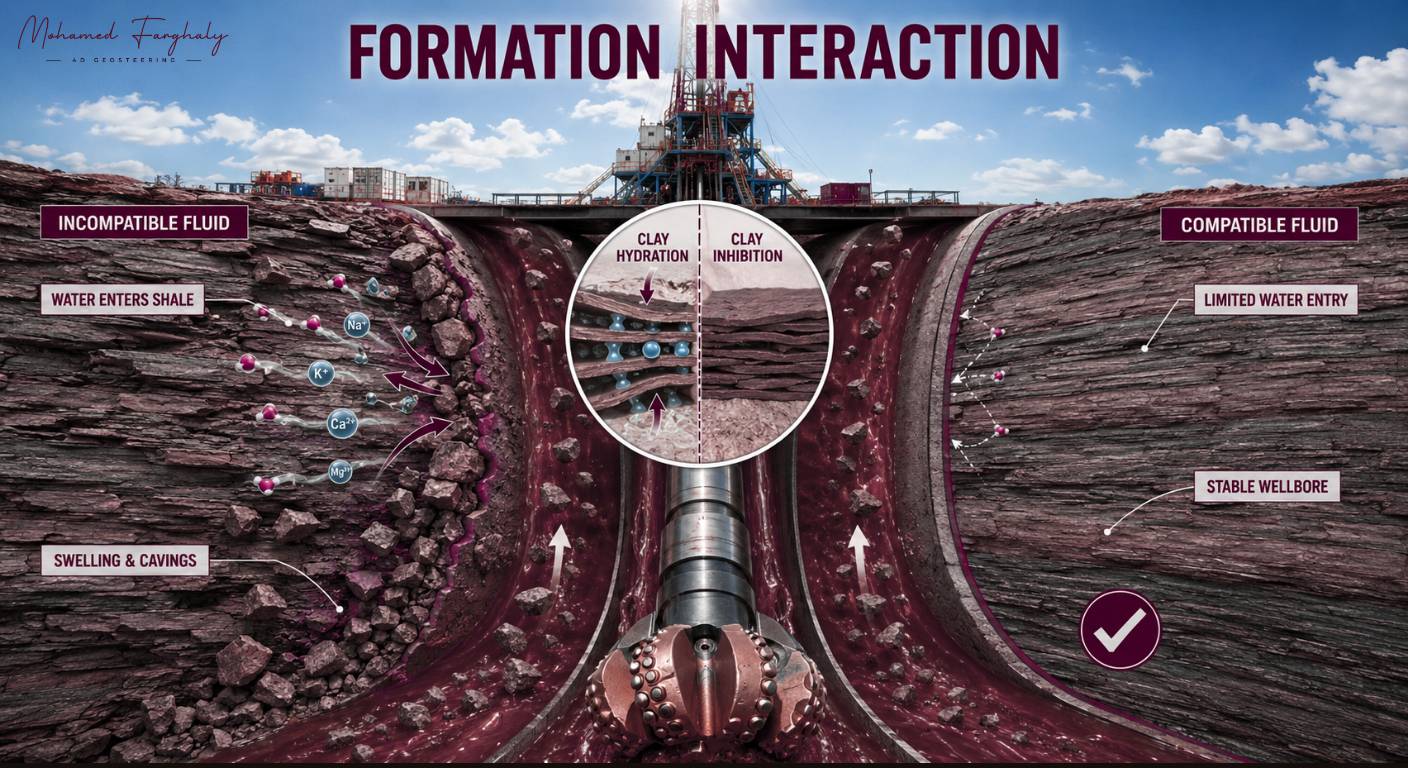
Formation interaction with drilling fluids begins as soon as the bit exposes fresh rock. From that moment, the fluid and formation can exchange water, ions, and chemical components. These reactions may alter the rock’s strength and change the condition of the wellbore.
Not every formation responds in the same way. Sandstone, carbonate, salt, and shale each have different mineral structures. However, reactive shale usually creates the greatest concern because its clay minerals can attract water and respond quickly to an incompatible fluid.
How Drilling Fluid Can Change the Formation
When water enters reactive clay, the clay may hydrate and expand. As a result, the shale can soften, swell, or break into small fragments. These changes can enlarge the hole, increase cavings, and create additional resistance around the drilling assembly.
Some clay particles may also disperse into the circulating fluid. Consequently, the rock loses cohesion while fine solids build up in the system. In severe cases, the wellbore may become irregular and difficult to clean.
Chemical differences can intensify this process. For example, a large imbalance between the salinity of the drilling fluid and the water inside the formation can encourage water movement. Temperature and exposure time also matter. Therefore, a formation may remain firm during fast drilling but weaken after prolonged contact.
Managing Fluid–Rock Compatibility
Engineers control formation interaction by designing a fluid that matches the expected mineralogy and downhole conditions. Inhibitive salts, encapsulating polymers, and other stabilizing additives can reduce water uptake and help clay particles remain intact.
However, the team must first understand the rock. Laboratory tests can expose shale samples to different fluid formulations and compare swelling, dispersion, hardness, and recovery. Therefore, engineers can select a system based on measured behavior instead of assumptions.
Monitoring continues while drilling. Changes in cutting shape, cavings volume, torque, drag, and hole condition may indicate that the formation has started reacting with the fluid. Moreover, surface samples can reveal whether the shale remains firm or breaks apart easily.
When these warning signs appear, the team can adjust the fluid’s chemistry, salinity, or inhibitor concentration. Early action often prevents a minor compatibility issue from becoming a major operational problem.
Ultimately, successful formation interaction management means keeping the exposed rock as close as possible to its original condition. A compatible drilling fluid limits damaging reactions, preserves rock strength, and supports a stable wellbore from the bit to the planned target.
🔗 Keywords
Drilling Rig, Drilling Mud, MWD, LWD, Directional Drilling, Geosteering, Well Placement, Oil Reservoir, Surface Logging, Borehole Imaging, Electromagnetic Resistivity LWD Tool, Bottom Hole Assembly, Study of Real-Time LWD Data, LWD Interpretation, Borehole Image Log, Dip Calculation Methods, Shale Gas Sweet Spot, Accurate Reservoir Boundary Detection, Machine Learning, Artificial Intelligence, The Future of Automated Geosteering, Ensemble-Based Well Log Interpretation, Digital Twins in Drilling, Remote Operations Centers
