The Drilling Mud
August 20, 2024 ·2 minutes reading
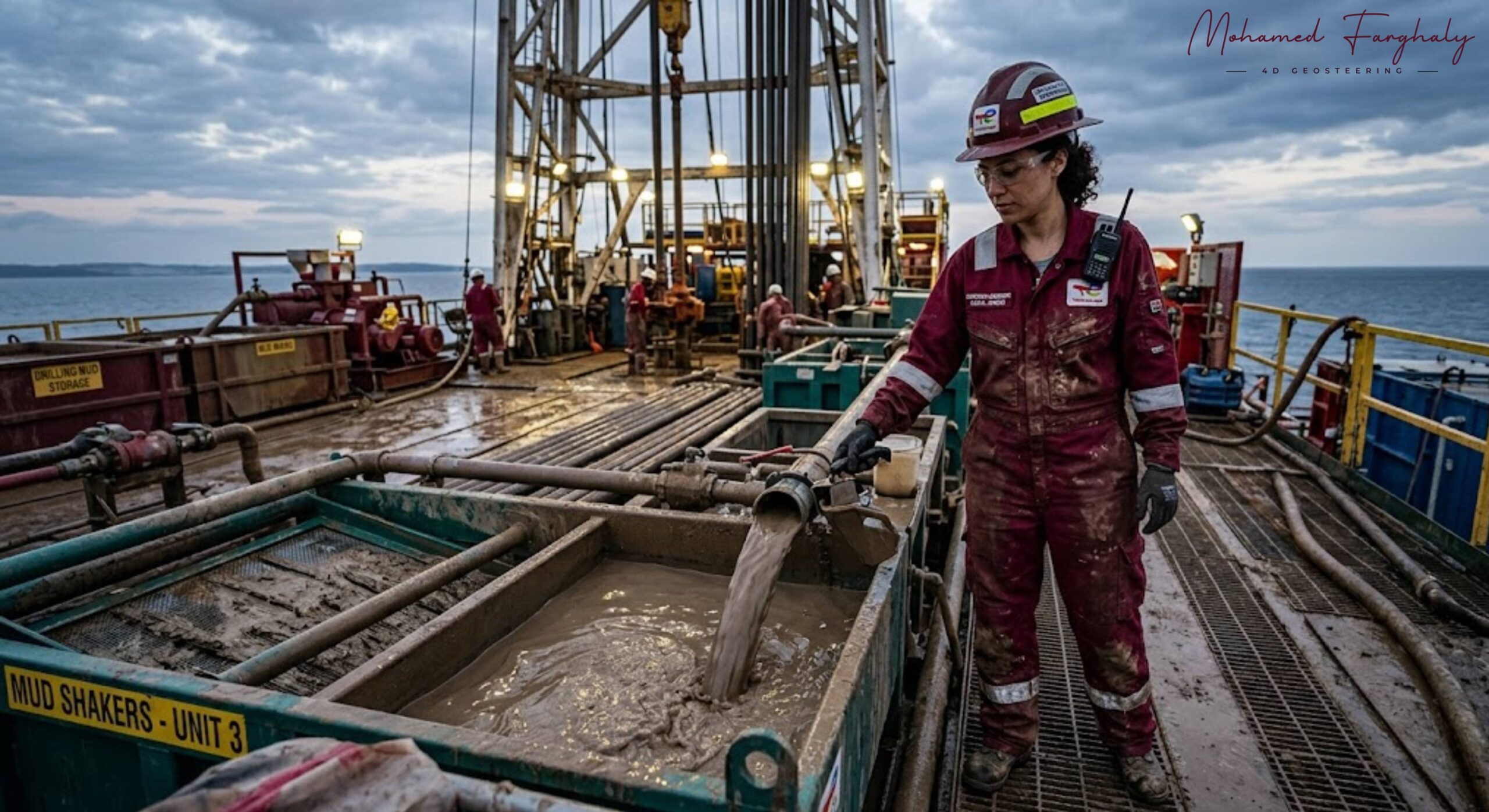
Many people think Drilling Mud is just “dirty fluid,” but in reality, it is a critical element that directly supports geosteering and safe drilling operations. In modern drilling, geosteering depends heavily on drilling mud performance because it is part of the hidden system that makes accurate geosteering possible from the very beginning to the final Well Placement stage.
Drilling mud is not just circulated—it is a carefully engineered system that controls pressure, stabilizes the wellbore, cools the drill bit, and transports cuttings to the surface. Without it, maintaining stable conditions for accurate geosteering would be impossible, especially in complex Directional Drilling operations targeting a specific Oil Reservoir zone.
Why is this important for geosteering?
Because geosteering depends on reliable downhole conditions and high-quality real-time data. Tools like MWD (Measurement While Drilling) and LWD (Logging While Drilling) require stable environments to provide accurate readings. Poor drilling mud performance can distort data, reduce LWD Interpretation quality, and directly decrease geosteering accuracy, leading to poor reservoir navigation during geosteering operations.
Every property of drilling mud is precisely controlled. Density maintains pressure balance, viscosity ensures effective cuttings transport, and chemical composition interacts with the formation. These factors directly influence the quality of real-time LWD Interpretation, Study of Real-Time LWD Data, and ultimately the success of geosteering decisions while drilling through the subsurface.
Drilling mud is also essential for preventing well control issues that could interrupt operations and force delays in geosteering adjustments. Continuous monitoring from the Drilling Rig, Bottom Hole Assembly (BHA), and Surface Logging systems ensures the mud system responds effectively to changing subsurface conditions, keeping geosteering on track.
Today, advanced technologies like Machine Learning, Artificial Intelligence, and Ensemble-Based Well Log Interpretation are being used to optimize drilling mud behavior and enhance real-time decision-making. This directly strengthens the Future of Automated Geosteering, improving accuracy, efficiency, and confidence in Well Placement inside the reservoir.
Even innovations like Digital Twins in Drilling and Remote Operations Centers are built around improving geosteering workflows, where drilling mud data plays a key role in simulation and real-time geosteering optimization.
In simple terms, drilling mud is not just a fluid—it is a key enabler of precise, stable, and successful geosteering, and without it, modern geosteering would not exist in its current advanced form.
🔗 Keywords
Drilling Rig, Drilling Mud, MWD, LWD, Directional Drilling, Geosteering, Well Placement, Oil Reservoir, Surface Logging, Borehole Imaging, Electromagnetic Resistivity LWD Tool, Bottom Hole Assembly, Study of Real-Time LWD Data, LWD Interpretation, Borehole Image Log, Dip Calculation Methods, Shale Gas Sweet Spot, Accurate Reservoir Boundary Detection, Machine Learning, Artificial Intelligence, The Future of Automated Geosteering, Ensemble-Based Well Log Interpretation, Digital Twins in Drilling, Remote Operations Centers