Mechanical vs Swellable Packers: Which Isolation Approach Fits the Well?
July 7, 2023· 2 minutes reading
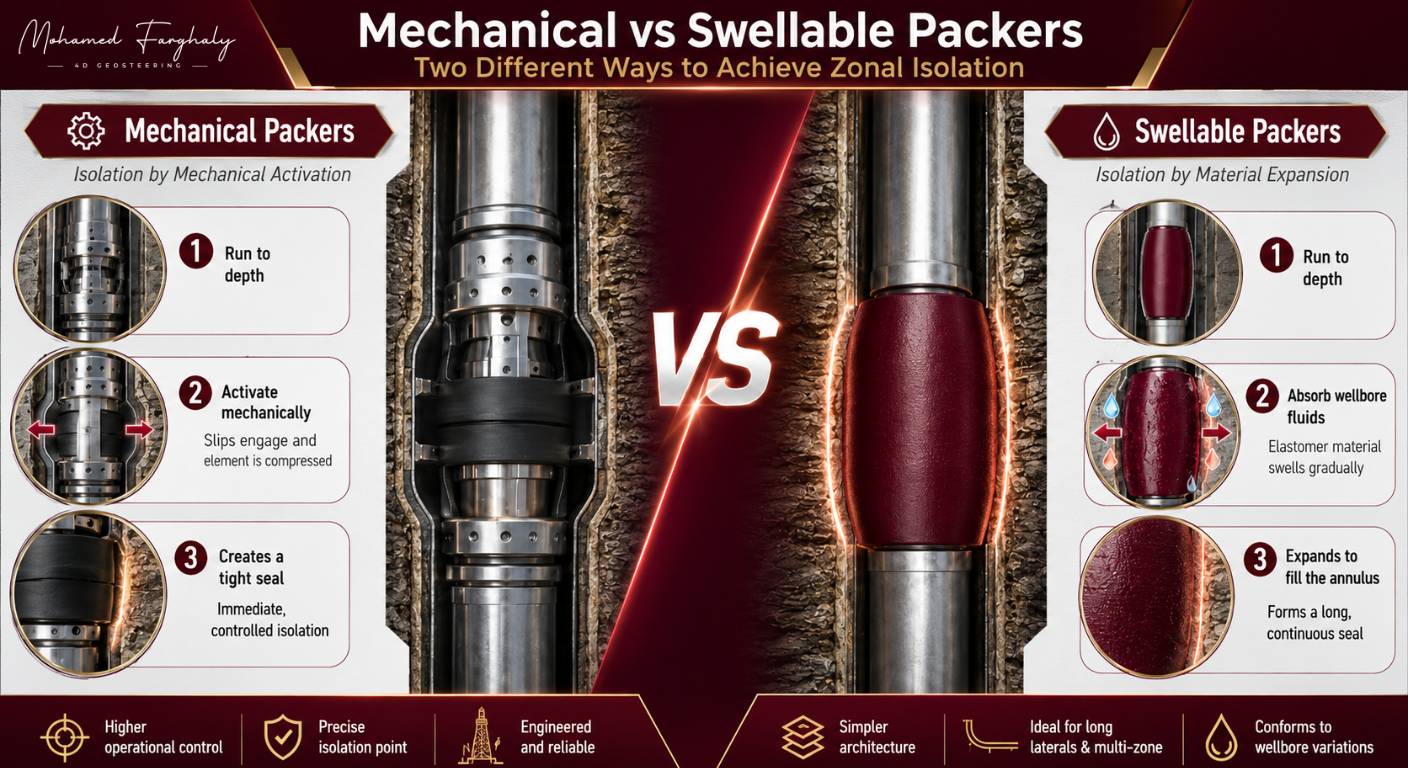
The mechanical vs swellable packers comparison is an important part of completion planning because each option offers a different balance of control, simplicity, and suitability for the well environment.
In geosteered wells, this decision becomes even more important. Long horizontal sections may cross changing reservoir properties, different geological intervals, and multiple planned isolation points. The packer type should therefore match both the completion objective and the actual well conditions.
| Comparison Factor | Mechanical Packers | Swellable Packers |
|---|---|---|
| Isolation approach | Provides a controlled, engineered isolation point | Provides passive isolation through material expansion |
| Operational control | Higher level of control | Lower intervention requirement |
| Completion complexity | Generally more complex | Generally simpler |
| Best suited for | Wells requiring precise, controlled isolation | Long laterals with multiple isolation intervals |
| Wellbore tolerance | Performs best where placement and geometry are well controlled | Can conform to variations in the surrounding annulus |
| Deployment strategy | Often selected for specific critical isolation points | Often attractive for repeated isolation along horizontal sections |
| Main advantage | Precision and operational control | Simplicity and efficient multi-zone isolation |
| Main consideration | More equipment and operational steps may be required | Performance depends strongly on compatibility with downhole conditions |
Which One Is Better?
There is no universal winner in the mechanical vs swellable packers comparison.
Mechanical packers generally offer more control and precision, while swellable packers can provide a simpler solution for extended multi-zone completions.
The better choice depends on the final well trajectory, reservoir architecture, completion objectives, wellbore conditions, and the level of operational control required.
In geosteered wells, the strongest completion strategy is the one that matches the isolation system to the actual reservoir position reached during drilling.
🔗 Keywords
Drilling Rig, Drilling Mud, MWD, LWD, Directional Drilling, Geosteering, Well Placement, Oil Reservoir, Surface Logging, Borehole Imaging, Electromagnetic Resistivity LWD Tool, Bottom Hole Assembly, Study of Real-Time LWD Data, LWD Interpretation, Borehole Image Log, Dip Calculation Methods, Shale Gas Sweet Spot, Accurate Reservoir Boundary Detection, Machine Learning, Artificial Intelligence, The Future of Automated Geosteering, Ensemble-Based Well Log Interpretation, Digital Twins in Drilling, Remote Operations Centers
