Well Types in Oil and Gas: Understanding Drilling Profiles
June 2, 2023· 3 minutes reading
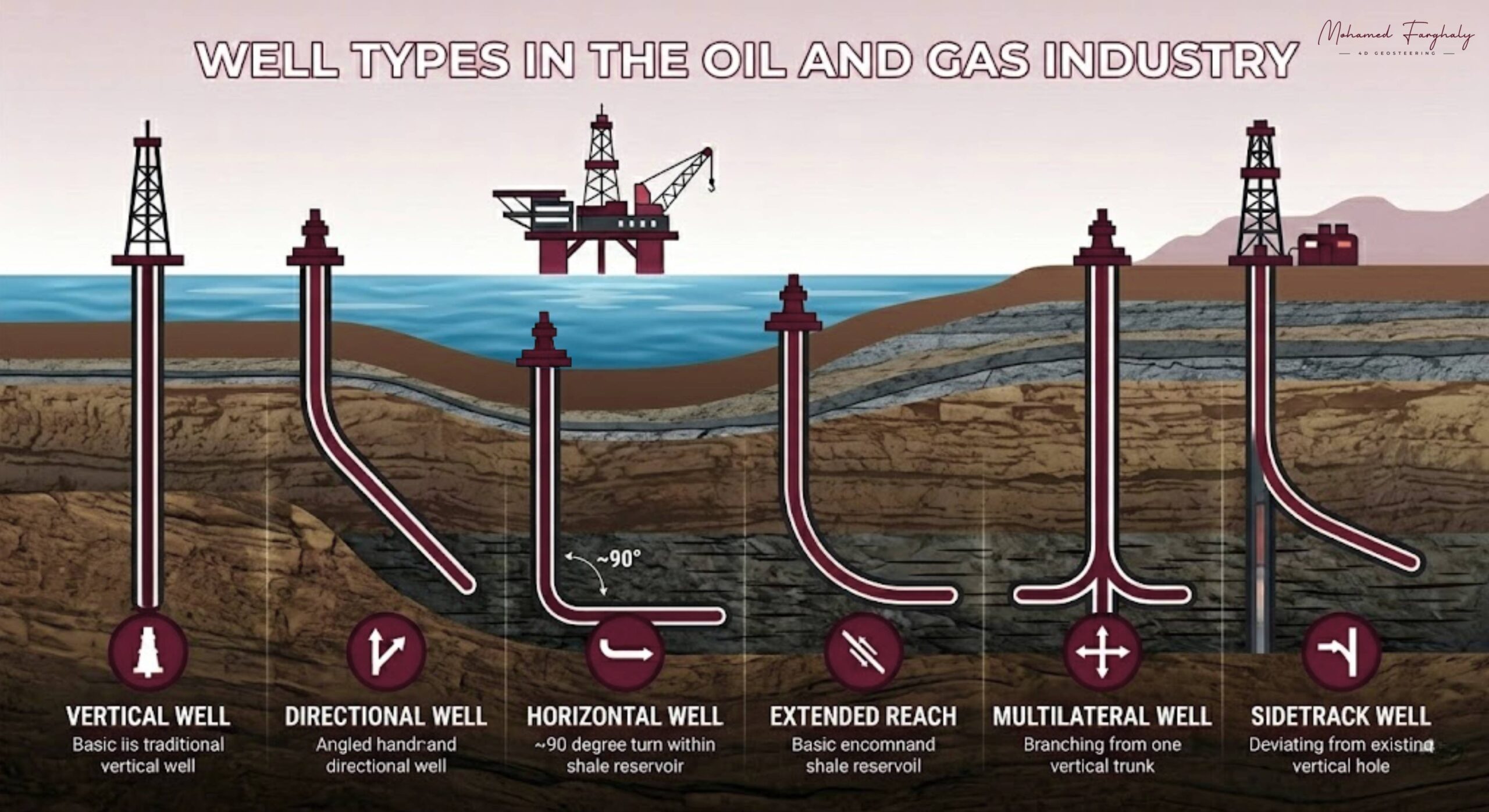
Engineers choose specific well types as a fundamental part of drilling strategy. Each well type serves a distinct purpose, maximizing reservoir recovery, ensuring operational efficiency, and overcoming geological challenges. Understanding these classifications helps anyone involved in drilling operations or reservoir management.
Classification of Well Types
The industry classifies oil and gas wells based on their trajectory, purpose, and the specific geological conditions they exploit.
1. Vertical Wells
The vertical well represents the most traditional form of drilling. It follows a straight path from the surface to the target reservoir. While vertical wells offer the lowest drilling costs, they provide limited contact with the reservoir. Therefore, operators primarily use them in thick, high-permeability formations where vertical flow supports economic production.
2. Directional Wells
Engineers drill a directional well at an angle rather than straight down. This technique reaches targets located away from the surface drilling location. By using controlled deviation, operators access reservoirs under lakes, urban areas, or other restricted environments. Furthermore, this method serves as the foundation for more complex well profiles.
3. Horizontal Wells
Operators use horizontal wells—a specialized type of directional well—to turn the wellbore to a horizontal angle within the reservoir. This design works best in thin reservoirs or unconventional shale formations. By creating a long, horizontal path, the wellbore significantly increases contact with the rock. Consequently, these wells often yield higher production rates than vertical wells.
4. Extended Reach Wells (ERD)
Extended Reach Drilling (ERD) reaches targets at extreme horizontal distances from the surface. These wells feature a high ratio of horizontal displacement to vertical depth. ERD provides significant value for offshore developments, as it allows operators to reach distant reservoirs from a single, centralized platform, which saves massive infrastructure costs.
5. Multilateral Wells
A multilateral well includes a primary wellbore with one or more lateral branches. This design allows operators to drain multiple sections of a reservoir or even different reservoir zones from one main borehole. Consequently, multilateral wells improve drainage efficiency and reduce the total number of wells required for field development.
6. Sidetrack Wells
Operators create a sidetrack well by deviating from an existing wellbore. They often perform this in mature fields to bypass mechanical obstructions or to reach an untapped “sweet spot.” Sidetracking maximizes the economic life of a well by providing access to new reserves without the high cost of drilling from the surface.
🔗 Keywords
Drilling Rig, Drilling Mud, MWD, LWD, Directional Drilling, Geosteering, Well Placement, Oil Reservoir, Surface Logging, Borehole Imaging, Electromagnetic Resistivity LWD Tool, Bottom Hole Assembly, Study of Real-Time LWD Data, LWD Interpretation, Borehole Image Log, Dip Calculation Methods, Shale Gas Sweet Spot, Accurate Reservoir Boundary Detection, Machine Learning, Artificial Intelligence, The Future of Automated Geosteering, Ensemble-Based Well Log Interpretation, Digital Twins in Drilling, Remote Operations Centers