Directional vs multilateral drilling comparison
June 6, 2023· 3 minutes reading
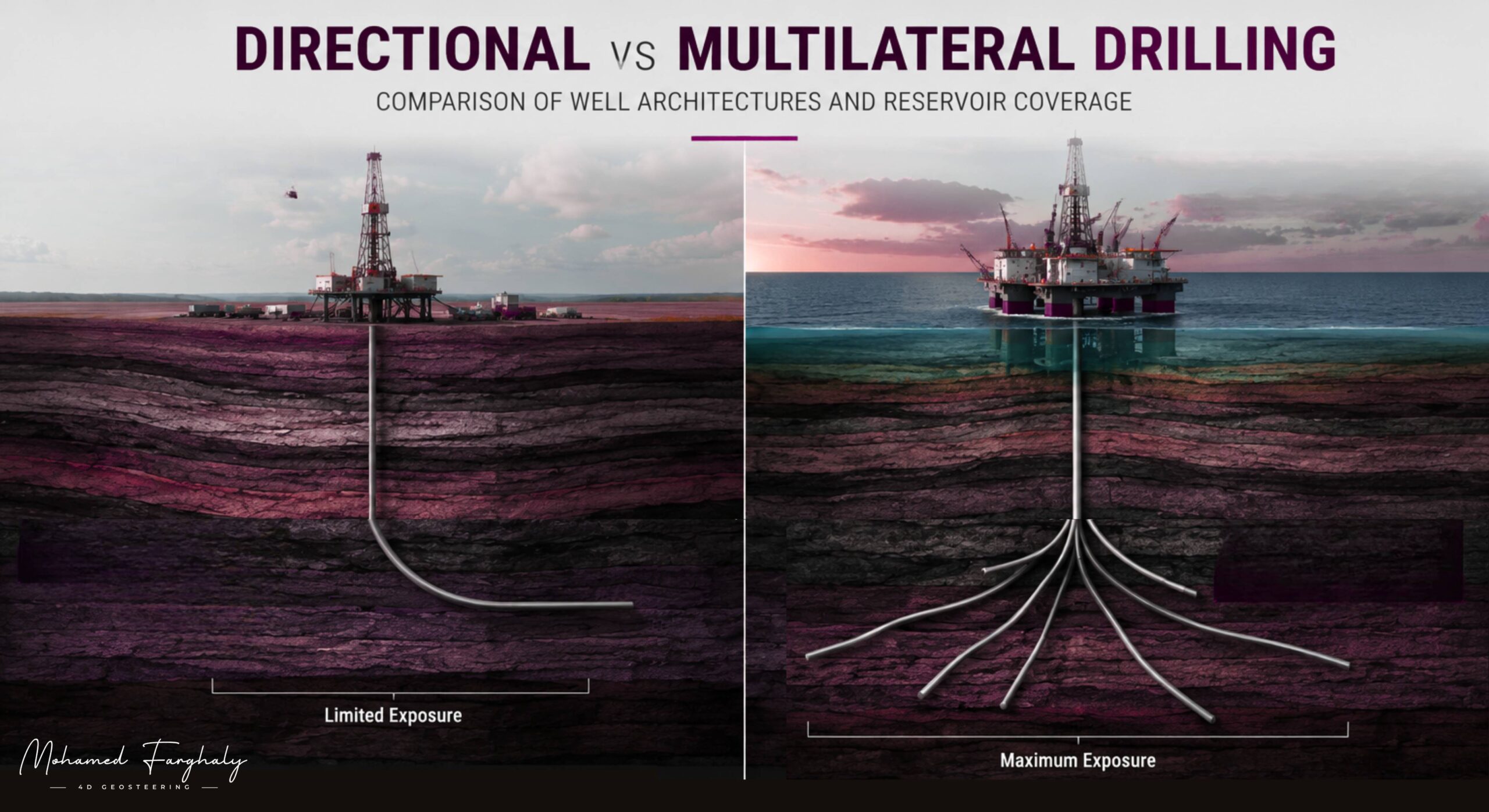
In modern petroleum engineering, the ability to manipulate the wellbore trajectory is essential for maximizing reservoir recovery. While directional drilling serves as the foundational technology for steering wells away from a vertical path, consequently, multilateral drilling represents an advanced application of these techniques to further optimize production. Therefore, understanding the distinction between these two approaches is key to selecting the right strategy for field development.
What is Directional Drilling?
Directional drilling is the practice of intentionally deviating a wellbore along a planned, non-vertical trajectory to reach specific targets.
- Furthermore, the core objective is to access reservoirs that are not directly beneath the surface location, such as those under cities, rivers, or environmentally sensitive areas.
- Additionally, the operational mechanism utilizes specialized equipment like mud motors or Rotary Steerable Systems (RSS) to control the drill bit’s path in 3D space.
- Moreover, it is critical for “steering” the well to hit specific geological sweet spots, bypassing obstacles, or drilling relief wells to control blowouts.
What is Multilateral Drilling?
Multilateral drilling is an advanced configuration where multiple well branches, or “laterals,” are drilled from a single primary “mother” or “trunk” borehole.
- In contrast, the core objective is to maximize reservoir exposure and recovery by tapping into multiple zones—or different parts of the same zone—from one main wellbore.
- Consequently, after the primary borehole is drilled, additional lateral branches are steered outward into the target formation.
- Specifically, these can be configured as stacked (at different depths), branched (emanating from a single point), or dual-lateral (opposed at 180 degrees).
Key Comparison: Directional vs. Multilateral
| Feature | Directional Drilling | Multilateral Drilling |
| Primary Goal | Steering to reach a specific target point. | Increasing total reservoir contact area. |
| Wellbore Structure | Usually a single wellbore path. | A main “trunk” with multiple branches. |
| Complexity | Standardized for most modern wells. | Highly complex; requires specialized completion. |
| Efficiency | Reduces surface footprint per well. | Maximizes recovery from one wellhead. |
Why Choose One Over the Other?
When to use Directional Drilling:
Directional drilling is the “go-to” for standard horizontal wells; however, it is especially essential when you need to navigate around subsurface hazards or reach a target that is geographically offset from the rig. Furthermore, it is highly effective for thin-bedded reservoirs where staying within a specific stratigraphic layer is paramount.
When to use Multilateral Drilling:
Multilateral wells are preferred when the goal is to maximize resource recovery in a cost-effective manner. By consolidating multiple drainage points into a single wellhead, operators can:
- Significantly reduce infrastructure costs by requiring fewer risers, wellheads, and surface facilities.
- Also improve flexibility by managing production from different reservoir zones independently.
- Finally, minimize environmental impact by reducing the overall surface disturbance compared to drilling multiple separate wells.
🔗 Keywords
Drilling Rig, Drilling Mud, MWD, LWD, Directional Drilling, Geosteering, Well Placement, Oil Reservoir, Surface Logging, Borehole Imaging, Electromagnetic Resistivity LWD Tool, Bottom Hole Assembly, Study of Real-Time LWD Data, LWD Interpretation, Borehole Image Log, Dip Calculation Methods, Shale Gas Sweet Spot, Accurate Reservoir Boundary Detection, Machine Learning, Artificial Intelligence, The Future of Automated Geosteering, Ensemble-Based Well Log Interpretation, Digital Twins in Drilling, Remote Operations Centers