Production Mechanisms in Artificial Lift Systems
July 3, 2023· 2 minutes reading
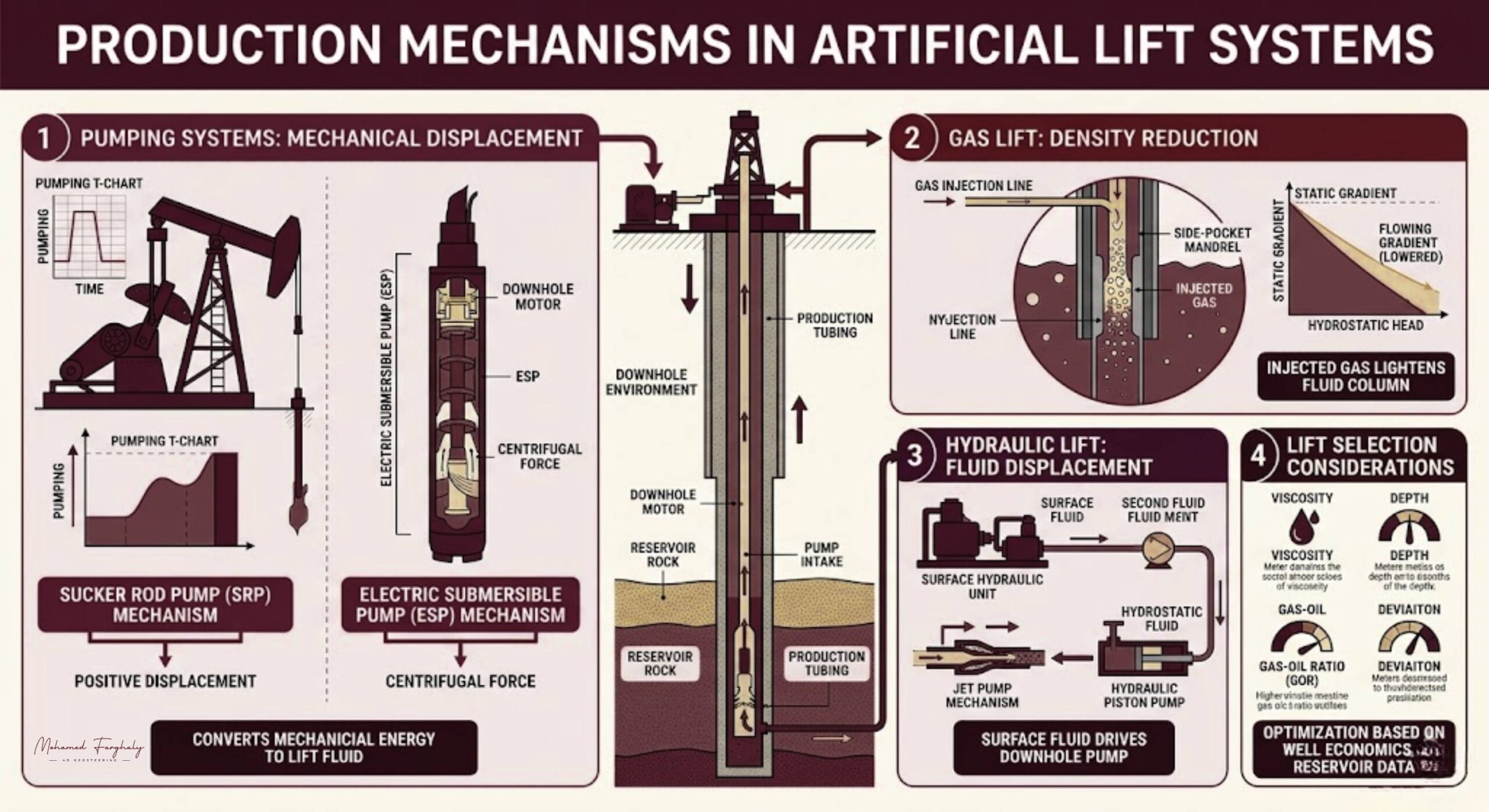
When natural reservoir pressure declines, maintaining profitable flow becomes the top priority for production engineers. Implementing the correct Production Mechanisms in Artificial Lift Systems is essential for optimizing well performance and extending asset life. Furthermore, by understanding these Production Mechanisms in Artificial Lift Systems, engineers can effectively lower bottom-hole flowing pressure and encourage reservoir inflow.
1. Pumping Systems: Mechanical Displacement Mechanisms
These systems utilize mechanical energy to physically displace reservoir fluids to the surface. For instance, Sucker Rod Pumps (SRP) operate via a positive displacement mechanism, which is characterized by a distinct pumping cycle. Conversely, Electric Submersible Pumps (ESP) generate centrifugal force to move high fluid volumes efficiently.
2. Gas Lift: Density Reduction Mechanisms
This technique involves the injection of compressed gas into the production tubing. Consequently, by lightening the density of the fluid column, the hydrostatic head is reduced. Therefore, this process effectively lowers the gradient, allowing the reservoir’s remaining pressure to lift the fluid to the surface.
3. Hydraulic Lift: Fluid Displacement Mechanisms
This approach employs high-pressure surface fluid to power downhole equipment. Systems such as jet pumps and hydraulic piston pumps utilize this power fluid to drive the mechanical processes necessary for fluid displacement. In this configuration, surface fluid is pumped down to the equipment; as a result, the lifting of reservoir fluids is facilitated.
4. Lift Selection Considerations for Artificial Lift Systems
Selecting the optimal production strategy is a complex engineering decision that requires balancing multiple variables. To begin with, operators must evaluate technical parameters such as fluid viscosity, well depth, gas-oil ratio (GOR), and wellbore deviation. Ultimately, these factors must be weighed against project economics and comprehensive reservoir data to ensure the most effective system is deployed.
🔗 Keywords
Drilling Rig, Drilling Mud, MWD, LWD, Directional Drilling, Geosteering, Well Placement, Oil Reservoir, Surface Logging, Borehole Imaging, Electromagnetic Resistivity LWD Tool, Bottom Hole Assembly, Study of Real-Time LWD Data, LWD Interpretation, Borehole Image Log, Dip Calculation Methods, Shale Gas Sweet Spot, Accurate Reservoir Boundary Detection, Machine Learning, Artificial Intelligence, The Future of Automated Geosteering, Ensemble-Based Well Log Interpretation, Digital Twins in Drilling, Remote Operations Centers