Kick detection principles
August 1, 2023· 2 minutes reading
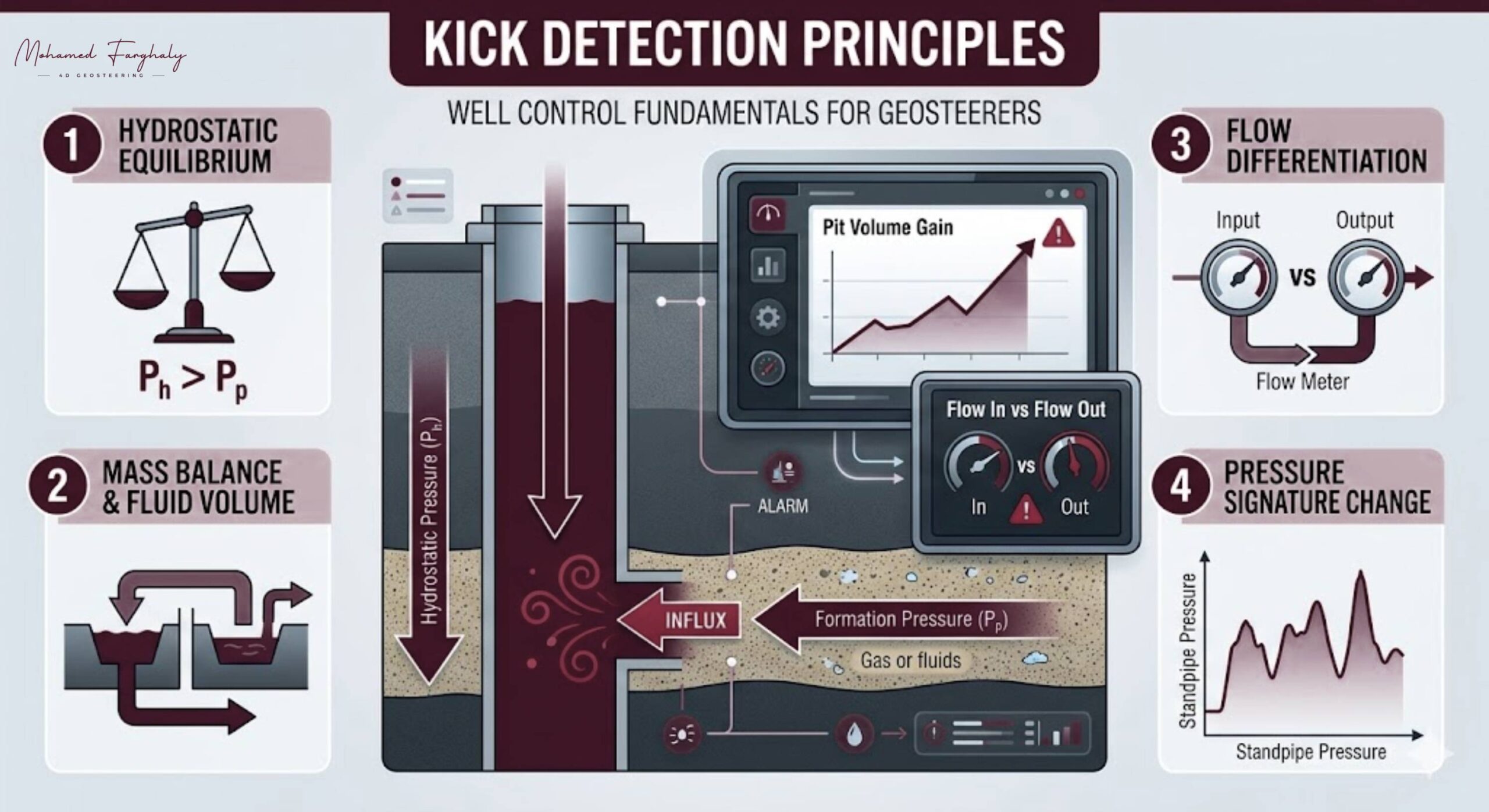
Geosteerers must understand core kick detection principles to maintain wellbore safety. These methods ensure that drillers monitor the balance between hydrostatic pressure and formation pore pressure. Because you analyze real-time logging data, your interpretation often provides the first warning of an impending influx. Consequently, applying these principles correctly helps you distinguish between routine reservoir penetration and genuine well control emergencies.
1. The Hydrostatic Equilibrium Method
The fundamental law of well control requires that the hydrostatic pressure of the drilling mud remains higher than the formation pore pressure. When this balance shifts, an influx occurs. Geosteerers utilize this method by identifying faults or pressure-depleted zones. Therefore, they suggest immediate adjustments to mud weight to maintain stability.
2. Monitoring Mass Balance
Mass balance serves as a cornerstone of drilling operations because the well acts as a closed system. Under normal conditions, the volume of fluid pumped into the hole must equal the volume returned to the surface. A “pit gain”—an unexplained increase in return volume—signals that formation fluids are entering the wellbore. Thus, this remains the most reliable indicator of an influx.
3. Comparing Flow Rates
Flow differentiation compares flow-in rates against flow-out rates in real-time. Because the system is sealed, any divergence where the return rate exceeds the input rate indicates an active influx. Geosteerers apply this technique to correlate flow anomalies with high-porosity reservoir entries. Accordingly, they help the drilling team verify if a gain originates from the reservoir.
4. Observing Pressure Signatures
The influx of reservoir fluids, such as gas or salt water, changes the density of the drilling fluid column. This change leads to sudden fluctuations in standpipe pressure. Monitoring these variations allows crews to identify problems before fluids reach the surface. Furthermore, geosteerers enhance this process by identifying permeable zones where such pressure changes are statistically expected.
5. Correlating Lithology
Lithological correlation integrates mechanical data with stratigraphic interpretation. By monitoring “drilling breaks”—or sudden increases in the Rate of Penetration—geosteerers determine the exact moment the bit penetrates a reservoir. This helps the team differentiate between a benign drilling event and a critical situation. Consequently, the geological context ensures that the team applies well control procedures effectively.
🔗 Keywords
Drilling Rig, Drilling Mud, MWD, LWD, Directional Drilling, Geosteering, Well Placement, Oil Reservoir, Surface Logging, Borehole Imaging, Electromagnetic Resistivity LWD Tool, Bottom Hole Assembly, Study of Real-Time LWD Data, LWD Interpretation, Borehole Image Log, Dip Calculation Methods, Shale Gas Sweet Spot, Accurate Reservoir Boundary Detection, Machine Learning, Artificial Intelligence, The Future of Automated Geosteering, Ensemble-Based Well Log Interpretation, Digital Twins in Drilling, Remote Operations Centers