Decision hierarchy in drilling operations
Nov 1, 2023· 3 minutes reading
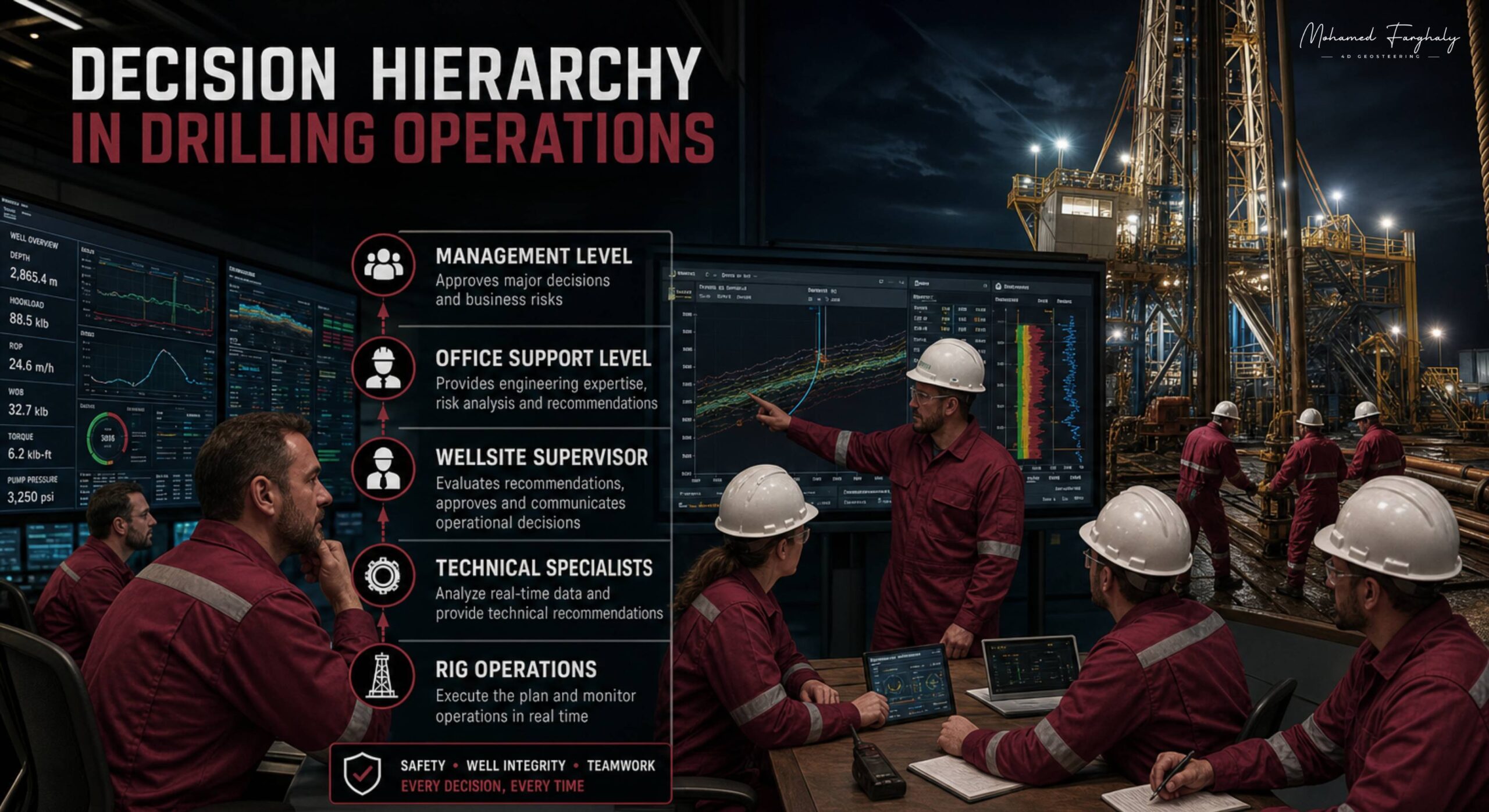
Decision hierarchy in drilling operations defines who monitors real-time data, provides technical recommendations, approves changes, and executes each action. Since drilling conditions can change within seconds, a clear hierarchy allows the team to respond quickly while protecting personnel, equipment, and well integrity.
Modern drilling operations generate continuous information from rig sensors, mud logging systems, directional surveys, and MWD and LWD tools. However, collecting data is not enough. The right information must reach the right person at the right time. Otherwise, slow communication or unclear authority can increase operational risk and nonproductive time.
A drilling team usually includes personnel from the operator, drilling contractor, and several service companies. At the operational level, the driller and rig crew control the equipment and monitor essential parameters such as pump pressure, flow rate, torque, hookload, pit volume, and rate of penetration. If they detect an immediate safety or well-control threat, they follow approved procedures to stop or secure the operation.
Meanwhile, technical specialists interpret the available data. Directional drillers evaluate the well trajectory, while MWD and LWD engineers monitor downhole measurements. Mud engineers, mud loggers, geologists, and geosteering specialists also assess drilling conditions and formation changes.
For example, a geosteerer may identify an approaching reservoir boundary from real-time resistivity or gamma ray data. The geosteerer can recommend a trajectory adjustment, and the directional driller can assess whether the Bottom Hole Assembly can achieve it safely. However, the drilling supervisor or company representative normally reviews and approves the final operational decision.
Real-Time Decisions and Escalation
A typical real-time decision begins when sensors or personnel detect a change. First, the team validates the data to ensure that the signal is reliable. Next, specialists evaluate the possible causes, risks, and available responses. The authorized decision-maker then approves an action, and the rig crew executes it while monitoring the outcome.
Routine adjustments may receive approval at the wellsite. These can include changing drilling parameters, adjusting mud properties, increasing survey frequency, or applying a planned steering correction. In contrast, major decisions may require escalation to office-based drilling engineers, superintendents, well-control specialists, or asset management. Examples include changing the approved well trajectory, drilling a sidetrack, responding to severe fluid losses, or modifying the casing program.
Clear escalation criteria make this process faster. Pressure limits, torque levels, vibration, fluid losses, dogleg severity, and distance from reservoir boundaries can determine when the team must stop, continue, or request higher approval.
Real-time dashboards, automated alerts, and remote operations centers can improve situational awareness. Nevertheless, technology should support human judgment rather than replace responsibility.
Ultimately, an effective decision hierarchy in drilling operations transforms real-time data into safe, coordinated action. It strengthens communication, reduces uncertainty, protects the well, and improves overall drilling performance.
🔗 Keywords
Drilling Rig, Drilling Mud, MWD, LWD, Directional Drilling, Geosteering, Well Placement, Oil Reservoir, Surface Logging, Borehole Imaging, Electromagnetic Resistivity LWD Tool, Bottom Hole Assembly, Study of Real-Time LWD Data, LWD Interpretation, Borehole Image Log, Dip Calculation Methods, Shale Gas Sweet Spot, Accurate Reservoir Boundary Detection, Machine Learning, Artificial Intelligence, The Future of Automated Geosteering, Ensemble-Based Well Log Interpretation, Digital Twins in Drilling, Remote Operations Centers