Build, Hold, Drop Sections
June 6, 2023· 2 minutes reading
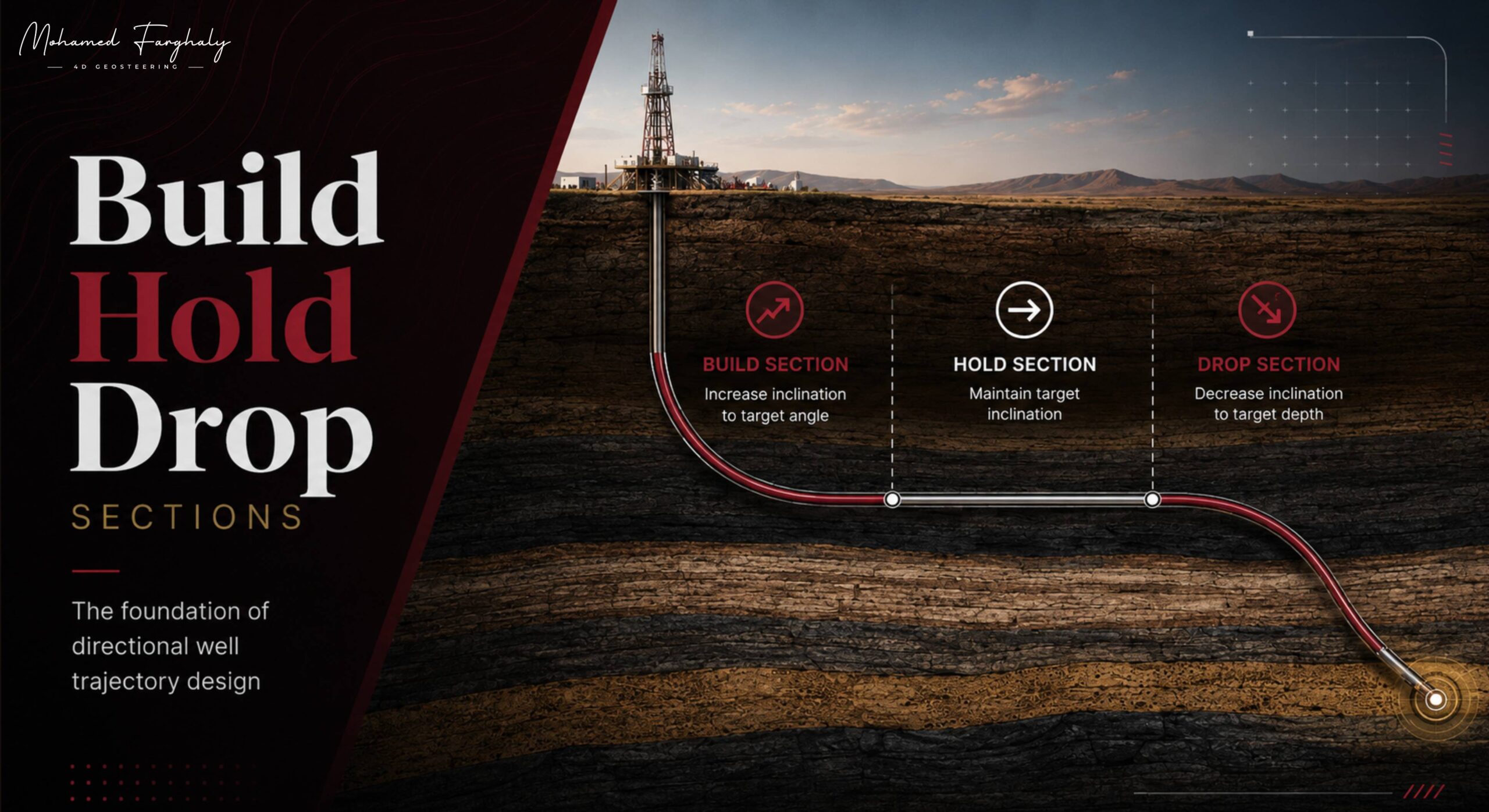
A successful directional well starts with a well-designed trajectory. Build Hold Drop Sections form the foundation of every directional well profile, guiding the wellbore from the surface to the target reservoir. Each section serves a specific purpose, helping drilling and geosteering teams achieve accurate well placement while minimizing operational risks.
Build Section
First, the well enters the Build Section, where directional drilling tools gradually increase the inclination from vertical to the planned angle. Engineers carefully control the build rate to create a smooth curve and avoid excessive stress on the drill string. A properly designed build section positions the well toward the target while maintaining safe drilling conditions.
Hold Section
Once the well reaches the planned inclination, it enters the Hold Section, also known as the tangent section. Here, the well maintains a nearly constant angle as it advances toward the reservoir. This stable trajectory allows geosteering specialists to compare real-time formation data with the planned path and make minor steering adjustments whenever necessary. As a result, the well remains on course and reaches the landing point with greater accuracy.
Drop Section
Finally, some wells include a Drop Section, where the inclination gradually decreases before reaching the final target. Engineers use this section when the trajectory requires a lower angle for reservoir entry or well completion. However, not every well profile includes a drop section. Many horizontal wells continue directly from the Hold Section into the reservoir.
Why Are Build Hold Drop Sections Important?
Build Hold Drop Sections play a critical role in well trajectory planning because they:
- Guide the well safely toward the target.
- Improve drilling efficiency.
- Reduce mechanical stress on the drilling assembly.
- Support accurate geosteering decisions.
- Increase the likelihood of optimal reservoir placement.
Ultimately, a well-planned trajectory helps drilling and geosteering teams reduce non-productive time, minimize costly corrections, and maximize reservoir contact. By understanding the purpose of each section, engineers can design safer, more efficient wells that meet both technical and production objectives.
🔗 Keywords
Drilling Rig, Drilling Mud, MWD, LWD, Directional Drilling, Geosteering, Well Placement, Oil Reservoir, Surface Logging, Borehole Imaging, Electromagnetic Resistivity LWD Tool, Bottom Hole Assembly, Study of Real-Time LWD Data, LWD Interpretation, Borehole Image Log, Dip Calculation Methods, Shale Gas Sweet Spot, Accurate Reservoir Boundary Detection, Machine Learning, Artificial Intelligence, The Future of Automated Geosteering, Ensemble-Based Well Log Interpretation, Digital Twins in Drilling, Remote Operations Centers