Dogleg severity (DLS)
June 6, 2023· 2 minutes reading
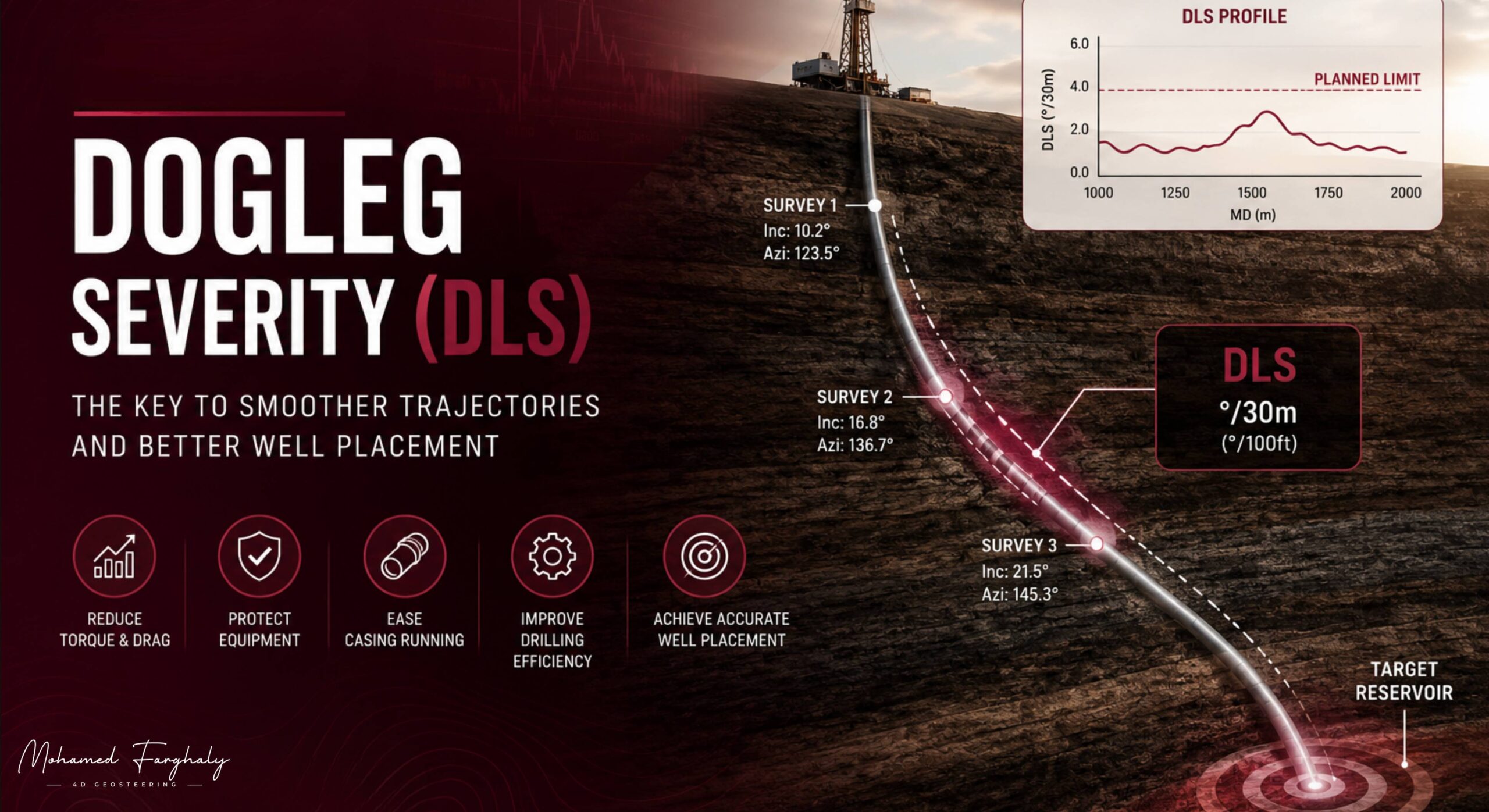
A directional well rarely follows a perfectly straight path. Instead, it gradually changes direction to reach the target reservoir. To evaluate these changes, engineers use Dogleg Severity (DLS), one of the most important parameters in well trajectory planning and geosteering. By monitoring DLS throughout the drilling process, drilling teams maintain a smooth trajectory, reduce mechanical stress, and improve well placement.
What Is Dogleg Severity?
Simply put, Dogleg Severity measures how sharply the wellbore changes direction between two consecutive survey stations. Engineers determine DLS by combining changes in both inclination and azimuth, which together describe the well’s three-dimensional path.
Engineers commonly express DLS in degrees per 30 meters (100 ft). A low DLS indicates a smooth and gradual trajectory, whereas a high DLS reflects a tighter curve that places greater stress on the drilling assembly.
Why Is Dogleg Severity Important?
A well with excessive curvature can create several operational challenges. For this reason, engineers establish acceptable DLS limits during the planning stage and monitor them throughout drilling.
High Dogleg Severity may result in:
- Increased torque and drag.
- Greater drill string fatigue.
- Difficulty running casing.
- Higher tool wear and failure risk.
- Reduced drilling efficiency.
Consequently, controlling DLS helps improve drilling performance, protect downhole equipment, and maintain wellbore integrity.
How Do Engineers Calculate DLS?
Typically, engineers calculate Dogleg Severity using directional survey data collected at regular intervals along the wellbore. They compare the inclination and azimuth recorded at two consecutive survey stations and determine the change in well direction over the measured distance.
Although specialized software performs these calculations automatically, drilling engineers continuously review the results to ensure the actual trajectory follows the planned well path.
Dogleg Severity and Geosteering
Meanwhile, geosteering specialists monitor Dogleg Severity alongside real-time formation evaluation data. If the well begins to deviate from the planned trajectory, they recommend gradual steering corrections instead of aggressive directional changes. As a result, the well remains within the target reservoir while maintaining a smooth, drillable trajectory.
Maintaining an appropriate Dogleg Severity allows drilling and geosteering teams to balance accurate well placement with safe and efficient drilling operations.
🔗 Keywords
Drilling Rig, Drilling Mud, MWD, LWD, Directional Drilling, Geosteering, Well Placement, Oil Reservoir, Surface Logging, Borehole Imaging, Electromagnetic Resistivity LWD Tool, Bottom Hole Assembly, Study of Real-Time LWD Data, LWD Interpretation, Borehole Image Log, Dip Calculation Methods, Shale Gas Sweet Spot, Accurate Reservoir Boundary Detection, Machine Learning, Artificial Intelligence, The Future of Automated Geosteering, Ensemble-Based Well Log Interpretation, Digital Twins in Drilling, Remote Operations Centers