Positive Displacement Motors
June 6, 2023 ·3 minutes reading
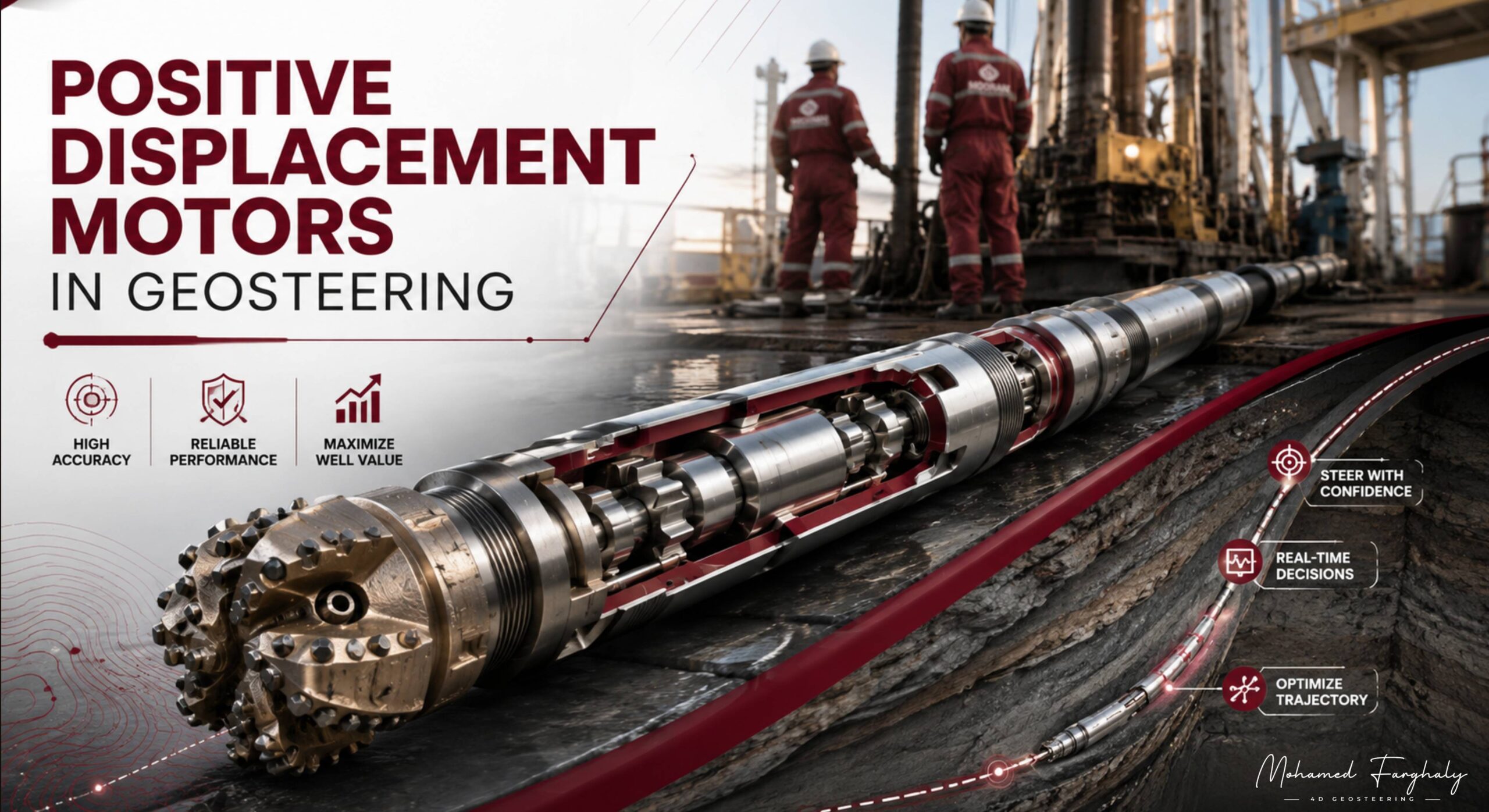
In geosteering, interpreting the reservoir is only part of the job. Once the geosteering team decides that the well trajectory needs to change, the drilling system must execute that decision.
One important tool for this purpose is the positive displacement motor, commonly known as a mud motor.
What Is a Positive Displacement Motor?
A positive displacement motor, or PDM, is a downhole drilling motor that converts the hydraulic energy of drilling fluid into mechanical rotation.
As drilling mud flows through the drillstring, it enters the motor and drives its internal components. The motor then transfers this rotational energy directly to the drill bit.
A typical mud motor includes several main components:
- Power section
- Transmission section
- Bearing section
- Drive shaft
- Bent housing or adjustable bend, when the assembly requires directional control
Among these components, the power section generates the rotation that drives the bit.
How Does the Power Section Work?
The power section contains two main components: the rotor and stator.
The rotor consists of a metal helical component that sits inside an elastomer-lined stator. When drilling fluid moves through the cavities between the rotor and stator, it creates a pressure difference.
As a result, this pressure forces the rotor to turn.
The rotor then transfers torque through the transmission and bearing sections to the drill bit. Therefore, the motor converts hydraulic energy from the drilling fluid into mechanical energy at the bit.
This process allows the bit to receive additional rotational power downhole.
Why Are Positive Displacement Motors Important in Geosteering?
Geosteering teams continuously evaluate the position of the well relative to reservoir boundaries.
For example, real-time measurements may show that the well is moving closer to the top or bottom of the target interval. Consequently, the geosteering team may recommend a trajectory adjustment.
The directional drilling team then uses the mud motor as part of the bottomhole assembly to help execute that adjustment.
The process can be simplified as:
Real-Time Data → Geological Interpretation → Geosteering Decision → Directional Adjustment
Therefore, the mud motor creates an important link between the geological decision and the physical well trajectory.
Positive Displacement Motors and Well Placement
PDMs play an important role in directional and horizontal drilling because they can deliver high torque directly to the bit. In addition, they support controlled trajectory adjustments when the drilling team needs to respond to changing subsurface conditions.
In geosteering operations, this capability can help the team respond to:
- Changes in reservoir dip
- Unexpected structural movement
- Approaching bed boundaries
- Formation thickness variations
- Required inclination or azimuth corrections
However, the mud motor does not decide where the well should go.
Instead, the geosteering interpretation defines the desired trajectory, while the positive displacement motor helps the drilling team execute the required directional response.
Moreover, this connection between subsurface interpretation and drilling execution allows geosteering teams to react more effectively to changing reservoir conditions.
Ultimately, positive displacement motors provide the mechanical support needed to turn a geosteering recommendation into an actual change in the well path.ntal well placement..
🔗 Keywords
Drilling Rig, Drilling Mud, MWD, LWD, Directional Drilling, Geosteering, Well Placement, Oil Reservoir, Surface Logging, Borehole Imaging, Electromagnetic Resistivity LWD Tool, Bottom Hole Assembly, Study of Real-Time LWD Data, LWD Interpretation, Borehole Image Log, Dip Calculation Methods, Shale Gas Sweet Spot, Accurate Reservoir Boundary Detection, Machine Learning, Artificial Intelligence, The Future of Automated Geosteering, Ensemble-Based Well Log Interpretation, Digital Twins in Drilling, Remote Operations Centers