Bent housing principle
June 6, 2023 ·2 minutes reading
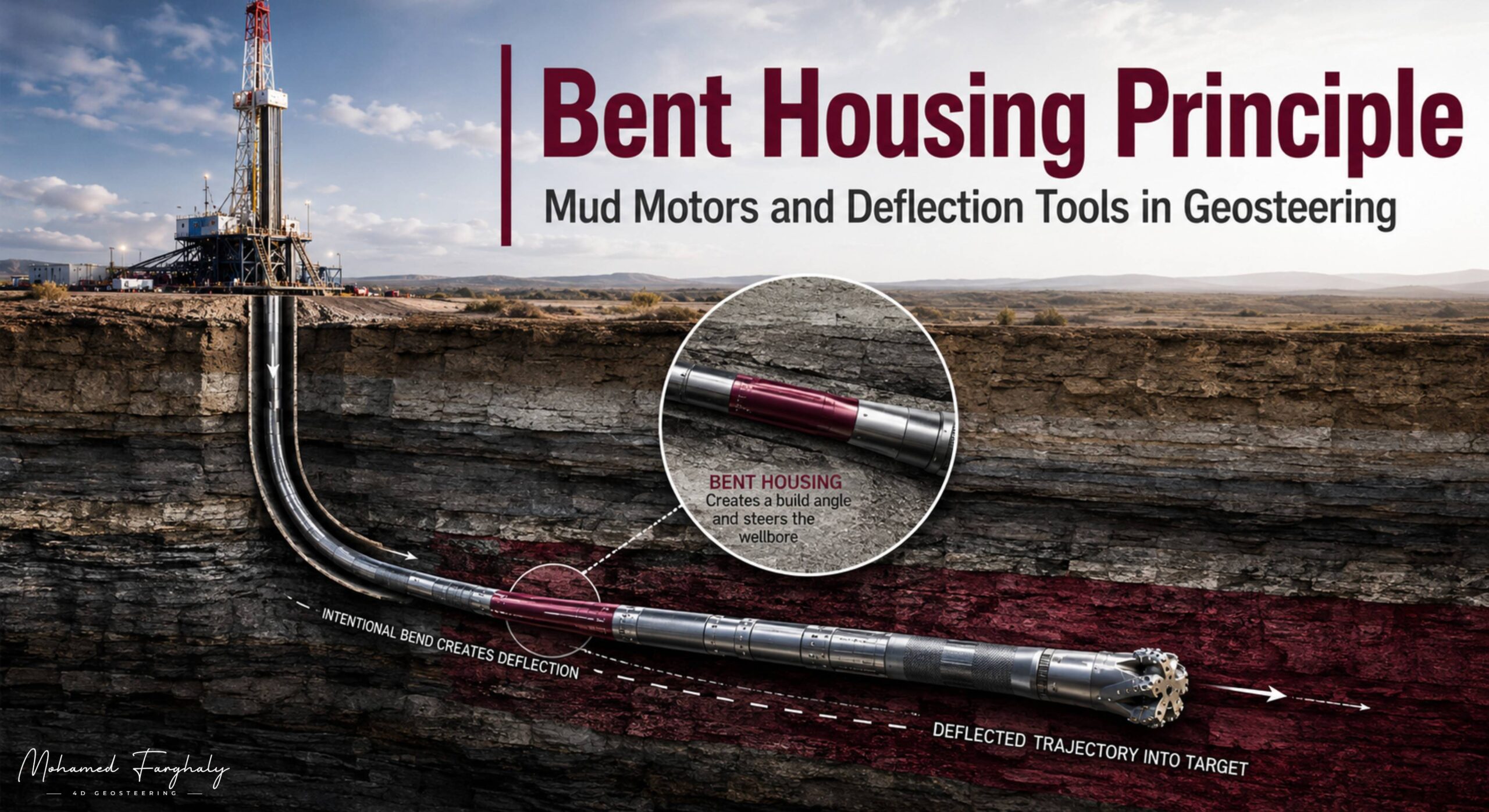
The bent housing principle is a fundamental directional drilling concept used in mud motors and deflection tools. It helps control the trajectory of a well during geosteering operations.
A bent housing contains a small angular offset in the motor assembly. This offset creates a slight angle between the upper and lower sections of the motor. The lower section connects directly to the drill bit.
Although the angle is small, it creates a directional tendency at the bit. Therefore, the tool can guide the wellbore toward a selected direction.
Drilling fluid passes through the mud motor and provides hydraulic energy. This energy powers the motor and rotates the bit. At the same time, the bent housing controls the direction in which the bit tends to drill.
The directional driller controls this direction by orienting the bend toward a specific toolface direction. Once the required toolface is established, the motor can drill ahead in that direction.
For example, pointing the bend upward can increase well inclination. Pointing it downward can reduce inclination. Likewise, orienting the bend toward either side can change the well azimuth.
Bent Housing Angle and Directional Response
The bent housing angle influences how strongly the mud motor changes the well trajectory.
A larger bend generally creates a stronger directional tendency. In contrast, a smaller bend usually produces a more gradual change.
However, the final directional response depends on several drilling conditions. These include formation properties, bit behavior, drilling parameters, and motor configuration.
The bent housing does not force the well into a new direction instantly. Instead, it creates a controlled tendency at the bit. This tendency gradually changes the wellbore trajectory as drilling continues.
Therefore, accurate toolface orientation is important. A small error in orientation can move the well away from the intended direction.
Bent Housing Principle in Geosteering
In geosteering, the bent housing principle helps the drilling team respond to changes in the reservoir.
Real-time geological and logging data may show that the bit is approaching a reservoir boundary. The data may also indicate that the well is moving away from the desired target.
The geosteering team can then recommend a trajectory adjustment. The directional driller orients the bent housing toward the required direction. The mud motor then guides the bit along the corrected trajectory.
This steering capability is especially important in thin or structurally complex reservoirs. Small trajectory changes can significantly affect reservoir contact.
Therefore, the bent housing acts as a mechanical steering mechanism. It converts a small angular offset into controlled wellbore deflection.
For geosteering operations, understanding the bent housing principle connects subsurface interpretation with the physical steering action taking place at the drill bit.
🔗 Keywords
Drilling Rig, Drilling Mud, MWD, LWD, Directional Drilling, Geosteering, Well Placement, Oil Reservoir, Surface Logging, Borehole Imaging, Electromagnetic Resistivity LWD Tool, Bottom Hole Assembly, Study of Real-Time LWD Data, LWD Interpretation, Borehole Image Log, Dip Calculation Methods, Shale Gas Sweet Spot, Accurate Reservoir Boundary Detection, Machine Learning, Artificial Intelligence, The Future of Automated Geosteering, Ensemble-Based Well Log Interpretation, Digital Twins in Drilling, Remote Operations Centers