Slide Drilling in Mud Motors and Deflection Tools for Geosteering
June 6, 2023 ·3 minutes reading
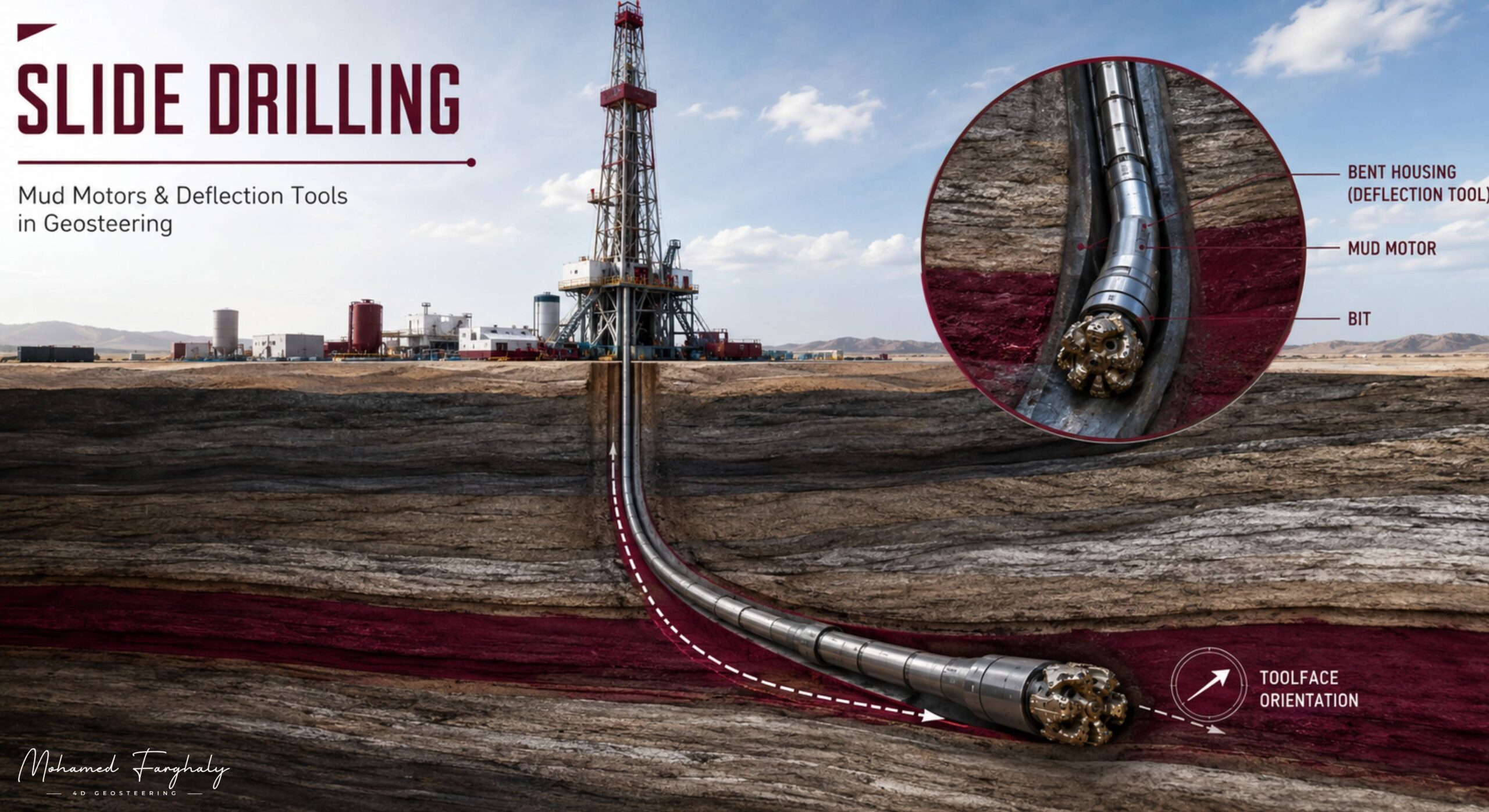
Slide drilling in geosteering is a directional drilling technique used to steer the wellbore toward a required trajectory. It is commonly performed with a mud motor and bent housing, which allow the drilling team to control the direction of the bit downhole.
In geosteering operations, slide drilling becomes important when the well trajectory needs an adjustment to remain within the target reservoir or approach the planned geological position.
How Slide Drilling Works
During slide drilling, the drillstring is held in a fixed rotational position at the surface. Drilling fluid then flows through the mud motor, creating the mechanical power required to rotate the bit.
The mud motor contains a bent housing, which introduces a small angular offset in the bottomhole assembly. The directional driller orients this bend toward the required direction using the toolface.
Once the toolface is correctly oriented, the bit drills in the direction created by the bent housing.
Therefore, the effectiveness of the slide depends strongly on accurate toolface orientation, motor configuration, formation response, and drilling parameters.
The Role of the Bent Housing
The bent housing acts as the main deflection tool during slide drilling.
Its bend creates a directional tendency in the bottomhole assembly. When the directional driller points the bend toward a specific direction, the bit follows that steering tendency while drilling progresses.
The selected bend angle influences how aggressively the well trajectory can change. However, the actual response also depends on factors such as:
- Formation hardness
- Weight on bit
- Motor bend setting
- Bit design
- Bottomhole assembly configuration
- Hole inclination
- Drilling parameters
Because of these variables, the actual trajectory response must be continuously monitored.
Slide Drilling in Geosteering Operations
In geosteering, real-time measurements help the team understand the position of the well relative to the reservoir boundaries.
If the geological interpretation indicates that the trajectory needs correction, the geosteering team can communicate the required steering direction to the directional drilling team.
The directional driller then determines the appropriate toolface orientation and slide interval.
For example, the team may require a controlled build, drop, or lateral correction to maintain the well inside the reservoir target.
As drilling continues, survey data and logging-while-drilling measurements help confirm whether the slide produced the expected trajectory response.
Why Slide Control Is Important
Successful slide drilling requires precise control because every steering interval affects the future position of the well.
Poor toolface control, excessive sliding, or an incorrect steering direction may move the well away from the desired trajectory.
For this reason, directional drillers and geosteering specialists must coordinate continuously during the operation.
When used correctly, slide drilling with mud motors and deflection tools gives the drilling team an effective method for adjusting the well trajectory and maintaining reservoir contact during geosteering operations.
🔗 Keywords
Drilling Rig, Drilling Mud, MWD, LWD, Directional Drilling, Geosteering, Well Placement, Oil Reservoir, Surface Logging, Borehole Imaging, Electromagnetic Resistivity LWD Tool, Bottom Hole Assembly, Study of Real-Time LWD Data, LWD Interpretation, Borehole Image Log, Dip Calculation Methods, Shale Gas Sweet Spot, Accurate Reservoir Boundary Detection, Machine Learning, Artificial Intelligence, The Future of Automated Geosteering, Ensemble-Based Well Log Interpretation, Digital Twins in Drilling, Remote Operations Centers