Rotation Drilling in Mud Motors
June 6, 2023 ·3 minutes reading
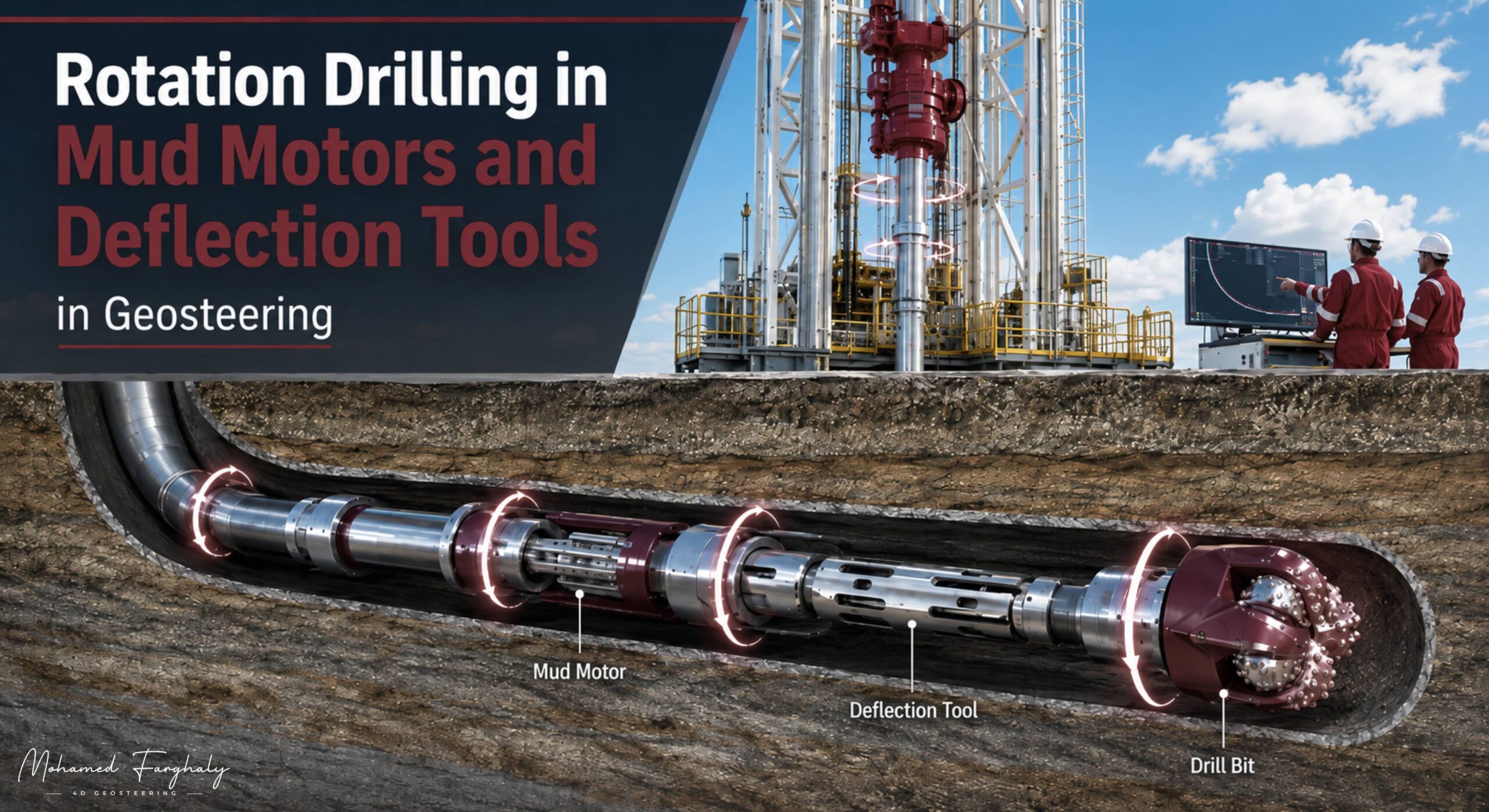
Rotation drilling in geosteering is a drilling mode in which the drillstring and bottom-hole assembly (BHA) rotate continuously from the surface while the drill bit advances through the formation.
The top drive supplies surface rotation to the drillstring. When the BHA contains a positive displacement mud motor (PDM), drilling fluid also powers the motor and generates additional rotation at the bit.
As a result, the drill bit receives rotational energy while the entire drilling assembly continues rotating inside the wellbore.
How Rotation Drilling Works with a Mud Motor
Drilling fluid enters the mud motor and drives the rotor inside the stator. This hydraulic energy converts into mechanical torque and rotational speed at the drill bit.
At the same time, the top drive rotates the complete drillstring.
The total bit speed therefore depends on the surface RPM together with the rotational speed generated by the mud motor.
The drilling team monitors this system through several important parameters:
- Surface RPM
- Motor RPM
- WOB — Weight on Bit
- Torque
- ROP — Rate of Penetration
- Flow rate
- Standpipe pressure
- Differential pressure
These parameters help drillers understand how effectively the bit interacts with the formation.
Bit Performance and Rate of Penetration
Rotation directly affects bit-rock interaction.
The combination of rotational speed, WOB, torque, bit design, and formation strength influences the rate of penetration.
Stable drilling parameters help the bit cut the formation efficiently. However, drillers continuously monitor torque, pressure, vibration, and ROP because sudden changes can indicate changes in formation properties or drilling conditions.
Maintaining suitable operating parameters also helps protect the mud motor, drill bit, MWD, and LWD tools from excessive mechanical loading.
Hole Cleaning During Rotation Drilling
Continuous drillstring rotation plays an important role in hole cleaning, especially in high-angle and horizontal wells.
Cuttings naturally tend to settle on the low side of the borehole. Drillstring rotation disturbs these cuttings beds and helps drilling fluid transport the cuttings through the annulus toward the surface.
Effective hole cleaning can help reduce:
- Cuttings accumulation
- Torque and drag
- Poor weight transfer
- Stuck-pipe risk
- Restrictions during drilling
For long horizontal reservoir sections, good hole cleaning becomes especially important for maintaining efficient drilling progress.
During geosteering, rotation drilling allows the well to continue progressing while MWD and LWD tools collect real-time directional and formation data.
Measurements may include inclination, azimuth, gamma ray, resistivity, formation evaluation data, drilling dynamics, and downhole pressure.
The geosteering team interprets these measurements to determine the position of the well relative to the target reservoir, geological structure, and bed boundaries while drilling continues.
🔗 Keywords
Drilling Rig, Drilling Mud, MWD, LWD, Directional Drilling, Geosteering, Well Placement, Oil Reservoir, Surface Logging, Borehole Imaging, Electromagnetic Resistivity LWD Tool, Bottom Hole Assembly, Study of Real-Time LWD Data, LWD Interpretation, Borehole Image Log, Dip Calculation Methods, Shale Gas Sweet Spot, Accurate Reservoir Boundary Detection, Machine Learning, Artificial Intelligence, The Future of Automated Geosteering, Ensemble-Based Well Log Interpretation, Digital Twins in Drilling, Remote Operations Centers