Motor vs RSS comparison
June 6, 2023 ·2 minutes reading
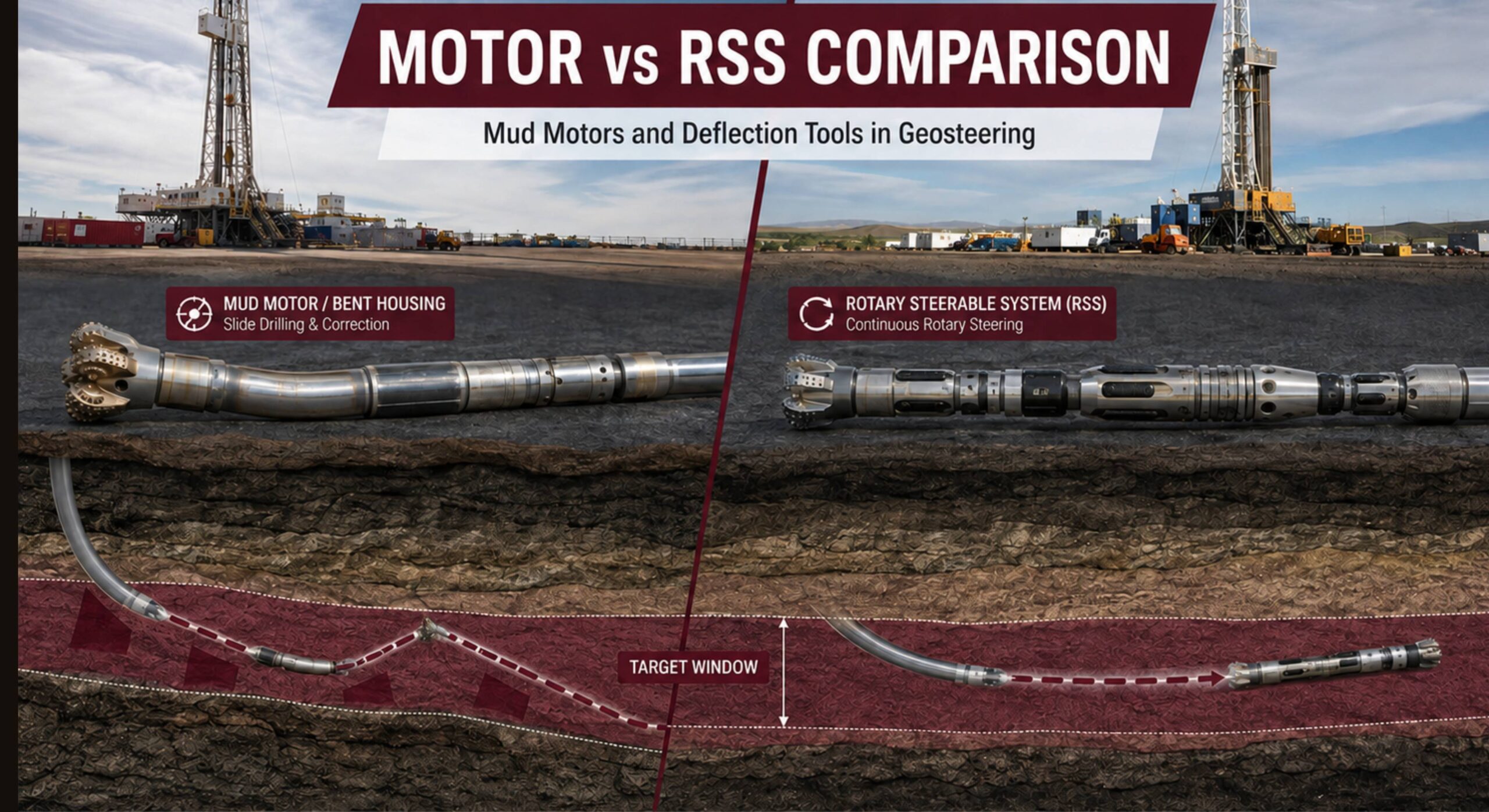
A steerable mud motor normally uses a bent housing to create a directional tendency. During slide drilling, the drillstring remains oriented while the downhole motor rotates the bit. The directional driller controls the toolface to build, drop, or turn the trajectory.
When the drillstring rotates from surface, the bent motor rotates with it. This reduces the directional effect and allows the assembly to drill a more nearly straight path.
Consequently, geosteering with a motor often involves switching between sliding and rotating as the trajectory requires correction.
How an RSS Steers the Well
An RSS can steer while the drillstring continues rotating from surface. In other words, it does not require conventional slide drilling to make directional corrections.
Continuous rotation can support smoother trajectory control and more consistent drilling. Modern RSS tools can also integrate near-bit or LWD measurements, which help geosteering teams react quickly to changes in formation position.
Motor vs RSS: Main Differences
| Feature | Mud Motor | RSS |
|---|---|---|
| Directional steering | Mainly through oriented sliding | Steers while rotating |
| Drillstring rotation while steering | Usually stopped during sliding | Continuous |
| Trajectory corrections | Slide and rotate intervals | Continuous proportional steering |
| Wellbore smoothness | Slide/rotate transitions can increase tortuosity | Generally supports smoother wellbores |
| Directional response | Depends strongly on toolface control and motor setup | Provides continuous steering control |
| Geosteering response | Corrections may require establishing a slide | Corrections can occur while drilling ahead |
Slide-to-rotate transitions with bent motors can contribute to additional doglegs and wellbore tortuosity. By contrast, fully rotating RSS technology is designed to provide smoother directional control.
Why the Difference Matters in Geosteering
Geosteering often requires the drilling team to make small trajectory adjustments while following changing bed boundaries, formation dip, reservoir thickness, and structural uncertainty.
With a mud motor, the team must consider not only where to steer, but also when to stop rotating, orient the toolface, and begin a slide. RSS removes the conventional sliding requirement and allows steering while maintaining rotation.
As a result, RSS can be valuable in long horizontal sections, extended-reach wells, complex 3D trajectories, and wells requiring frequent directional adjustments.
However, choosing between a mud motor and RSS should consider the required build rate, well profile, formation behavior, drilling performance, available equipment, and overall well economics. High-performance mud motors can remain effective in suitable applications, while RSS can justify its greater system complexity when continuous steering and precise well placement create enough operational value.
🔗 Keywords
Drilling Rig, Drilling Mud, MWD, LWD, Directional Drilling, Geosteering, Well Placement, Oil Reservoir, Surface Logging, Borehole Imaging, Electromagnetic Resistivity LWD Tool, Bottom Hole Assembly, Study of Real-Time LWD Data, LWD Interpretation, Borehole Image Log, Dip Calculation Methods, Shale Gas Sweet Spot, Accurate Reservoir Boundary Detection, Machine Learning, Artificial Intelligence, The Future of Automated Geosteering, Ensemble-Based Well Log Interpretation, Digital Twins in Drilling, Remote Operations Centers