Target Window Definition in Well Trajectory Planning
June 6, 2023· 2 minutes reading
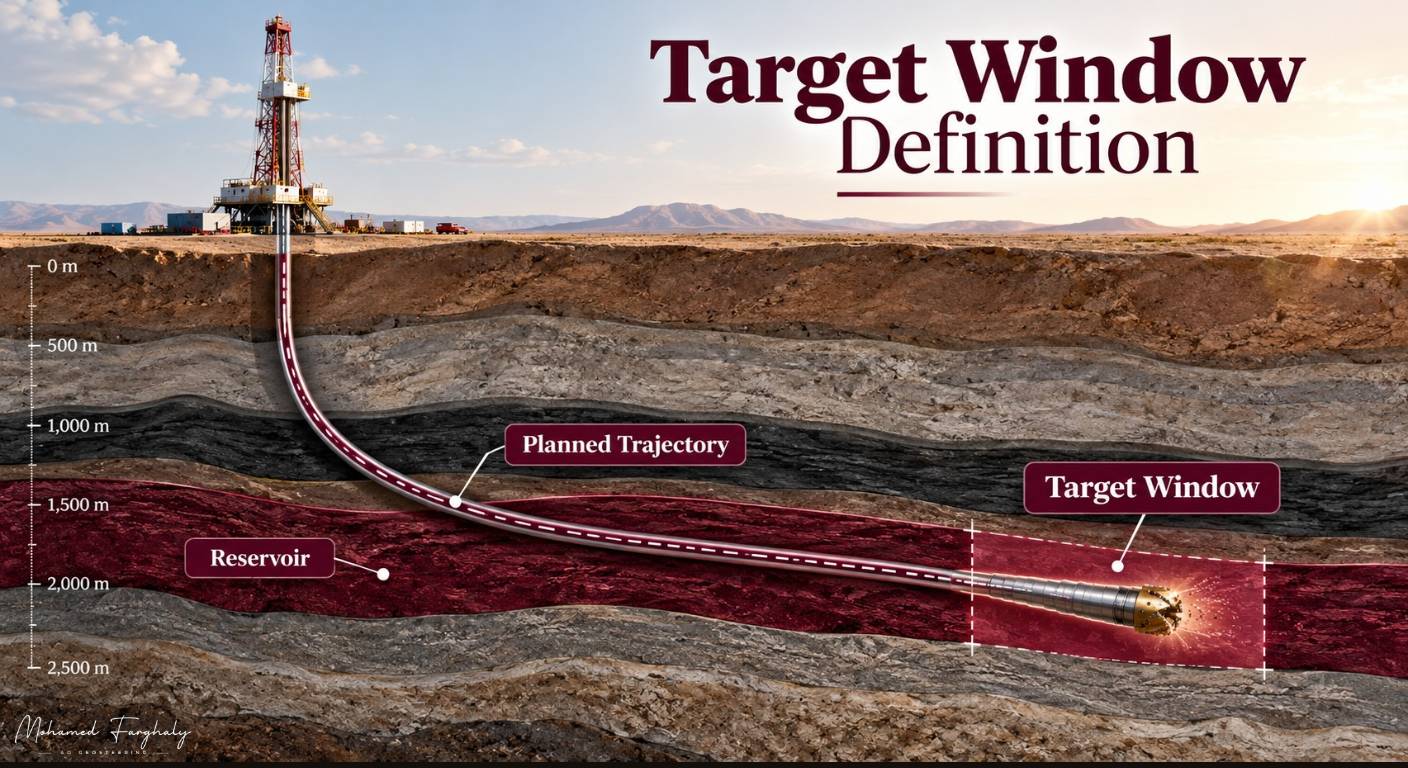
A well can follow the planned trajectory perfectly and still miss the reservoir target. That’s why defining the target window is one of the most important steps in well trajectory planning.
In directional drilling and geosteering, reaching the correct depth is not enough. The wellbore must enter the reservoir within a defined area while respecting geological, directional, and operational constraints.
What Is a Target Window?
A target window is a defined three-dimensional area through which the planned well trajectory must pass to reach its geological objective.
Its dimensions and position depend on several factors:
- Reservoir thickness: Thin formations require tighter vertical targeting.
- Geological uncertainty: Faults, structural variations, and uncertain formation boundaries affect target placement.
- Drilling limitations: Build rates, dogleg severity, and bottom-hole assembly capabilities determine whether the target is reachable.
- Survey uncertainty: Errors in measured wellbore position must be considered when establishing acceptable tolerances.
A target window must be realistic, achievable, and aligned with the reservoir development objectives.
How Is the Target Window Defined?
Engineers begin by analyzing seismic interpretation, offset well data, geological models, and reservoir boundaries.
The target is then established using TVD (True Vertical Depth), geographical coordinates, and allowable positional tolerances.
For example, a horizontal well targeting a thin reservoir might have a permitted landing interval between 2,450 and 2,454 meters TVD.
However, the geological target alone does not guarantee successful placement. Engineers must also evaluate trajectory feasibility, positional uncertainty, and the available steering capability.
During drilling, real-time MWD and LWD measurements help the team evaluate well position and update geological interpretations.
If the actual formation differs from the prediction, geosteering decisions may require adjustments to the trajectory while maintaining drilling safety.
Why Does Target Window Definition Matter?
A poorly defined target window can lead to missed landing points, unnecessary trajectory corrections, increased drilling costs, and reduced reservoir exposure.
A properly defined target window connects geological understanding with directional drilling execution, helping the drilling team place the well where it can deliver the greatest value.
Successful well placement begins long before the bit reaches the reservoir. It begins with knowing exactly where the well needs to go — and how much uncertainty the plan can tolerate.
🔗 Keywords
Drilling Rig, Drilling Mud, MWD, LWD, Directional Drilling, Geosteering, Well Placement, Oil Reservoir, Surface Logging, Borehole Imaging, Electromagnetic Resistivity LWD Tool, Bottom Hole Assembly, Study of Real-Time LWD Data, LWD Interpretation, Borehole Image Log, Dip Calculation Methods, Shale Gas Sweet Spot, Accurate Reservoir Boundary Detection, Machine Learning, Artificial Intelligence, The Future of Automated Geosteering, Ensemble-Based Well Log Interpretation, Digital Twins in Drilling, Remote Operations Centers