Ensemble-Based Well Log Interpretation
Jan 4, 2024· 3 minutes reading
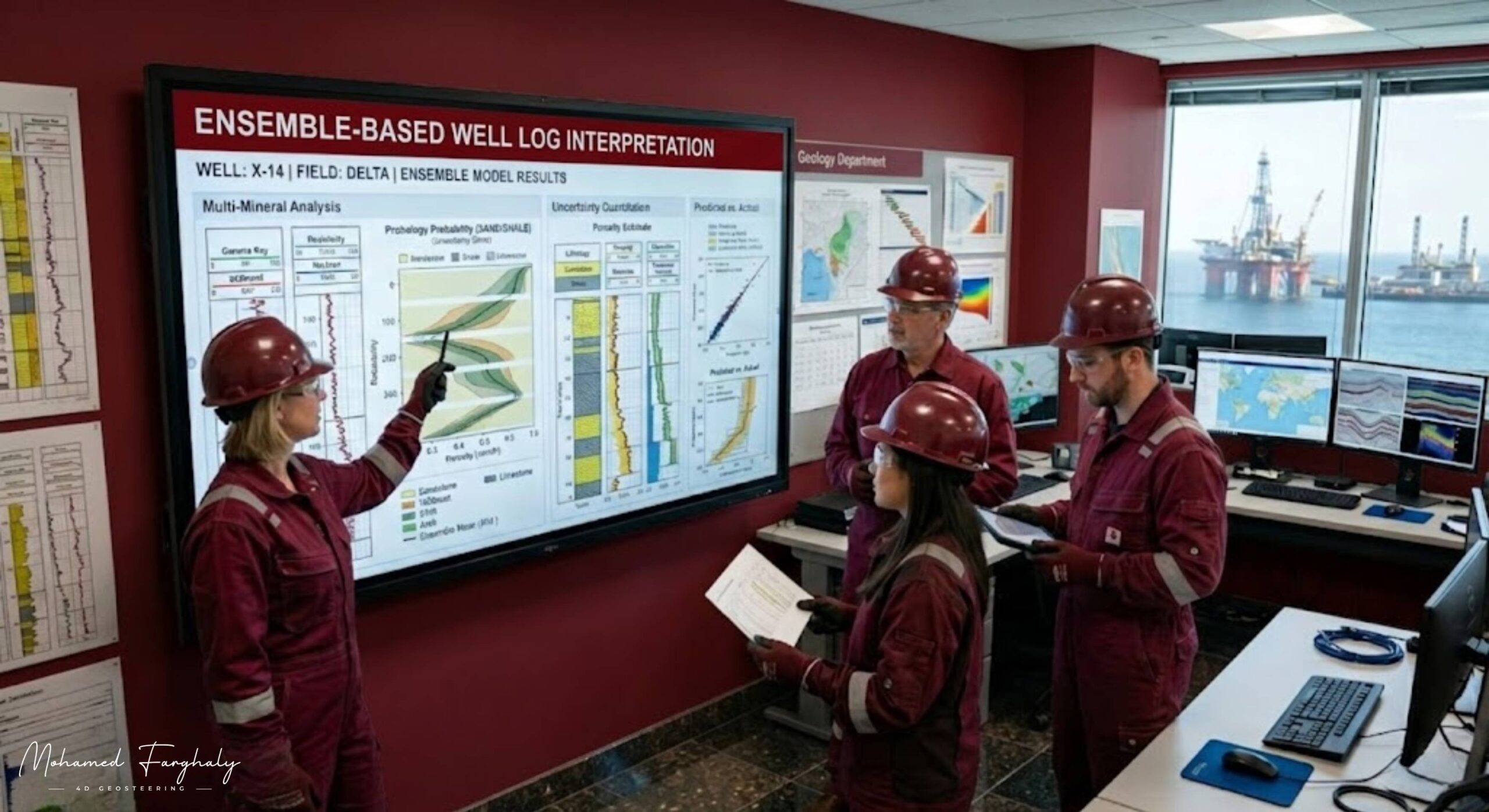
Every geosteering decision carries uncertainty — but what if you could reduce that uncertainty by looking at the formation from multiple perspectives at the same time? That is exactly what ensemble-based well log interpretation brings to modern geosteering operations — a smarter, more reliable way to understand the subsurface.
In traditional workflows, geosteering often relies on a single interpretation of well log data such as resistivity, gamma ray, density, and neutron porosity. However, subsurface conditions are inherently complex, and relying on one model can introduce significant uncertainty. Ensemble-based interpretation in geosteering addresses this challenge by combining multiple models to improve geosteering accuracy and decision reliability.
In ensemble-based well log interpretation for geosteering, different models analyze the same real-time LWD data and generate multiple possible interpretations of the formation. These interpretations are then combined, compared, and weighted to produce a more robust understanding of the subsurface. This approach strengthens geosteering decisions by reducing the risk of relying on a single incorrect interpretation.
This method becomes especially important in directional drilling and horizontal wells, where geosteering requires continuous adjustments to stay within a thin reservoir zone. Small errors in interpretation can lead to poor well placement, reduced reservoir contact, and lower production efficiency. By using ensemble methods, geosteerers gain a clearer and more reliable picture of formation boundaries and reservoir behavior.
When integrated with Measurement While Drilling (MWD), ensemble-based interpretation becomes a core component of advanced geosteering workflows. MWD provides accurate trajectory data, while ensemble models improve the interpretation of formation responses. Together, they support precise and data-driven geosteering operations.
One of the key strengths of ensemble-based geosteering is its ability to quantify uncertainty. Instead of providing a single answer, it presents a range of possible outcomes, allowing geosteerers to evaluate risks and make more informed decisions. This is critical in complex reservoirs, where uncertainty is unavoidable and must be managed effectively.
In addition, ensemble-based well log interpretation enhances the ability to detect subtle formation changes. By comparing multiple interpretations, it becomes easier to identify trends, recognize inconsistencies, and improve confidence in identifying reservoir boundaries. This directly improves geosteering accuracy and supports better well placement decisions.
As machine learning and artificial intelligence continue to evolve, ensemble-based geosteering is becoming more advanced and more efficient. These technologies allow models to learn from historical and real-time data, improving their predictions and enabling faster, more accurate geosteering decisions.
Many professionals still rely on single-model interpretation, but the future of geosteering is clearly moving toward integrated, data-driven approaches. Ensemble-based interpretation represents a major step forward, providing stronger insights and more reliable outcomes in real-time drilling environments.
If you want to improve geosteering accuracy, reduce uncertainty, and make more confident decisions, start with ensemble-based well log interpretation. It is where multiple perspectives come together to create smarter and more precise geosteering decisions.
🔗 Keywords
Drilling Rig, Drilling Mud, MWD, LWD, Directional Drilling, Geosteering, Well Placement, Oil Reservoir, Surface Logging, Borehole Imaging, Electromagnetic Resistivity LWD Tool, Bottom Hole Assembly, Study of Real-Time LWD Data, LWD Interpretation, Borehole Image Log, Dip Calculation Methods, Shale Gas Sweet Spot, Accurate Reservoir Boundary Detection, Machine Learning, Artificial Intelligence, The Future of Automated Geosteering, Ensemble-Based Well Log Interpretation, Digital Twins in Drilling, Remote Operations Centers