Real-Time Simulation Models in Upstream Operations
Dec 16, 2023· 2 minutes reading
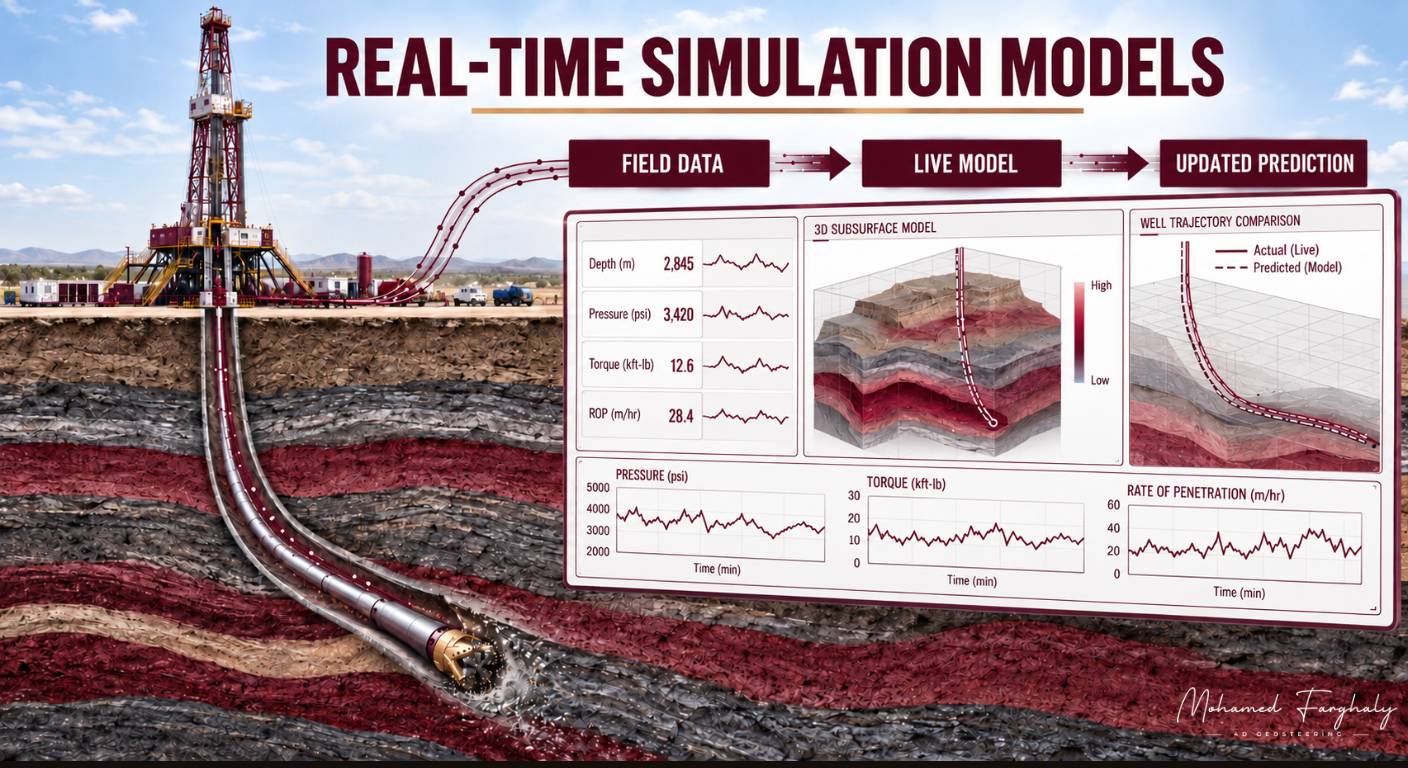
Upstream operations rarely follow a perfectly fixed plan. Formation properties change, equipment performance varies, and drilling conditions can shift within minutes. Real-time simulation models help engineers respond by continuously converting live field measurements into an updated representation of the operation.
How Real-Time Simulation Models Work
A real-time simulation model combines an engineering model with continuous data from surface sensors and downhole tools. During drilling, this data may include flow rate, standpipe pressure, torque, weight on bit, rate of penetration, inclination, azimuth, vibration, and mud properties.
The system first checks and aligns the incoming measurements. It then compares the actual operating response with the model’s expected response. Whenever new data arrives, the model recalculates the current conditions. Therefore, engineers can see how the operation is developing instead of depending on a model built before drilling began.
This connection between live measurements and engineering calculations is especially valuable when downhole conditions cannot be observed directly.
Detecting Problems Before They Escalate
The greatest value of real-time simulation is its ability to identify small deviations before they become major operational problems. For example, if measured standpipe pressure rises above the simulated value, the difference may indicate restricted flow, poor hole cleaning, a changing mud condition, or an equipment issue.
Likewise, a growing difference between simulated and measured torque may reveal increasing friction, cuttings accumulation, or contact between the drillstring and the wellbore. Engineers can investigate these deviations while the evidence is still developing.
However, one measurement rarely provides a complete answer. A reliable interpretation considers several related parameters, their rate of change, and the operating activity taking place at that moment.
Supporting Operational Decisions
Engineers can use real-time models to evaluate a proposed adjustment before applying it. For instance, they may estimate how changing the flow rate could affect pressure losses and hole cleaning. They may also examine how modifying weight on bit or rotary speed could influence drilling performance, vibration, and tool behaviour.
As a result, the team can compare possible responses using current conditions rather than relying only on general assumptions. This approach improves decision speed during narrow operating windows, where a delayed or incorrect response can increase risk and non-productive time.
Model Accuracy and Human Judgement
A simulation cannot become reliable simply because it receives live data. Incorrect sensor readings, transmission delays, inconsistent depth references, wrong units, and unrealistic model assumptions can all produce misleading results.
Therefore, engineers must validate the incoming data and compare simulated outputs with independent measurements. They must also recalibrate the model when actual field behaviour consistently differs from its predictions.
Real-time simulation models do not replace experienced engineers. Instead, they organize live evidence, expose important deviations, and show the probable consequences of operational changes. When reliable data, accurate physics, and engineering judgement work together, these models help teams understand conditions earlier and make safer, faster upstream decisions.
🔗 Keywords
Drilling Rig, Drilling Mud, MWD, LWD, Directional Drilling, Geosteering, Well Placement, Oil Reservoir, Surface Logging, Borehole Imaging, Electromagnetic Resistivity LWD Tool, Bottom Hole Assembly, Study of Real-Time LWD Data, LWD Interpretation, Borehole Image Log, Dip Calculation Methods, Shale Gas Sweet Spot, Accurate Reservoir Boundary Detection, Machine Learning, Artificial Intelligence, The Future of Automated Geosteering, Ensemble-Based Well Log Interpretation, Digital Twins in Drilling, Remote Operations Centers
